…this paper challenges the interpretation which views the Kalām-i pīr primarily as a philosophical text; more broadly, it suggests a revision of the framework by which we understand both the legacy of Nāṣir-i Khusraw and the historical process of conversion among the Ismāʿīlīs of Central Asia.
Rethinking the Kalām-i pīr and Its Role in the Central Asian Ismāʿīlī Tradition by Beben, Daniel
This paper investigates the tradition of the Kalām-i pīr, a fundamental text preserved among the Ismāʿīlī Shīʿīs of the Badakhshan region of Central Asia attributed to the eleventh-century Ismāʿīlī poet and missionary Nāṣir-i Khusraw. The first major study of the text was undertaken by Wladimir Ivanow, who produced an edition and translation of the work in 1935. Ivanow judged the Kalām-i pīr to be a “forgery” of an earlier text committed by the sixteenth-century Ismāʿīlī author Khayrkhwāh Hirātī, who falsely ascribed his work to Nāṣir-i Khusraw. Ivanow concluded that the text is to be understood primarily as a specimen of Ismāʿīlī philosophical writing, and that the attribution to Nāṣir-i Khusraw is merely fanciful and unrelated to the work. Since that time, Ivanow’s interpretation of the text has remained authoritative among scholars of Ismāʿīlism. In recent years, however, multiple new manuscripts of the work, as well as a range of related materials have come to light, suggesting the need for a thorough re-evaluation of the text and its history.
In this paper I demonstrate, based on research in multiple collections of Ismāʿīlī manuscripts, that Khayrkhwāh Hirātī likely had no role in the development or transmission of the text, and that the present redaction of the work should instead be dated to the mid-eighteenth century. Furthermore, I argue that the attribution to Nāṣir-i Khusraw is not merely incidental to the text, but rather is central to understanding the interpretation and significance of the text among the Ismāʿīlīs of Central Asia. Its development and attribution must be considered within the context of the social and religious history of Badakhshan in the eighteenth century, an era which saw an energetic expansion of the Ismāʿīlī daʿwa in the region and the development of a flourishing hagiographical tradition connected with Nāṣir-i Khusraw. This paper draws as well upon a series of oral histories and ethnographic observations which demonstrate a much wider range of significances and forms of extra-literary engagement with the text as a sacred object among Central Asian Ismāʿīlīs, which indicate the role of the text as an agent of conversion and Islamization. In summary, this paper challenges the interpretation which views the Kalām-i pīr primarily as a philosophical text; more broadly, it suggests a revision of the framework by which we understand both the legacy of Nāṣir-i Khusraw and the historical process of conversion among the Ismāʿīlīs of Central Asia.
 Daniel Beben won a Social Sciences Research Council International Dissertation Research Fellowship and an American Councils Advanced Research Fellowship to conduct dissertation research in the post-Soviet republic of Tajikistan in the 2012-13 academic year.
Daniel’s research focuses on the religious and social history of Central Asia in the early-modern era. His dissertation explores the history and hagiographical literature of the Ismaili Shia Muslim community of the Badakhshan district of eastern Tajikistan. This community traces its foundation to the renowned Persian poet and philosopher Nasir-i Khusraw, who is held to have converted the region to the Ismaili sect of Shia Islam in the eleventh century.
More on Daniel Beben from Ismailimail Archives:
- Daniel Beben: Jami‘ al-salasil and the Place of Nasir-i Khusraw in the Central Asian Sufi Tradition
- From Neo-Platonism to Peasant Uprising: The Image of Nasir-i Khusraw and Ismailism in Soviet Orientalism | Eastblog
- Scholars from IIS, Harvard, and Indiana host panels on Ismaili History and Philosophy at MESA 2014
- Event – October 16-17 | Chicago: First Ever “Ismaili Studies Conference” at University of Chicago
- Event – October 16-17 | University of Chicago: Ismaili Studies Conference
- Event – October 18 | University of Chicago: Ismaili Studies Conference and Islamicate Studies Symposium – Teaching Islam
- Event – October 18 | University of Chicago: Islamicate Studies Symposium
- Event – November 22-25 | Washington DC: 2014 Annual Middle East Studies Association (MESA) Meeting with Ismaili Scholars
- Rethinking the Kalām-i pīr and Its Role in the Central Asian Ismāʿīlī Tradition – Daniel Beben’s Presentation at MESA 2014 Conference in Washington, DC
- Event – January 30 | Daniel Beben: Harvard University: The Pamiri Peoples and Tajik National Identity: The Legacy of Primordialism
- Event: March 21 | University of St. Andrews, UK | Daniel Beben: Nasir-i Khusraw and Ismailism in Badakhshan
- Dr Daniel Beben wins the Foundation for Iranian Studies 2015 Dissertation Award
- Dr. Daniel Beben to present at Rice University: Central Asian Islam: A Model of Ecumenicalism
- Khalil Andani & Shiraz Hajiani to organize Ismaili Studies Panels at 2016 MESA Conference in Boston
- Fifteenth-Century Central Asian Text: Reflections on Authorship and Confessional Identity – Presentation by Daniel Beben
- Daniel Beben: The Ismaili of Central Asia
- Cyclical Sanctity and Ismaili Identity: A Framework for Rethinking Conversion to Shi’i Islam in the Iranian World
- The First Aga Khan: Memoirs of the 46th Ismaili Imam
- Daniel Beben: Religious identity in the Pamirs
About MESA:
The Middle East Studies Association (MESA) is a private, non-profit, non-political learned society that brings together scholars, educators and those interested in the study of the region from all over the world. MESA’s 48th annual meeting will be held in Washington, DC at the Marriott Wardman Park Hotel.
Related Event:
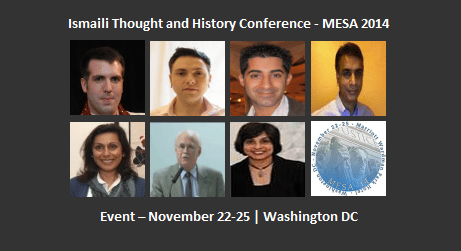
All related MESA 2014, from Ismailimail Archives:
- The Neoplatonic Qur’anic Exegesis of Nāṣir-i Khusraw – Khalil Andani’s Presentation at MESA 2014 Conference in Washington, DC
- Echoes of the Gnostics: Incorporation of Mythic Cosmology into Ismāʿīlī Thought – Paul Anderson’s Presentation at MESA 2014 Conference in Washington, DC
- Rethinking the Kalām-i pīr and Its Role in the Central Asian Ismāʿīlī Tradition – Daniel Beben’s Presentation at MESA 2014 Conference in Washington, DC
- The Conversions of Hasan-i Sabbah – Shiraz Hajiani’s Presentation at MESA 2014 Conference in Washington, DC
- Realpolitik & Sectarian strife: A re-appraisal of Fatimid rule in Syria – Shainool Jiwa’s Presentation at MESA 2014 Conference, Washington, DC
- Esoteric Explorations of the Sharī‘a, the path to the Divine: A Fatimid Exposition – Nadia Eboo-Jamal’s Presentation at MESA 2014 Conference, Washington, DC
- A Newly Discovered Treatise from the Earliest Fatimid Period – Professor Paul E. Walker’s Presentation at MESA 2014 Conference, Washington, DC
- Event – November 22-25 | Washington DC: 2014 Annual Middle East Studies Association (MESA) Meeting with Ismaili Scholars
- Scholars from IIS, Harvard, and Indiana host panels on Ismaili History and Philosophy at MESA 2014
Earlier, Ismaili Studies, from Ismailimail Archives:
- Carleton University in Canada invites Papers for International Ismaili Studies Conference
- Governor Pat Quinn’s Welcome Letter for the Ismaili Studies Conference
- Reporting from Ismaili Studies Conference – University of Chicago
- Event – October 18 | University of Chicago – Logan Center for the Arts: Ismaili Studies Conference – Public Music Engagement – Silk Road Rising
- Event – October 18 | University of Chicago: Islamicate Studies Symposium
- Event – October 18 | University of Chicago: Ismaili Studies Conference and Islamicate Studies Symposium – Teaching Islam
- Event – October 16-17 | University of Chicago: Ismaili Studies Conference
- Khalil Andani’s Presentation in Chicago: Revelation in the Thought of Nasir-i Khusraw
- Event – October 16-17 | Chicago: First Ever “Ismaili Studies Conference” at University of Chicago
 Be the First to Know – Join Ismailimail
Get breaking news related to the Ismaili Imamat, the Noorani Family, the world wide Ismaili Jamat and all their endeavors and successes.
Learn how to subscribe and join 17,000 + other amazing people – Subscribe now!
Our Recommendations:













 Ismailimail