By: Sadruddin Noorani, Chicago, USA
Ever since my wife Rukhsana and I recently became grandparents for the fourth time we have been in a mode of revisiting how we raised our three sons back in the 80s. Every minute of our children’s/grandchildren’s lives tells us something about how each child is growing, learning, and developing. Development occurs in many ways in a child’s life, for example with physical, language, and social skills. If a child is behind in one skill set, it does not necessarily mean the child is behind in every other area. It is common and normal for young children to excel in one area despite being delayed in another.
Still it is important to note that globally, many children who have developmental delays are not identified and treated before beginning grade school. By this time early opportunities for treatment have been missed.
When delays are recognized at a very young age, early treatment and therapies can decrease or eliminate the effects of many delays. Some common delays accompany ADHD and autism, while others are less known and understood, such as language or social interaction delays. Delays can potentially be identified and overcome through Early Childhood Development Centers (ECDC) with additional therapeutic support as necessary.
Developmental Milestones are events that occur in every child’s life that can help you know if your child is developmentally on track. For example: making eye contact, smiling, rolling over, crawling, uttering first words, and walking, all have well-established age-ranges associated with them. Parents should become more familiar with Pediatric developmental milestones. As a parent, if you notice one or more inconsistencies in developmental milestones, you should bring this to the attention of your pediatrician. At the very least, you will gain information about the many resources that are available to you to help make sure that your child’s development is on track.
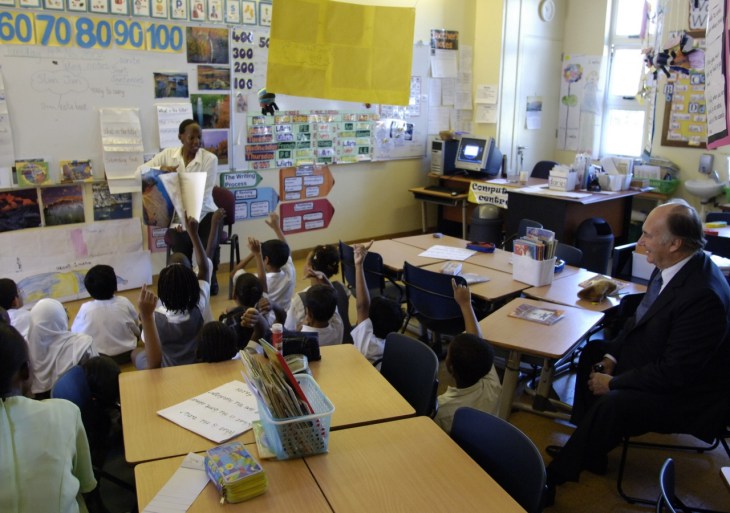
Mawlana Hazar Imam meets with primary school students at the Aga Khan Academy in Mombasa, Kenya 2006 AKDN/GARY OTTE
Mawlana Hazar Imam, the Aga Khan, ensures there is quality educational development in the Jamat by guiding endeavors of the Aga Khan Education Boards (AKEBs), tasked with promoting quality education from Early Childhood Development to Continued Learning, and every stage in between. In addition to delivering formative lessons on childhood development, ECD programs promote continuing education as a lifestyle choice.
For older children with behavioral issues, there are more options available because there are more professionals involved in an older child’s daily life. While the pediatrician is still a useful resource, your child’s teachers can also be helpful in the process. Teachers can make changes in the way they instruct so that children are better able to take in information and keep up with their peers. Parents should use teachers as a resource because they can make necessary adjustments in the classroom to help children with behavioral, attention, or social skills barriers to achieve their full potential. If your child has a diagnosed disability, then the school can make necessary adjustments. Children with ADHD, learning disabilities, or other disabilities have additional rights in schools to help them succeed. Talk to your school’s administrators to ensure that your child has the best environment for his/her success. Requesting special accommodations is not a setback; in fact, special accommodations may help your child excel in school in ways you may not have realized they were able to before.
Investing in your child’s early development can have dramatic results. Although, if you feel that an older child may have a developmental delay or a concern, it is still not too late to treat or address the delay.
Reflections on Early Childhood Education
The ‘Alid tradition in Islam is a tradition of the intellect, and that intellectual formation and search begins from birth. In the first few years, a child’s brain develops more rapidly than at any other time in life, underscoring the importance of quality early childhood education. As a child develops into an adult, the separation of higher-quality versus lower-quality education becomes more pronounced. Here, let us explore the importance of quality education throughout the life of a Shia Ismaili Muslim.
Continuing his grandfather’s legacy of emphasizing education by creating the network of Diamond Jubilee schools, Mawlana Hazar Imam has made 100% participation in early childhood education one of his priorities. The Imam’s goal is to ensure that each young murid starts his/her development trajectory with a strong foundation of health, nutrition, personal and social development, ethical literacy, moral reasoning, and religious formation. Mawlana Hazar Imam emphasizes the criticality of early childhood development to succeed globally in the future. He believes that the earlier we can offer opportunities for early childhood development, the earlier we will be able to reposition the future of children in their respective societies. Therefore, this is his major commitment to prepare the community for life in the future.
Early childhood development is foundational to our ability to lead in the Knowledge Society of today and tomorrow’s Artificial Intelligence (AI) society, and simulation of human intelligence processes. We know that only quality education can provide children with better opportunities for future development. Research demonstrates that proficient teachers have the potential to double the rate of learning compared to average teachers. Furthermore, when students are fortunate to experience a series of exceptional teachers, their educational progress can undergo exponential growth. Moreover, the impact of quality education is quantifiable in the overall quality of life of the student over time.
In London on 14th August 1994, Mawlana Hazar Imam in introducing the idea of meritocracy asked the Jamat to think carefully about developing their competences through education so that they can become leaders in their countries and serve in different positive ways. He asked the Jamat to push themselves towards excellence in their educational endeavors.
He encourages us to prepare for meritocracy in the decades ahead and discourages us to take it up with mediocrity or half-heartedly. He also encourages us to take education with competence, with commitment, and make it serve us and future generations of the communities in the years ahead. He reminds our youth that it is the quality of the education that will count for them. And he says to our younger generation: you have the opportunity to benefit from education in the Western World.
Education is not only for getting a degree for the sake of increasing one’s earnings potential but also to continue learning throughout our lifetime. Education also enables us to understand how nature works and helps us to underwrite the risks in whatever we do in life and better understand the ethics of Islam, e.g., it provides us the framework to be honest, compassionate and behave in an ethical manner in our lives. In essence, proper education must prepare us for a lifelong learning practice.
Let us reflect on what we could do to ensure that our children receive comprehensive care during their early life, starting with prenatal care, to a path of quality education into the future? How do we access the highest quality education possible, whether at an early childhood center, in grade school, in college, and throughout our life? How can we make our Jamatkhanas spaces of intellectual celebration, happiness, prayers, spiritual search, community values, and belonging for community members of all ages? Finally, how can we achieve the Imam’s vision that all Ismaili children benefit from comprehensive early childhood such that they may continue a lifelong journey of intellectual curiosity and discovery?
Let us offer our sincere Shukrana to our beloved Imam for his continuous guidance, vision, and his untiring efforts for the progress and development of the community worldwide. Let us offer a humble prayer that may Allah’s grace and protection always be with us.
Aameen!
#DidYouKnow
AKDN’s early childhood development (ECD) interventions reached 2.3 million children in 2021! Click to learn more: https://the.akdn/en/how-we-work/our-agencies/aga-khan-foundation/akf-early-childhood-development

 Ismailimail
Very you sharing for early childhood knowledge.
LikeLike
Abu Sadruddin, As-salaam ‘alykum
You are indeed a Renaissance Man of Islamic traditions!
My family and I enjoy reading your articles in IsmailiMail blog.
Marwan Dulaimi
LikeLike
This article written by Mr Sadbuddin Noorani is truly praiseworthy. I commend him for bringing out the IMPORTANCE of child’s development in a child’s life early on and guiding us with the various ways to solve the issue before it’s too late.
LikeLike