Zainub Verjee’s essay on Home Ground exhibition at Aga Khan Museum published in the Journal of Asian Diasporic Visual Cultures and the Americas
In her provocative essay, titled Elsewhere, Within Here: The Politics of Home, Zainub Verjee engages with the question: Is the idea of home in contemporary art practice a creative act of affiliation? The essay is based on her presentation in December 2015 at the Aga Khan Museum at the Home Ground Exhibition Symposium.
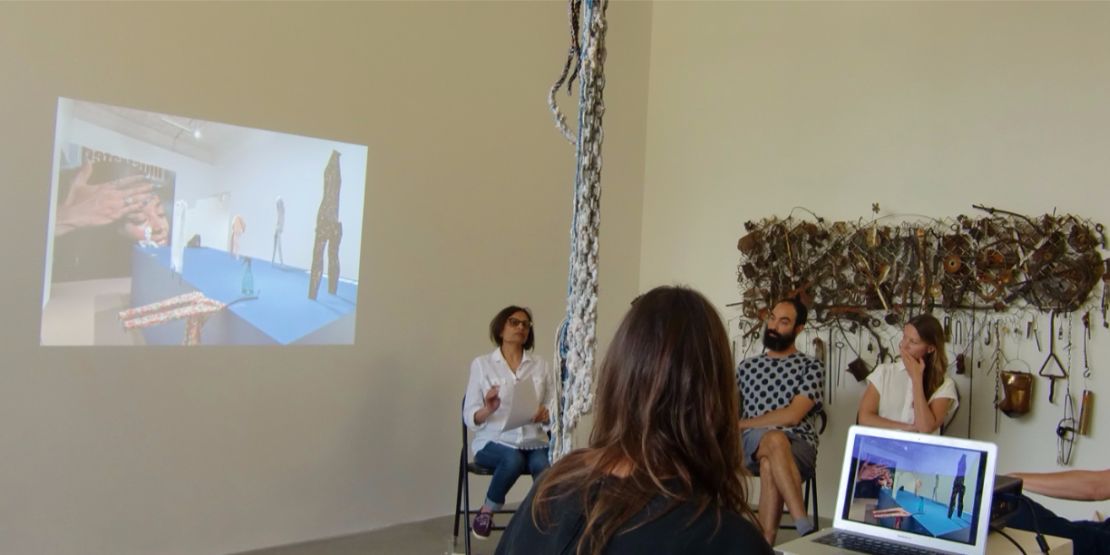
Premised on the larger context of how visitors in Toronto would relate to the Home Ground exhibition of contemporary art from the Barjeel Art Foundation, Sharjah UAE, that was held from 25 July 2015 to 3 January 2016 at the Aga Khan Museum, Toronto, she writes: “Yes, contemporary art is not always clear-cut or transparent, nor is it homogenous or unilateral, though it is contingent on where the visitor is coming from. How might audiences to the Home Ground exhibition relate to the work presented? Immersed in this clamour of versions and clashing modes of truth-telling, we get a feel ‘from inside’ of the anguish and dilemmas, rights and wrong presented by the Home Ground exhibition. The visitor is riddled with untranslatable elements, riven with the sense of epistemic non-fit and in-comparable cultural difference. The dialogic exchange happens within the same cultural wavelength shot through pre-given terms.”
Dr. Alice Ming Wai Jim, the founding Co-editor of the Journal says, “Your essay is an invaluable contribution to the collection of essays presented in this issue. The densely woven argument reveals the fraught oscillation between of the concepts of filliation and affiliation that Said develops in order to nuance and possibly mobilize attachments that speak to national belonging and subjectivity in a way that does not lead to a condition of naturalization.”
Responding to Home Ground, Zainub notes that the post-9/11 period has witnessed a rising interest by museums and curators in the West to showcase art and artists from the Middle East and South Asia. These exhibitions are required to display, explain and critique its politics ignoring the context of the negotiations endured by the artists in the first place. Yet, the same period has also been marked by the demonization and vilification of Islam and people of Muslim descent in the context of what came to be known as the global War on Terror. It is in the nexus of war, citizenship and territory that the monumental and mundane of political life are produced. The War on Terror has successfully defined the geographies of the interrelationship between war, citizenship and territory as a project of modernity. The nation-state has strengthened its control of juridical power over its border, through securitization. Citizenship, in times of globalization, has posed a more peculiar problem. In normative terms, this national subjectivity plays the central role in othering through a discursive process to form new inter-subjectivities. Implicit in this process, of othering and the formation of new inter-subjectivities, is the production of fear and anxiety and the idea of nationalism, which can be defined as a territorial form of ideology. Though the notion of building bridges is often offered as premise for an exhibition, it does two things: one, in words of Nada Shabout, “it obscures the conflation of Arab, Middle East and Islamic in its indiscriminate celebration of all three”, two, it links to the a particular definition of humanity discourse that places an implicit demand on Muslims to eschew political Islam or critique religion, and thus feed into the operative binary of Good Muslim and Bad Muslim, as parsed out by Mahmood Mamdani.
Carefully analyzing the concept of filiation and affiliation developed by Edward Said in his 1983 essay “Secular Criticism”, she highlights the loop of filiative that continues to produce a discourse and history of violence. The construct of blood and its ties straddles the filiative and affiliative order that has rendered all nationalism and its discourse a scandal. “The essay is in conversation with what Julie Kristeva in The Powers of Horror calls the “not-self” or the abject. In order to achieve subjectivity, there is a social pressure to affiliate upwards (to at least be like, or appear to be with the dominant majority) and disaffiliate downwards (break ties with a minority status even as ethnic origins are endeared to and are celebrated through cultural expressions)—something that for diasporic subjects occurs repeatedly and that merits serious consideration. The essay is thus also significant in the way that it provides a brief survey of exhibitions in recent history that has taken up precisely this challenge,” says Dr. Alice Jim.
To Zainub the normative engagement with the idea of home as an iterative condition in contemporary art is tempting. How does one then define the contemporary in the trope of modernity? She underlines, identity and home are as old as Modernity and questions, what is the desire of this repeated demand to modernize? So, in exploring the imperial domination of manufactured geographies—Middle East—we have to approach geography neither as a location nor as a frame but as a situated knowledge and evaluate how this knowledge is produced in the museum system.
Elsewhere, Within Here: The Politics of Home (in the journal of Asian Diasporic Visual Cultures and the Americas, Volume 2, Issue 3, 2016. pp.: 310–322 (13))
Related
- Canada | Dr. Zainub Verjee Inducted to the Royal Canadian Academy of Arts
- Zainub Verjee and Nurjehan Aziz Vassanji appointed to the Order of Canada
- Zainub Verjee Received Governor General’s Award at Rideau Hall, Ottawa, Canada
- Zainub Verjee Delivered the Commencement Address at University of Victoria (Canada)
- Zainub Verjee, Executive Director of Galeries Ontario/ Ontario Galleries, bestowed an Honorary Degree by Simon Fraser University, Canada
- Zainab Verjee (@zainubverjee) bestowed honorary degree by NSCAD University, Halifax, Canada
- Zainub Verjee moderates the Massey Dialogues
- Conversations with the Real Action Figures: Zainub Verjee
- Massey College: Senior Fellow Luncheon Lecture by Zainub Verjee
- Zainub Verjee elected a Senior Fellow of Massey College
- Zainub Verjee talks about the death of languages, neon, and the status of the artist
- Dr. Zainub Verjee (@zainubverjee) appointed as a fellow of McLaughlin College at York University
- Zainub Verjee conferred with an Honorary Doctorate for her exceptional contribution | (@zainubverjee)
- Zainub Verjee (@zainubverjee): Connecting to Spirit through Art
- Zainub Verjee (@Zainubverjee): 2020 Governor General’s Visual and Media Arts Award Winner
- Dreams and Dystopias, East Africa at the Crossroads at ZAMANA SPACE, Ismaili Centre, London, UK
- Zainub Verjee Appointed Member of Board of Directors at Work In Culture (WIC)
- Zainub Verjee Appointed to the Board of the Cultural Human Resources Council
- The Premiere Panel: Artists’ Journey – Role of Artist in Our Society
- New Canadian Film Records the Work of Zainub Verjee
- Zainub Verjee: “Don’t reduce Diversity to an HR issue! It has far more complex and nuanced history.”
- Three Watermelons, One Hand: The Feminists read things from when they were young(er)
- Zainub Verjee: For Love or Money
- Zainub Verjee delivers the Opening Note at the Ideas Digital Forum
- Zainub Verjee invited to speak on the Massey Commission Report
- Zainub Verjee’s essay in Canadian Art Magazine answers who is an Artist
- Future of Art Galleries – keynote by Zainub Verjee
- Nomadic Architecture showcased two decades ago at Burnaby Jamatkhana
- Feature interview of Zainub Verjee in Canadian Art Fall Issue 2017
- Zainub Verjee leads Visual Arts as a partner in the $2.5 million Partnership Grant Awarded to McGill University
- Zainub Verjee’s essay on Home Ground exhibition at Aga Khan Museum published in the Journal of Asian Diasporic Visual Cultures and the Americas
- Being Parviz Tanavoli: a note by Zainub Verjee
- Women and Leadership: Zainub Verjee reflects on state of the culture sector and offers inspirational insights
- Zainub Verjee appointed to the Board of Canadian Filmmakers Distribution Centre
- Zainub Verjee to speak on the feasibility of opening a new Public Art Gallery for the Town Huntsville, Muskoka region, Ontario
- Aga Khan Museum Launches International Roster of Fall Education Programs
- Zainub Verjee appointed as the New Executive Director of Ontario Association of Art Galleries
- Event: March 29th, 2015 | In Conversation with M. G. Vassanji | Ismaili Centre Toronto
- Event – October 27 | Ismaili Centre, Burnaby: An evening with Giller Prize winning author M.G. Vassanji

 Ismailimail