“….The Faith urges freedom of intellectual enquiry and this freedom does not mean that knowledge will lose its spiritual dimension. That dimension is indeed itself a field for intellectual enquiry…”
Mawlana Hazar Imam
November 11, 1985
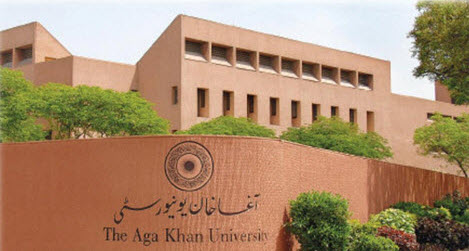
The Faculty of Health Sciences of the Aga Khan University (AKU) and the Aga Khan University Hospital was inaugurated on November 11, 1985 in Karachi. The Faculty was planned with the support of Harvard, McGill, and McMaster Universities.* The University now has campuses and programmes in Afghanistan, East Africa, Pakistan, and the United Kingdom. Its facilities include teaching hospitals, Nursing Schools, Medical Colleges, Institutes for Educational Development, an Examination Board, and an Institute for the Study of Muslim Civilizations.**

Mawlana Hazar Imam had announced the construction of a hospital, medical college, and school of nursing in December 1964, laying the foundation in 1971. It was granted university status, receiving its charter in 1983 as Pakistan’s first private, autonomous university. The first graduation ceremony of the School of Nursing was held on December 14, 1983.***
When accepting the Charter of the University, Mawlana Hazar Imam stated that the Aga Khan University is the “first University inspired by my family since Al-Azhar was founded in the Fatimid dynasty’s capital of Cairo in 970, a thousand years before we laid the foundation stone of the Aga Khan Medical College…. Although this University is new, it will draw inspiration from the greatest traditions of Islamic civilization and learning…One of the first and greatest research centres, the Bayt al-Hikma established in 830, led Islam in translating philosophical and scientific works from Greek, Roman, Persian and Indian classics.

By the art of translation, learning was assimilated from other civilizations. It was then advanced and furthered in new directions by scholarship in such institutions as the Dar al-Ilm, the House of Science, which during the ninth and tenth centuries spread to many cities through colleges like those of Al Azhar in Cairo, Qayrawan at Fez in Morocco, Zaytuna in Tunis and the eminent Spanish centre of Cordoba founded between 929 and 961… Making wisdom available from one country to another is truly the finest tradition of Islamic learning.
My prayer is that the university we are now building will enable many generations of the students to acquire both knowledge and the essential spiritual wisdom needed to balance that knowledge and enable their lives to attain the highest fulfilment.”
Extracts from Mawlana Hazar Imam’ speech
Acceptance of Charter of AKU, Karachi, Pakistan
March 16, 1983
Speech published in Hikmat, Volume II, No. 4, July 1984

In his address at the inauguration ceremony, Mawlana Hazar Imam explained the relationship between Faith and intellect, and Islam’s injunction to pursue knowledge:
“The relationship between the intellect of man and Faith has always been of fundamental importance to Muslims. How can a modern University respect and re-enforce that relationship? The divine intellect Akl-e-kul’, both transcends and informs the human intellect. It is this intellect which enables man to strive towards two aims dedicated by the Faith: that he should reflect upon the environment Allah has given and that he should know himself. It is the light of intellect which distinguishes the complete human being from the human animal and developing that intellect requires free enquiry. The man of Faith who fails to pursue intellectual search is likely to have only a limited comprehension of Allah’s creation. Indeed, it is man’s intellect that enables him to expand his vision of that creation.
Islam is for all places and all time. This is why there is a role for a modern Islamic University which can draw inspiration from the Faith and from the past in addressing the opportunities of the future.
The Holy Qu’ran’s encouragement to study nature and the physical world around us gave the original impetus to scientific enquiry among Muslims. Exchanges of knowledge between institutions and nations and the widening of man’s intellectual horizons are essentially Islamic concepts. The Faith urges freedom of intellectual enquiry and this freedom does not mean that knowledge will lose its spiritual dimension. That dimension is indeed itself a field for intellectual enquiry…
Your Excellency, it is now my privilege to ask you on this day to which I have been looking forward for 21 years of my life, to perform the inauguration ceremony of the Faculty of Health Sciences of the Aga Khan University and of the Aga Khan University Hospital.”
Extracts from Mawlana Hazar Imam’s speech at the Inauguration Ceremony of AKU’s Faculty of Health Sciences, Karachi, Pakistan
November 11, 1985.
Speech printed in Ismaili Forum, March 1986
Sources:
Aga Khan University
About the University
Hidayat, October 1985
Aga Khan University School of Nursing
Compiled by Nimira Dewji

