
Umar Khayyam, an Islamic poet, and mathematician, was born around 1048 in Nishapur, a prominent centre of learning in Iran, and is best known in his native country for his mathematical achievements.
After completing his education in Nishapur, he travelled to Samarkand, now in Uzbekistan, where he completed his famous work, Treatise on Demonstration of Problems of Algebra, on which rests his mathematical reputation. He discovered a geometrical method of solving cubic equations by intersecting a parabola with a circle, and extended the work on extraction of cube and fourth roots to the extraction of nth roots for arbitrary whole numbers. His reputation resulted in an invitation from the Seljuk* Sultan to Isfahan, in Iran, to undertake the astronomical observations necessary to reform the calendar.
An observatory was built there in order for him to accomplish this task and a new, more accurate calendar was produced; it was adopted as the official Persian calendar on March 15, 1079 and became the base for the Gregorian and other calendars.
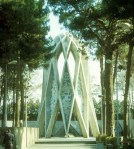
Umar Khayyam’s works influenced the English mathematician John Wallis (1616-1703), who contributed substantially to the origins of calculus, and was the most influential English mathematician before Isaac Newton. Several treatises on other scientific topics are also attributed to Khayyam: a work on music theory that uses ratios to deal with musical intervals, another on weights and balances, and another on a mathematical problem in metallurgy.
Having mastered philosophy, jurisprudence, history, mathematics, medicine, and astronomy, Umar taught and served the court in Nishapur where he died in 1131.
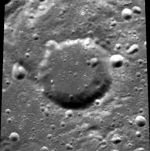
A lunar crater is named after Umar Khayyam in recognition of his contribution to astronomy.
Visit Gazetteer of Planetary Nomenclature to view the location of this crater.

*Seljuk: Major Muslim dynasty of Turkish origin in Persia and Iraq (1040–1194) and Syria (1078–1178)
References:
- Professor Seyyed Hossein Nasr, Professor Mehdi Aminrazavi, An Anthology of Philosophy in Persia, Vol. 1: From Zoroaster to ‘Umar Khayyam, I.B. Taurus & Co. Ltd, London, 2008
- Stanford Encyclopedia of Philosophy, Fall 2011 Edition
Research by Nimira Dewji
Earlier & Related:
 Be the First to Know – Join Ismailimail
Get breaking news related to the Ismaili Imamat, the world wide Ismaili Muslim community and all their creativity, endeavors and successes.
Inspired? Share the story
Want to inspire? Send your stories to us at Ismailimail@gmail.com
Subscribe and join 19,000 + other individuals – Subscribe now!
Earlier & Related – Nimira Dewji at Ismailimail Archives:
- Nasir-i Khusraw is considered the founder of the Ismaili spiritual and intellectual tradition in Central Asia
- The history of Nizari Ismailis in Syria dates to the ninth century
- Mawlana Shah Karim: “The relationship between the Imam and his Jamat is a deep and continuing bond”
- Mawlana Hazar Imam was gifted manuscripts on architecture of Andalusia, a Knowledge Society of its time
- Mawlana Hazar Imam Designates Ismaili Center Houston as Darkhana for US Jamat, the ninth Darkhana
- The arts of the Fatimids, Mawlana Hazar Imam’s ancestors, continue to inspire
- Rumi: “The light that lights the heart is the Light of God”
- Pir Sabzali: “Hearing the farman, their eyes brimmed over with tears of joy”
- Al-Tusi: “The ‘nass’ is not in order to make him an Imam; it is … so that people should recognise him as such”
- Mawlana Hazar Imam Aga Khan V: “The Shia Ismaili Muslim community, of which I am the Imam, has been established in Syria for more than 1,000 years”
- Mughal Emperor Akbar’s pluralism is evidenced by an inscription of Hazrat Isa’s teaching on his “Victory Gate”
- Moment in Time | 1 January 1931 – Ivanow, the pioneer of Ismaili Studies, began to work for Sir Sultan Muhammad Shah Aga Khan III
- Imam Hasan Ali Shah Aga Khan I’s migration to the Indian subcontinent initiated the modern phase of Nizari Ismaili history
- Ibn al-Haytham, a pioneer of modern optics, influenced Renaissance art and architecture
- Fabricated tales based on fear and ignorance instigated hostility towards the Nizari Ismailis (2/2)






![[Music in Islam] Is listening to music unlawful?](https://ismailimail.blog/wp-content/uploads/2014/08/music-in-islam.jpg?w=150)


 Ismailimail
A valuable, interesting article – thank you.
Charles Mugleston
Omar Khayyam Theatre Company. UK
LikeLike