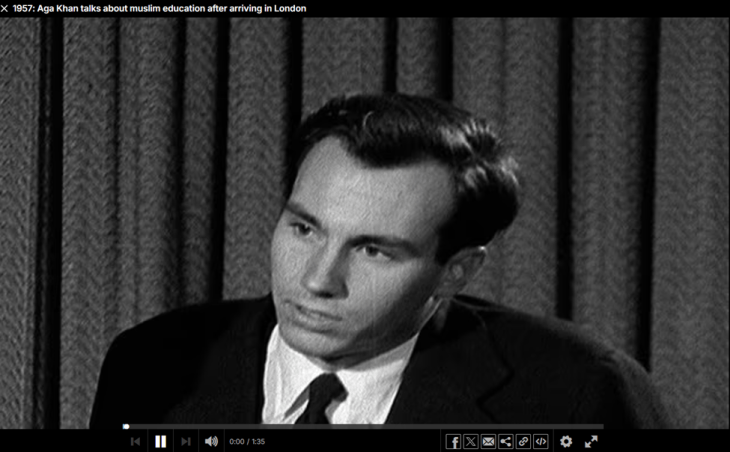
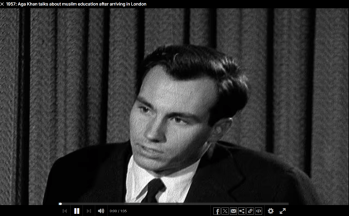
1957: Aga Khan talks about Muslim education after arriving in London
“Most of the education for the Christians has been done by Christian missions and the Muslims in general have fallen fairly far behind, and I think that is one weaknesses in my own community.”
Shortly after Prince Karim Aga Khan became the 49th Imam of the Ismaili Muslims, he embarked on a worldwide tour to visit his community (Jamat) across the globe, and meet government leaders of both the Muslim and the Western world.
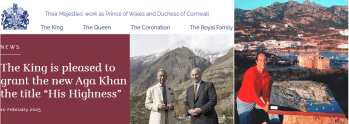
The title of ‘His Highness’ was accorded to Prince Karim Aga Khan IV by Queen Elizabeth II in July 1957, approximately a fortnight after he succeeded his grandfather. Shortly thereafter, the Sultan of Zanzibar decorated His Highness with the “Brilliant Star of Zanzibar. During his visit to East Africa, in mid November, a month before his 21st birthday and four months on becoming the 49th hereditary Imam, His Highness Prince Karim Aga Khan IV was made Patron-in-Chief, by the East African Muslim Welfare Society of Mombasa in Kenya. Returning back from his East African trip, His Highness granted an interview on his arrival in London – a short and incomplete interview clip from the Daily Mail is presented below.
Since 1957 and over the course of his long Imamat (67 years), His Highness has founded 2 universities (AKU & UCA), a research institute (IIS), a think tank (GCP – in partnership with the Canadian Government), in addition to a network of over 200 schools across Asia and Africa. Furthermore, over two dozen universities from a dozen countries have bestowed him with honorary degrees – the list of universities comprise of the US Ivy League, Canadian Group of 13, UK’s Russell Group, among others.
His Highness the Aga Khan IV has emphasized the view of Islam as a thinking spiritual faith, one that teaches compassion and tolerance and that is inherently pluralistic. In 2008 during the foundation stone-laying ceremony of the Aga Khan Academy, Dhaka, he shared the principles behind the motivation of the founding the Academies in the following sentiments:
“World and faith are inseparable in Islam. Faith and learning are also profoundly interconnected. The Holy Qur’an sees the discovery of knowledge as a spiritual responsibility, enabling us to better understand and more ably serve God’s creation.
Our traditional teachings remind us of our individual obligation to seek knowledge unto the ends of the earth – and of our social obligation to honor and nurture the full potential of every human life.
The creation of a new Aga Khan Academy in Dhaka thus grows out of rich Islamic precedents.”
His Highness Prince Karim Aga Khan IV was a leader whose impact will endure for several generations. His ability to merge faith with pragmatism, tradition with modernity, and service with progressive impact remains an unparallel example of leadership. As the world bids farewell to this extraordinary global citizen we are assured that his mission will continue undeterred with the 50th Imam of the Ismaili Muslims – His Highness Prince Rahim Aga Khan V at the helm, committed with the same dedication and fervour.
Aga Khan, 49th Imam of Nizari Ismailis gives an interview as he arrives in London for an official visit in 1957.
Video clip commences without the question posed by the reporter.
Interview transcript
His Highness Prince Karim Aga Khan IV: The moment is education, and I think that goes for all the Muslims in East Africa at the moment. Most of the education for the Christians has been done by Christian missions and the Muslims in general have fallen fairly far behind, and I think that is one weaknesses in my own community
Reporter: What about the money: Where’s the money going to come from?
His Highness Prince Karim Aga Khan IV: Well, the money comes from the community and part of it comes from the government.
Reporter: London, your home?
His Highness Prince Karim Aga Khan IV: Well, not I can’t say for the moment, no, simply because I’ll be traveling until June or July 1958 and then if all works out well, I hope to go to Harvard in September ’58.
Reporter: Well, what are you studying your Highness … that you are celebrating your 21st birthday on Friday? First one, wish you every success in the future. But now is there any significance about the 21st? Any significance at all about coming of age in your religion?
His Highness Prince Karim Aga Khan IV: No, it will be a private party. Muslim boys of age when he is 16. And so it doesn’t have any particular meaning for myself.
Reporter: But won’t you be using the occasion to make any pronouncements about future changes?
His Highness Prince Karim Aga Khan IV: No, not in the community. The changes will be made when the various appointments end. We have our own constitutions and the appointments have their set times.
1985: UK Prime Minister Margaret Thatcher, speaks about the triumph of the Ismaili Community & their contributions to British society during the opening of the Ismaili Centre London
London, England: April 24, 1985
“There has been an Ismaili community in this country for very many years. But I know that many members came here comparatively recently, having been uprooted from settled and successful lives in East Africa. For them, leaving East Africa must have been a sad, deeply disturbing and in some cases, terrible experience. But clearly the Ismaili community who made Britain their new home triumphed over these adversities and have found here a new sense of security and belonging. This Centre is a powerful symbol of that feeling of belonging.
And in return, Britain, like so many other parts of the world where there are Ismaili communities, benefits from the contributions that Ismailis make to society.
The Ismaili community in London is self-sufficient and independent, energetic and highly talented. It contributes to society in every sort of way. And at the same time, its powerful sense of community, both spiritual and cultural, provides a firm and unchanging basis for living.”
2007: His Majesty King Charles III, then Prince of Wales, speaks about the progress & contributions to modern British society of the Ismaili Community during the opening of the Spirit & Life exhibition
London, England: July 13, 2007
“Can I also just say a brief word about the Ismaili community in this country, and the contribution they make to modern British society.
I can only applaud your [His Late Highness Prince Karim Aga Khan IV] emphasis on intellectual and cultural exploration as a means of integration, and your determination to discharge your obligations as citizens of this country without losing your own distinctive traditions.
I suspect it is no coincidence that the younger members of the community have among the highest participation in tertiary education, helping to create strong role models for all young people in Britain.
The reasons behind this are probably more of a subject for a Doctoral thesis than a short speech. But I have no doubt that the existence of shared values is a key defining factor. These values celebrate humility, greatness of soul, honour, magnanimity and indeed, hospitality. They form the bedrock of the excellent outreach work of the Ismaili Centre. These shared values are perhaps, the greatest of the treasures displayed here today.”
2008: His Late Highness Prince Karim Aga Khan IV talks about UK immigrant community settlement case study during the Golden Jubilee dinner
London, England: July 3, 2008
“Our story in this country is a case study in the settlement of an immigrant community – one which originated from East Africa, the Indian subcontinent and now Central Asia. Upheavals in their native lands – wars of independence, civil wars, collapsed economies and other dislocations affected the Ismailis and millions of others around them.
Today almost one third of my community in this country have been born in the United Kingdom. They have maintained their religious and cultural identity and they are well integrated into their local environment.
It is a community in which 90 per cent of the university age population participate in tertiary education … Britain has been an enabling environment.
As a result, the community is now making a meaningful contribution to the economy and civic society, whilst also providing a resource to support initiatives in other parts of the world.”
2017: His Late Highness Prince Karim Aga Khan IV on the Spirit of Connection during the opening of the international headquarters of the Global Centre for Pluralism
Ottawa, Canada: May 16, 2017
“Throughout the history of Canada, the Ottawa River has been a meeting place for diverse peoples, originally the First Nations, and then the British and the French, and more recently Canadians from many different backgrounds. It symbolises the spirit of connection. And the spirit of connection, of course, is at the very heart of the Global Centre for Pluralism (GCP).
It was with Prime Minister Jean Chretien, that we first discussed the idea of founding a new pluralism centre, and it was with Prime Minister Paul Martin who helped develop the plan. Prime Minister Stephen Harper’s government sealed the partnership and Minister Bev Oda then signed with me the establishing Agreement. Minister Melanie Joly has also given strong support to the GCP. And Prime Minister Trudeau has articulated, with conviction and with passion, the need for pluralism in our world.”
2024: Reflection | Princess Zahra Aga Khan, Aga Khan University’s 2024 Global Convocation
Nairobi, Kenya: February 17, 2024
Speech Extract
Princess Zahra Aga Khan gives a speech at the Aga Khan University’s Global Convocation in Nairobi, Kenya. Image credit: AKDN
Since I was a young girl, my father always told me what a mistake it had been for many international organisations, in the 1960s and 70s, to focus almost exclusively on primary education, and effectively de-fund tertiary and higher education across many countries. We all, I suspect, share the Chancellor’s belief that tertiary education is essential for any country to prepare effective leaders who will power successful economies, sustain social development, and fuel strong civil societies. When I reflect on the pace of change of today’s world, which is accelerated by artificial intelligence and the digital world, higher education and the creation of new knowledge becomes vital to teaching new ways of thinking, developing critical thinking skills, and adjusting to rapid change.
With his strong conviction that the contribution of higher education to thriving and productive societies was critical, His Highness founded the Aga Khan University 40 years ago, and has encouraged the University’s expansion ever since, with uncompromising commitment to the values of impact, quality, relevance and access. In his words, in 1983, the Chancellor explained that “the overall aim of the Aga Khan University will be to make clear and rational judgements as to which foreseeable future needs of the developing countries require new educational programmes and, having identified those openings, to address them by the appropriate means, setting the highest standards possible, whether in teaching, in research or in service.”
2025: Reflection | John Stackhouse on Remembering the Aga Khan: A Legacy of Leadership and Community
Toronto, Canada: February 9, 2025
Memorial Extract
Toronto, Ontario, Canada. 2014: John Stackhouse and the late Aga Khan, His Highness Prince Karim Al-Hussaini. Image credit: Galit Rodan
Education matters above most else. The Aga Khan’s work championed basic education in the 1960s, and then expanded to post-secondary education, most notably its nursing and medical schools in South Asia and East Africa. But decades later, he began to worry that higher education for its own sake had become too political in many countries where young people felt entitled to a university degree and then entitled to a job-for-life, often in government. During one of our last conversations, he shared with me that one of Canada’s greatest contributions to low-income countries would be to help them reform their post-secondary systems to adapt to a 21st century economy. I told him Canada might want to fix our own system first, for the same reasons. He suggested we look to do it in tandem with others, to benefit them and us.
That suggestion stayed with me. For all the commentary about his lifestyle, which I never saw first-hand, I found him to be among the most pragmatic leaders I have met. Indeed, a pragmatic idealism may be one of his lasting legacies.
About Aga Khan Schools (AKS)
Aga Khan Schools (AKS) comprises a network of 200 schools, more than 100 non-formal education programme centres and seven hostels. We serve close to 100,000 students from the age of 18 months to adulthood each year, with the support of over 6,500 teachers and staff. We work in 11 countries in East Africa and South and Central Asia.
AKS brings together the Aga Khan Education Services (AKES) and the Aga Khan Academies (AKA). AKES is one of the largest private, not-for-profit, non-denominational, pre-tertiary education networks. AKA is an international network of non-denominational, co-educational, residential schools. Together, they aim to provide high-quality education to students across the Global South, helping them to develop into leaders who can positively impact the people in their communities.
More than 2,300 AKS students graduate every year & 98% of our staff are recruited within our countries of operation.
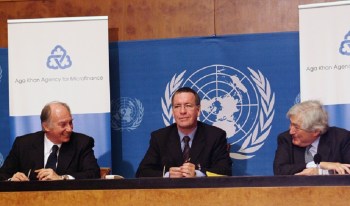
Geneva, Switzerland, February 22, 2005: The Aga Khan (left) and Jim Wolfensohn of the World Bank (right) share a light moment during the Press Conference announcing the launch of the new Aga Khan Agency for Microfinance (AKAM). Photo: AKDN/Jean-Luc Ray.
“I’m here because I’m the leader of the groupies of the Aga Khan, not so much for his work in the built environment (although I must say to you that I am deeply impressed by all that he’s done) but by his work in the human environment.
In my 10 years at the bank [World Bank], I’ve had the opportunity of meeting many people in the so-called development business. People that are concerned with the issues of poverty, people that in various ways display their interest in humanity, their concern for history, their concern for hope and for the future.
And in that 10 years, I can tell you that there is one person who stands out in my mind as an icon of not only thought and philosophy but of action. And I have to say this in front of His Highness, that I don’t say this about everybody in the development business. He has truly done the most amazing job not only for the Ismaili community throughout the world, but really for all the communities that he serves.
… At the end of the day he is looking for human profits.”
~ Late James Wolfensohn,
World Bank President (1995 – 2005),
introducing His Late Highness Prince Karim Aga Khan IV

 Be the First to Know – Join Ismailimail
















 Ismailimail