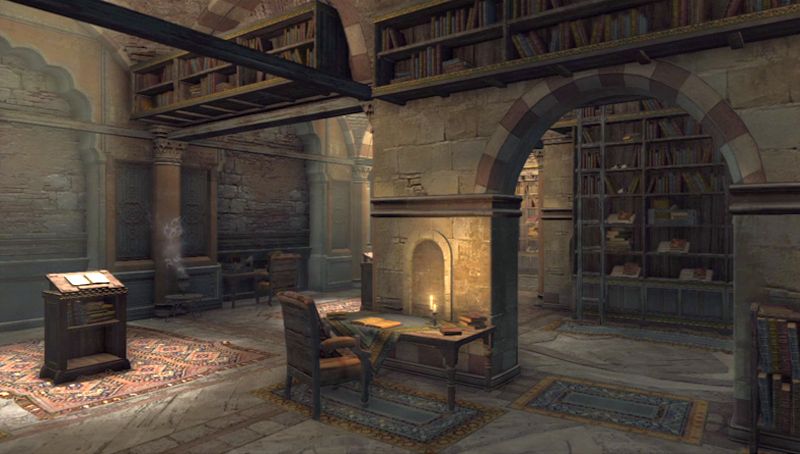
 In the Islamic world, book collections were initially linked to religious collection – in mosques and madrasahs (theological schools) – some mosques had separate rooms for non-religious materials which were often donated by scholars. Large collections of books were also housed in palaces and in the homes of the wealthy.
In the year 909, the Ismailis founded a caliphate in present-day Tunisia, when the eleventh Nizari Ismaili Imam, Abd Allah al-Mahid was proclaimed as caliph. In 969, they conquered Egypt where they founded their new capital, Cairo. After Imam al-Mu’izz moved to the new capital in 973, the “Fatimid palace in Cairo acquired a library unmatched anywhere in the contemporary world. During the reign of Imam al-Aziz (975-996) it contained more than thirty copies of the al-Ayn dictionary by the well-known grammarian Khalil (d. 791). The famous world chronicle of al-Tabari (839-923) was represented by twenty copies, as well as an autograph copy of the major work of the philologist and the lexicographer Ibn Durayd (837-933), al-Jamhara, there were a hundred copies. When this palace library was plundered by Turkish soldiers in the year 1068 it consisted of forty rooms. The works of classical authors alone comprised 18,000 volumes.”*
The sixth Fatimid Caliph, al-Hakim (996-1021) founded the Dar al-Ilm (House of Knowledge, sometimes called House of Wisdom) in Cairo in the year 1005. It was at this institution, which taught non-religious subjects and included a hospital, “that the first specifically astronomical observations with precision instruments were carried out at the end of the ninth century. The court chronicler al-Musabbihi (quoted by al-Maqrizi) described the library at this institution:
“Into this house they brought all the books that the commander of the faithful al-Hakim bi-Amr Allah ordered to bring there, that is, manuscripts in all the domains of science and culture, to an extent to which they had brought together for a prince. He allowed access to all this to people of all walks of life, whether they wanted to read books or dip into them. One of the already mentioned blessings, the likes of which had been unheard of, was also that he granted substantial salaries to all those who were appointed by him there to do service – jurists and others. People from all walks of life visited the House; some came to read books, others to copy them, yet others to study. He also donated what people needed: ink, writing reeds, paper and inkstands.”*
Ibn al-Tuwayr, a chronicler of the late Fatimid period, a major source of information about this period, wrote a description of the library:
“This library contained a great many bookshelves standing all around the enormous hall; the shelves were divided into compartments by vertical partitions; each compartment was secured by a hinged door with a padlock. There were more than 200,000 bound books and a few without bindings: jurisprudence according to different schools, grammar and philology, books about the traditions of prophets, history, biographies of rulers, astronomy, spiritual knowledge (ruhaniyyat) and alchemy……All this was written on a label attached to the door of each compartment.”*
After the fall of the Fatimid empire, some of the contents of the library were sold and others destroyed, and the rooms were converted into a hospital. The chronicler Ibn Abi Tayyi, a Twelver Shi’i wrote the following account of the Fatimid library:
“It was one of the wonders of the world, and it was said that in all the lands of Islam there had been no greater library than the one in the palace of Cairo.”*
References:
* Heinz Halm, The Fatimids and their Traditions of Learning, I.B. Taurus & Co Ltd., New York, 1997
Dr. Farhad Daftary, The Ismailis Their History and Doctrines, Cambridge: Cambridge University Press, 1990
Research by Nimira Dewji
 Be the First to Know – Join Ismailimail
Get breaking news related to the Ismaili Imamat, the world wide Ismaili Muslim community and all their creativity, endeavors and successes.
Inspired? Share the story
Want to inspire? Send your stories to us at Ismailimail@gmail.com
Subscribe and join 20,000 + other individuals – Subscribe now!
Earlier & Related – Nimira Dewji at Ismailimail Archives:
- Mawlana Shah Karim: “The relationship between the Imam and his Jamat is a deep and continuing bond”
- Mawlana Hazar Imam was gifted manuscripts on architecture of Andalusia, a Knowledge Society of its time
- Mawlana Hazar Imam Designates Ismaili Center Houston as Darkhana for US Jamat, the ninth Darkhana
- Imam Hasan ala dhikrihi’l-salam appointed Sinan as his deputy in Syria
- The arts of the Fatimids, Mawlana Hazar Imam’s ancestors, continue to inspire
- Rumi: “The light that lights the heart is the Light of God”
- Pir Sabzali: “Hearing the farman, their eyes brimmed over with tears of joy”
- Al-Tusi: “The ‘nass’ is not in order to make him an Imam; it is … so that people should recognise him as such”
- Mawlana Hazar Imam Aga Khan V: “The Shia Ismaili Muslim community, of which I am the Imam, has been established in Syria for more than 1,000 years”
- Mughal Emperor Akbar’s pluralism is evidenced by an inscription of Hazrat Isa’s teaching on his “Victory Gate”








![[Music in Islam] Is listening to music unlawful?](https://ismailimail.blog/wp-content/uploads/2014/08/music-in-islam.jpg?w=150)

 Ismailimail
Thank you very much for your informative emails about Ismailis. I’m so happy to be with you.
LikeLike