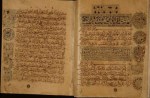
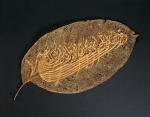
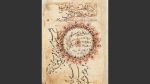
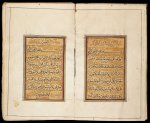
 The Holy Qur’an, the sacred book of Muslims, literally means ‘recitation’ and thus, originated not as a written text to be read silently, but an orally transmitted message from God to be memorized and recited aloud. It is also a work that has been copied by hand more than any other book in Muslim regions. The Qur’an has also played a vital role in Muslim civilizations as the inspiration for several art forms. Inscriptions of the Qur’anic ayats are not only displayed on buildings but also appear on a variety of objects within domestic spaces, are inscribed on various metals to make amulets, or woven into articles of clothing, and are also etched into hand held mirrors, suggesting a very intimate relationship between the divine book and the believer.
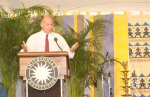
In 2003, The Institute of Ismaili studies organized an international colloquium to mark its twenty-fifth anniversary. The colloquium, titled Word of God Art of Man, focused on the Qur’an as a source for creative and artistic inspiration. The conference examined how the discourse of the Qur’an has provided the motivation for many Muslims to beautify the spaces they inhabit and the objects which they cherish.
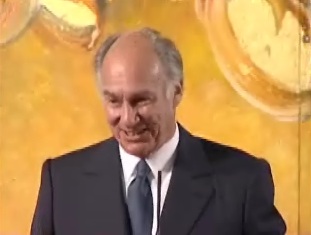
In his address at the opening of the colloquium, Mawlana Hazar Imam stated that “….the discourse of the Qur’an-e Sharif, rich in parable and allegory, metaphor and symbol, has been an inexhaustible well-spring of inspiration, lending itself to a wide spectrum of interpretations.…..From early on, its passages have inspired works of art and architecture, shaped attitudes and norms that have guided the development of Muslim artistic traditions. In this context, would it not also be relevant to consider how, above all, it has been the Qur’anic notion of the universe as an expression of Allah’s will and creation that has inspired, in diverse Muslim communities, generations of artists, scientists and philosophers? Scientific pursuits, philosophic inquiry and artistic endeavour are all seen as the response of the faithful to the recurring call of the Qur’an to ponder the creation as a way to understand Allah’s benevolent majesty.”
Reference:
Dr. Fahmida Suleman, Word of God, Art of Man: The Qur’an and its Creative Expressions, Selected Proceedings from the International Colloquium, London, 18-21 October 2003, The Institute of Ismaili Studies
Research Nimira Dewji.


![[Music in Islam] Is listening to music unlawful?](https://ismailimail.blog/wp-content/uploads/2014/08/music-in-islam.jpg?w=150)


- In his composition “Kalmaa kaho re momino” Pir Satgur Nur instructs to recite the Word with a pure heart
- Islamic Thought | Karim H. Karim: Re-asserting the Qur’an’s Cosmopolitan Ethics
- ‘Kitab’ – Revelation, Source of Revelation, and Past Revelations
- The Virgin Mary: A Muslim Role Model By Dr Zahra Jamal (@znjamal)
- Ismaili thinkers have engaged with diverse theological systems including the Vaishnavite framework to compose Ginans
- Quran, The Book of Divination- Poem by Amir Samji
- Reflections Reading: Significance of Ramadan via @TheIsmaili (Canada)
 Be the First to Know – Join Ismailimail
Get breaking news related to the Ismaili Imamat, the world wide Ismaili Muslim community and all their creativity, endeavors and successes.
Subscribe and join 17,000 + other individuals – Subscribe now!
 Ismailimail