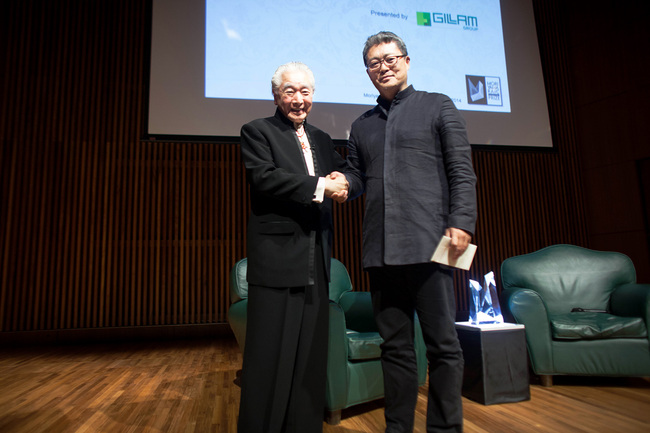
At the award gala held October 11 at the newly opened Aga Khan Museum in Toronto, there were two big surprises: the winning entry and the competition. First it seems amazing that such a small, modest building so far away could embody so many concepts we hold dear in Canada. The design is resourceful, modest yet ambitious, and seemingly at home in its landscape. The community building focuses on natural lighting, passive heating and cooling techniques, and builds community involvement with book exchange scheme. The building’s small size, use of low-tech, local materials and its modest expression make it an unusual choice for one of the largest architectural prizes in the world.
Watching the lecture and video by the architect that followed the announcement, it is hard to gauge the reaction of the 350 (mainly) architects in the room. Were they surprised? Inspired? Did they imagine a more high profile and expensive cultural project would win? Raymond Moriyama said at the awards ceremony that the award was “designed to give Canadian architects a kick in the ass” – will this prize work? Will it instigate the important discussion about the value of exemplary architecture and what it means to be a Canadian architect?
Another surprising aspect of the award is the news that entries were submitted for projects located in nine countries: Canada, China, France, Germany, Israel, Japan, South Korea, the United Kingdom and Tajikistan. With such an open brief it is very surprising there were not more entries. No entries located in the USA? Scandinavia? Elsewhere?
Three $5,000 CAD scholarships sponsored by the BMO Financial Group were also awarded to students of Canadian architecture schools. The awards were based on 1,000 word essays about why they wanted to become an architect. From over 150 submissions in both English and French, the awards were won by Loïc Jasmin of Université de Montréal, Benny Kwok of Dalhousie University and Shu Yin Wu of University of Waterloo.


Designed to inspire Canadian architects and raise the level of ambition in Canadian architectural culture, the inaugural 2014 Moriyama RAIC International Prize of $100,000 CAD has been awarded to Liyuan Library, a dramatic and beautiful project in Jiaojiehe China. The building is a simply detailed, glazed volume screened by locally sourced wood twigs, set in a stunning rural landscape. Designed to make a big impact in its social context, the community-run facility is building its collection asking visitors to donate two books for each one they borrow. The award is for a “single, transformative work of architecture”.
The award was founded by esteemed Canadian architect Raymond Moriyama and this year´s prize was judged by jurors Brian Mackay-Lyons, Patricia Patkau, Bing Thom, Maxime Alexis-Frappier, Barry Johns and Edward Cullinan. The submission guidelines were surprisingly open: any building, anywhere, any program, any size, by architects or designers. The main stipulation was that it must have been in use for at least two years.
Designed by Bejing-based Li Xiaodong Atelier, the Liyuan Library opened in 2012 and has been widely reviewed and won several awards including a World Architecture Festival award. The dramatic interior has integrated shelving, furniture and stairs. A spatially diverse, stepped section relates to the natural landscape and carves out spaces for sitting together, reading and stretching out.
Daylight is an important quality in the main space, using variation in the timber screens on the façade. The materials palette of wood for the structure, furniture, cladding and finishes are an important part of the experience, with one visitor quoted as describing the inside as feeling like being inside a giant hollowed out tree. When the building won the Architecture of Necessity Award in 2013 the architect explained “architecture is about finding the point of “no more and no less””.
The small library is 175m2 with a construction budget of about $185,000 CAD. The message that this prize sends out is clear: ambitious architectural designs can be found anywhere, for almost any budget and be designed for all kinds of users. The Jury Chair, architect Barry Johns argues “We need more of these types of perhaps modest, yet powerful buildings which make architecture from a deep understanding of people, culture, context, site, materiality and light”.
About Li Xiaodong
Li Xiaodong has an international background with experience living in Singapore and the Netherlands. His work draws on his research gained in his PhD in Architecture relating to sustainable site planning. His work is concerned with integrating Chinese and global artistic and technological concepts, and combining historical and contemporary techniques and forms. He designed a processional sequence of spaces ending in what he likens to “a zen garden” in the ambitious group show “Sensing Spaces: Architecture Reimagined” at the Royal Academy of Arts” earlier this year alongside works by architects Kengo Kuma and Alvaro Siza.
His work has won national and international design awards, including a 2010 Aga Khan Award for Architecture for Bridge School in Fujian Province, a World Architecture Festival award in 2012 for Liyuan Library, and the Architecture of Necessity Award, Sweden in 2013. Li has also received the UNESCO Jury Award for Innovation for Yuhu Elementary School.
Learn more at the Source Via:
- Archinect News – Reporting from Toronto: Li Xiaodong wins inauguralMoriyama RAIC International Prize for the Liyuan Library
- 2014 Moriyama RAIC International Prize
Related:


More on Upcoming Events at the Aga Khan Museum:

All Related to The Royal Architectural Institute of Canada
- Canada | Governor-General Adrienne Clarkson: The Aga Khan believed in Canada – “He thought very highly of Canada and had a great belief in our values”
- Aga Khan IV’s Architectural Vision Celebrated with RAIC Honorary Fellowship
- Global: Why the World Celebrates His Late Highness Prince Karim Aga Khan IV | Constellation of Honours: Over 300 Accolades from 55 Countries
- Canada: Royal Architectural Institute of Canada bestows 2nd honour on His Highness Prince Karim Aga Khan IV
- “Architecture of Pluralism”
- Publication: RAIC Gold Medal 2013: His Highness the Aga Khan | Canadian Architect
- Ismaili Centres: Ambassadorial Buildings of Excellence
- Aga Khan Campus: A Museum, Ismaili Centre & Islamic-inspired Park
- When it comes to architecture, the Aga Khan knows his stuff …
- In Search of Empathetic Architecture: Architect Bruno Freschi recalls the inspired discussions with his Highness the Aga Khan
- Architecture and the “essence of human life” – By His Highness the Aga Khan
- Architecture Matters: Quoting His Highness the Aga Khan
- Film produced on the occasion of His Highness the Aga Khan receiving RAIC Gold Medal
- Aga Khan honoured for commitment to architecture
- Canadian Architect’s Press Release: RAIC presents His Highness the Aga Khan with 2013 Gold Medal
- Thinking beyond four walls: Mawlana Hazar Imam, architecture and the world
- Video: His Highness the Aga Khan receives RAIC Gold Medal
- Aga Khan wins Royal Architectural Institute of Canada’s highest honour – The Globe and Mail
- His Highness the Aga Khan: RAIC Gold Medal – 2013 Recipient
- His Highness the Aga Khan awarded the 2013 Royal Architectural Institute of Canada Gold Medal
- Press Release: RAIC – Royal Architectural Institute of Canada – honours His Highness the Aga Khan with 2013 Gold Medal
- Royal Architectural Institute of Canada (RAIC) honours His Highness the Aga Khan with 2013 Gold Medal
 Be the First to Know – Join Ismailimail
Get breaking news related to the Ismaili Imamat, the Noorani Family, the world wide Ismaili Jamat and all their endeavors and successes.
Learn how to subscribe and join 15,000 + other amazing people – Subscribe now!
All stories from Ismailimail reporting from Toronto:



Aga Khan Museum Inauguration – Media & Press Coverage









 Ismailimail