(the light is lit) in houses of worship which God has allowed to be raised, and His name remembered in them. His praises are sung there morning and evening. Holy Qur’an 24:36
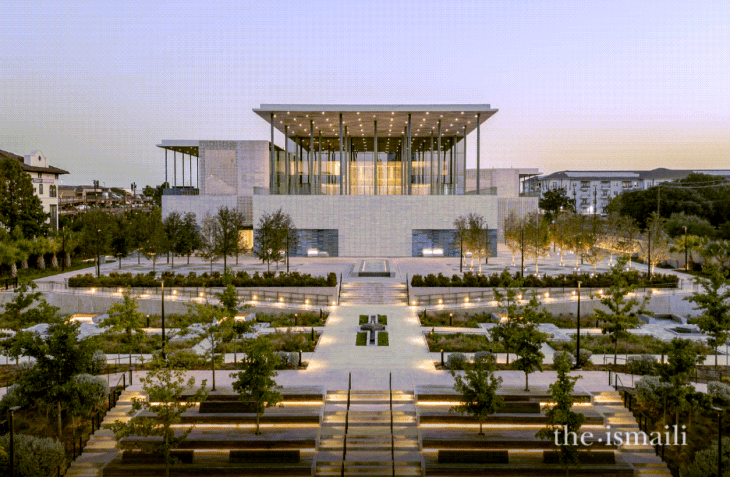
From the Arabic word jama‘a (gathering) and the Persian word khana (house, place), a jamatkhana is a place of gathering for worship for many communities including the Nizari and Mustalian Ismailis, Sunni Memon as well as the Chisti Sufis.
Places of worship
During the time of the Prophet (d. 632), the community congregated in a masjid, a place of prostration (from the Arabic root sa-ja-da meaning ‘to prostrate’). In the early Islamic era, the word masjid simply meant a place of prayer which could be any clean spot on earth. The first masjid was built in Medina in 622 CE, for the offering of canonical ritual prayers by Muslim congregations, and was also used as the centre of community life which served social, political, and educational purposes.
Over time, as Islam expanded and diverse interpretations arose, a variety of spaces of worship and gathering developed, with architectural styles reflecting the respective local cultures and materials.
Khaniqa/Khaniqah – from Persian, lit. ‘residence,’ khaniqa is a term for a Sufi meeting house for communal worship, which also served as a residential teaching centre for Sufi disciples.
Ribat – from the Arabic root ra-ba-ta meaning ‘to attach’ or ‘to link’; in certain Sufi traditions it means strengthening the heart. Ribat as a building could describe a small fort, a fortified place, or an urban establishment for mystics who gathered there to study, pray, and write. The earliest foundations of this kind of building date back to the first half-century of the Abbasid period (750-1258 CE)
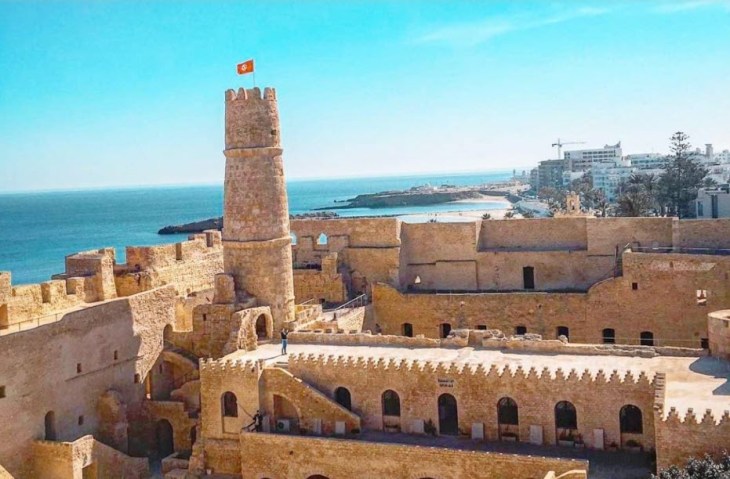
Zawiya – from the Arabic meaning ‘a corner,’ it is a Sufi place of worship referring to the corner of a mosque where a worshiper would isolate to perform dhikr, or may refer to a mausoleum of a saint or the founder of a specific Sufi tariqah.
The names of these centres have varied according to location: zawiya and ribat were used mostly in the Maghrib (present-day Morocco, Algeria, and Tunisia); khanaqah in Egypt, Syria; khanagah from Iran to India; and tekke in Turkish-speaking areas.
Jamatkhana
In the Khoja Ismaili tradition, Pir Sadardin is credited with establishing the earliest jamatkhana in the Indian subcontinent in Kotri, Sind, around the thirteenth century. Pir Sadardin converted large numbers of members of the Lohana community, giving them the Persian title of khwaja, an honorary term meaning lord or master, corresponding to the Hindi title thakur. Subsequently, in India, the Nizari Ismailis came to be generally designated as Khojas.
Earliest Darkhana in the Khoja Tradition
Imam Hasan Ali Shah Aga Khan I (1804-1881) migrated from Persia to the Indian subcontinent eventually settling in Bombay (now Mumbai) in 1846, the first Imam to set foot in the subcontinent. This marked the end of the Persian period in Nizari Ismaili history that had lasted some seven centuries since Alamut times, and the beginning of the modern period in Ismaili history. Imam’s presence there was greatly rejoiced by the Nizari Khojas, who had found it difficult to make the hazardous journey to the Imam’s residence in Persia to see him. When the Nizaris found direct access to the Imam in Mumbai, they paid homage to him at his durkhana, from the Persian darb-i khana, meaning main residence; Imam had also established residences and headquarters in Poona and Bangalore. When Imam was in Mumbai, he attended jamatkhana on special religious occasions and held a darbar (ceremonial gathering) on Saturdays.
Migration to the East African Coast
The Nizari Khojas had emigrated regularly from western India to Zanzibar, where they established their earliest jamatkhana. The emigration of the Khojas and other communities increased significantly during 1840-1870 owing to continued famine in western India and increased economic prosperity on the island.
When Zanzibar became the Omani capital in 1832, it provided political stability and security as well as enhanced economic opportunities for traders to expand their businesses. The Indian merchants soon became politically and economically important for the local rulers who appointed them to various positions in the government.
More about the early East Africa Ismailis here.
Although the earliest Ismaili jamatkhana in Zanzibar was established in the 1830s during the time of Imam Hasan Ali Shah Aga Khan I (1804-1881), the darkhana of Zanzibar was officially opened by Imam Sultan Muhammed Shah (1877-1957) on 16 August 1905. For the Nizari Ismailis, a darkhana historically referred to the residence of the Imam. In modern times, a country’s darkhana is designated by the Imam of the time to be in a city where the largest number of Nizari Ismailis reside.
Migration to the West
As jamat settled in the West, there arose a need for symbolic markers of jamat’s presence and to represent the ethos of the faith. Incorporating spaces for social and cultural gatherings, intellectual engagement, and spiritual contemplation, they are bridges of friendship serving to enhance relationships among faith communities, government, and civil society.
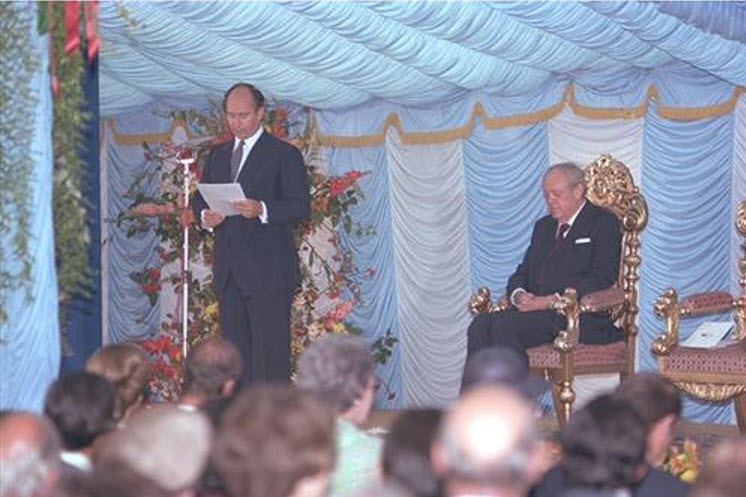
At the foundation ceremony of the first Ismaili Centre established in London, UK, on 6 September 1979, Mawlana Shah Karim (1936-2925) expressed his vision for the Centre:
“It is my conviction that the building of this Centre is symbolic of a growing understanding of Islam….This building and the prominence of the place it has been given indicate the seriousness and the respect the West is beginning, to accord Muslim civilisation, of which the Ismaili community, though relatively small, is fully representative. May this understanding, so important for the future of the world, progress and flourish.”
Presently there are nine Darkhana jamatkhanas around the globe. As per the Ismaili Constitution instituted by Mawlana Shah Karim in 1986, there are six Darkhanas:
Cromwell Gardens, South Kensington, London, UK (the first Ismaili Centre, opened in 1985)
Burnaby, Canada (second Ismaili Centre, opened in 1985)
Garden East, Karachi, Pakistan
Khadak, Bombay, India
Parklands, Nairobi, Kenya
Mosque Street, Dar-es-Salaam, Tanzania (established in 1935)
In 1998, as per the revised Ismaili Constitution, Mawlana Shah Karim added:
Namirembe Road, Kampala, Uganda
Lisbon, Portugal (Ismaili Centre, opened in 1998)
On 6 November 2025, Mawlana Hazar Imam inaugurated the seventh Ismaili Centre and on 7 November, Imam designated the Ismaili Center Houston as the Darkhana for the US Jamat, the ninth Darkhana Jamatkhana.

At the inauguration of the Center, on 6 November, Hazar Imam expressed his vision for the Centre:
“The Ismaili Center Houston is the seventh in a family of buildings spanning Europe, the Middle East, Central Asia, and North America. They serve many purposes. While daily congregational prayer is a primary focus, they also seek to enable a vibrant exchange of ideas, and to nurture understanding amongst peoples of diverse communities and faiths.”
Speech
Contributed by Nimira Dewji, who also has her own blog –Nimirasblog – where she writes short articles on Ismaili history and Muslim civilisations
Sources:
Farhad Daftary, A Short History of the Ismailis
Karim Jiwani, Muslim Spaces of Piety and Worship, The Institute of Ismaili Studies
Oleg Grabar, “The Mosque,” Islam: Art and Architecture Edited by Markus Hattstein and Peter Delius. Cologne, Konenmann, 2000
 Ismailimail