At the European Commission’s ninth annual conference in support of Syria, held on 17 March 2025 in Brussels, Mawlana Hazar Imam pledged, on behalf of the Ismaili Imamat and the Aga Khan Development Network, a minimum of €100 million over two years to help address the country’s urgent humanitarian and development need. In his address he stated:
“The Shia Ismaili Muslim community, of which I am the Imam, has been established in Syria for more than 1,000 years.”
Speech

As part of the region of Mesopotamia – from the Greek meaning ‘between two rivers’ (the Euphrates and Tigris) – Syria’s history dates to at least the third millennium BCE. Mesopotamia, later termed the ‘Fertile Crescent’ by historian J.H. Breasted, was known as the cradle of civilisation as it “has inspired some of the most important developments in human history including the invention of the wheel, the planting of the first cereal crops, and the development of cursive script” (Mark).
Syria has been part of numerous empires including the Seleucid (312 – 63BCE), Byzantine (476 – 608BCE), Umayyad (661-750CE), Abbasid (1183 -1260), Fatimids (1003-1038), Ayyubids (1171-1260) among others, all leaving their artistic and cultural stamps, revealing the richness of their diverse heritage. Ross Burns states “few countries can match Syria in the richness of its historical remains” (Monuments of Syria).
Named after the sixth Imam, the history of Ismailis in Syria begins around the early ninth century when Salamieh, an ancient city dating to Babylonian times (2300-141 BCE), served as the secret headquarters of the Ismaili da’wa.
Imam Muhammad b. Ismail succeeded his father to the Imamat around 765, at the age of twenty-six, during a turbulent time in Medina, due to disputes over the successors of his father and grandfather, as well as anti-Alid Abbasid policies. Shortly after 766, Imam Muhammad b. Isma’il left Medina for the east in order to escape persecution, initiating the dawr al-satr, ‘period of concealment’ in early Ismaili history. Imam evidently spent the later part of his life in Khuzistan, in southwestern Persia, where he had some followers and from where he dispatched da’is to adjoining areas. For almost a century after his reign, a group of leaders worked secretly to spread the da’wa; Imams did not claim the Imamat openly, assuming code names, in order to escape persecution.
The success of the da’is began to arouse the hostility of the local authorities, who attempted to arrest the Imam when his identity was disclosed. At an unknown date, in the first half of the ninth century, Imam Abd Allah b. Muhammad, known as Wafi Ahmed (‘Trustworthy’), found refuge in Salamieh, where he established contact with his da’is, posing as a merchant. Henceforth, Salamieh served as the secret headquarters of the da’wa, which had spread to many regions including Yaman, Bahrayn, Egypt, and the Indian subcontinent.
Earlier, around 762, Imam Ja’far al-Sadiq had sent two da’is to the Magrib (modern day Morocco, Tunisia, and Algeria) to spread Ismaili teachings. “More than a century later in [893], the pioneering da’i Abu Abd Allah al-Shi’i arrived in the mountainous Berber region of eastern Algeria, where he lived among the local tribesmen for nearly sixteen years, preaching the Ismaili doctrine, uniting them under his leadership….” He prepared the ground for the establishment of the Fatimid caliphate, “making it possible in for the Ismaili Imam [Al-Mahdi]… to undertake the long, hazardous journey from Syria to North Africa” (Jiwa, Towards a Shi’i Mediterranean Empire p 7). In August 909, Imam al-Mahdiwas proclaimed caliph in Sijilmasa, Morocco, officially establishing the Fatimid Caliphate (909-1171) thereby ending the dawr al-satr period.
See Hardships encountered by Imam al-Mahdi
Alamut Period
Anticipating the end of the Fatimid caliphate, Hasan Sabbah acquired the fortress of Alamut in Persia in 1090. Over the course of the next 150 years, the Ismailis acquired more than 200 fortresses in the mountainous regions for refuge of Ismailis who were fleeing persecution.
In early twelfth century, Hasan Sabbah sent the first da’is to Syria, where they operated initially in Aleppo and then in Damascus. Following constant persecution and massacres in both centres, the surviving Ismailis concentrated their efforts on acquiring a network of safe strongholds in the Jabal al-Bahra, a mountainous region in northwestern region (present-day Jabal Ansariyya), away from urban centres.
Rashid al-Din Sinan
Shortly after his succession to the Imamat in 1162, Imam Hasan ala dhikrihi’l-salam sent Rashid al-Din Sinan, one of the most powerful and energetic da’is, to Syria to resolve the variety of issues that the community was facing. The area in which the Ismailis were residing was not fertile for agriculture causing many to migrate to Hama, Hims, and Aleppo in order to earn a living. Furthermore, the invasions by the Templars on Ismaili territories forcing them to pay tributes, along with the disputes within the community added to the complexity of issues. Virani states that Sinan “brought with him a letter from the Imam urging the Syrians to set aside their differences and unite behind him:
“May God preserve you all, brethren, from conflicts of opinion and from following your passions, for that is the temptation of the first generation and the doom of the last, and in this is a lesson for those who heed…. Be united in following the teaching of a person appointed by the designation of God and his friend [the Imam], and [unify] your passions in obeying him. Accept willingly whatever commands and prohibitions he vouchsafes to you…” (The Ismailis in the Middle Ages p 105).
A skillful strategist and a master of the art of diplomacy, Sinan promptly ended the internal dissensions, while playing a prominent role in the regional politics of his time in order to safeguard the security of the Ismailis. In the three decades that he was chief da’i of Syria, Sinan led the Ismailis to the peak of power and fame until his death in 1193.
Post-Alamut
Following the Mongol onslaught on the Ismaili state that fell in 1256, the Syrian Ismailis no longer received guidance directly from the Imam; they came under Mamluk rule (1250-1517).
The Sultan – Baybars – systematically adopted measures which led to the loss of the independence of the community, forcing them to surrender their fortresses. In 1271, Ullayqa and Rusafa were captured; by 1273, all strongholds had been surrendered.

Following the decline of the Mamluks, Syria came under Ottoman rule from 1516 to 1918.
Re-Settlement of Ismailis in Salamiyya
In 1843, the amir of Qadmus, Amir Isma’il b. Amir Muhammad, obtained permission from the Ottomans to restore Salamieh, then in ruins, for the permanent settlement of the community. Among the earliest settlers were Ismailis who benefited from a general Ottoman policy which granted amnesty to those willing to settle in areas that were rich farmland where the villages had been deserted for several generations. Over time, Salamieh, became an important agricultural centre, where a variety of crops including wheat and legumes were cultivated.
Douwes states that in a letter sent in 1890, preserved in the archives of the Ismailis Council in Salamieh, Mawlana Sultan Muhammad Shah appointed Shaykh Sulayman al-Hajj as their mukhi, “introducing the Khoja religious terminology into Syria” (A Modern History of the Ismailis p 29, p 41 n 18). Upon his death, Shaykh Ahmad, who reportedly spent a year in Bombay (where Imam Sultan Muhammad Shah was residing) before returning to Syria, was appointed as mukhi. He faced much resistance when he attempted to introduce new teachings and rituals. “However, he is said to have argued that the Imam sought to emphasize the inner spirituality of the rituals” ( A Modern History of the Ismailis p 27).
Mawlana Sultan Muhammad Shah had sent his son Prince Aly Khan (d.1960) on regular visits, beginning in 1931, to Syria, where he opened the Muhamadiyya school (Douwes, A Modern History of the Ismailis p 38). Prince Aly Khan, who was decorated with the Legion of Honour in 1950 for his military service in the Allied Forces and elected to the UN General Assembly in 1958, played a vital role in the development of the Ismailis of Syria. Prince Aly Khan was eventually buried (in 1972) in a mausoleum next to the jamatkhana in Salamieh,, as per his wishes.
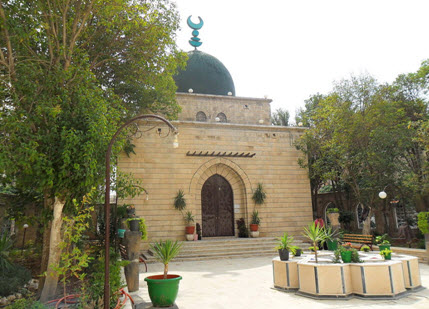
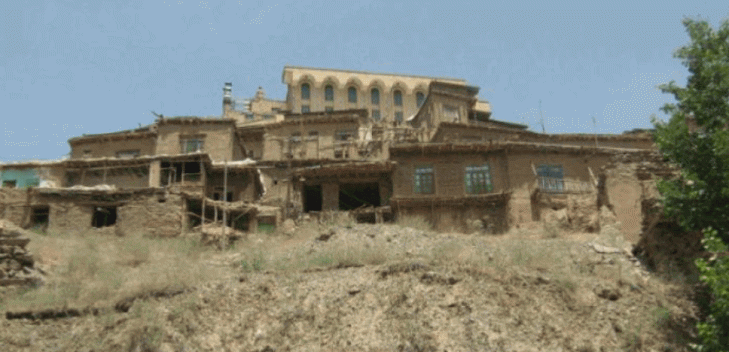
In 1932, Imam Sultan Muhammad Shah founded a school at Dizbad, which was named after da’i Nasir-i Khusraw. In 1951, Mawlana Sultan Muhammad Shah visited Salamieh, where he subsequently founded several schools.
Mawlana Shah Karim visited Salamieh, for the first time as Imam on 27 July 1959.
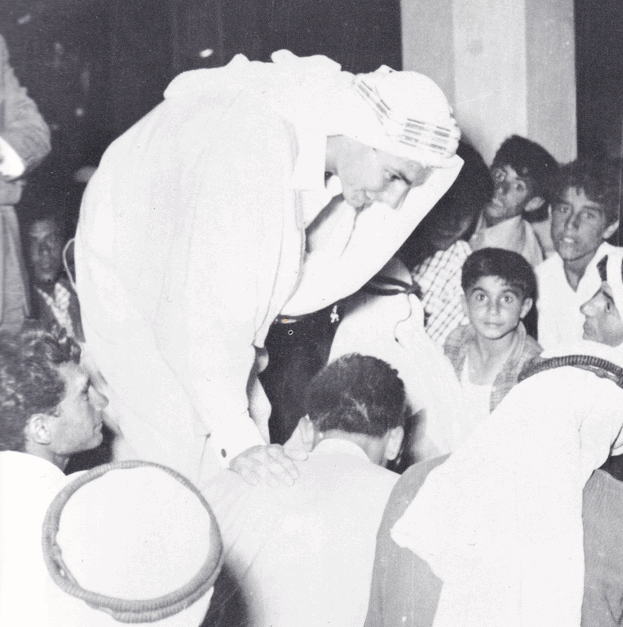
During his Golden Jubilee visit to Syria in 2008, Mawlana Shah Karim granted Golden Jubilee Darbars in Salamieh and Al-Khawabi.
Restoration work was done by Aga Khan Trust for Culture on the citadels of Aleppo, Masyaf, and Salah al-Din.

Contributed by Nimira Dewji, who also has her own blog – Nimirasblog – where she writes short articles on Ismaili history and Muslim civilisations.
Sources:
Almut von Gladib, Islam: Art and Architecture, Edited by Markus Hattstein and Peter Delius, Konemann, 2000
Carboni, Stefano, and Qamar Adamjee, Enameled and Gilded Glass from Islamic Lands, In Heilbrunn Timeline of Art History. New York: The Metropolitan Museum of Art
Farhad Daftary, Zulfikar Hirji, The Ismailis An Illustrated History, Azimuth Editions, London, 2008
Farhad Daftary, The Ismaili Imams, I.B. Tauris, London, 2020
Joshua J. Mark, Mesopotamia, Ancient History Encyclopedia
Nasseh Ahmed Mirza, Syrian Ismailism, Curzon Press, 1997
Peter Willey, Eagle’s Nest, I.B. Tauris, London, 2005
Shainool Jiwa, Towards a Shi’i Mediterranean Empire, London, 2009
 Ismailimail
Ya Ali Madad . Very interesting history of Imam. Knowledgeable history.
LikeLiked by 1 person