From the word ‘Mongol,’ the Mughals were a Muslim dynasty of Turkic-Mongol origin that ruled the Indian subcontinent from 1526 to 1857, building a magnificent empire based on well-founded and enduring institutions. The name ‘Mughal’ – which is not how the dynasty referred to itself, but a name given to it by outsiders – is a reference to the Mongol heritage of Babur, the founder of the dynasty in the subcontinent (Treasures of the Aga Khan Museum Catalogue p 20). At their peak, the Mughals ruled over most of South Asia and parts of modern day Afghanistan.
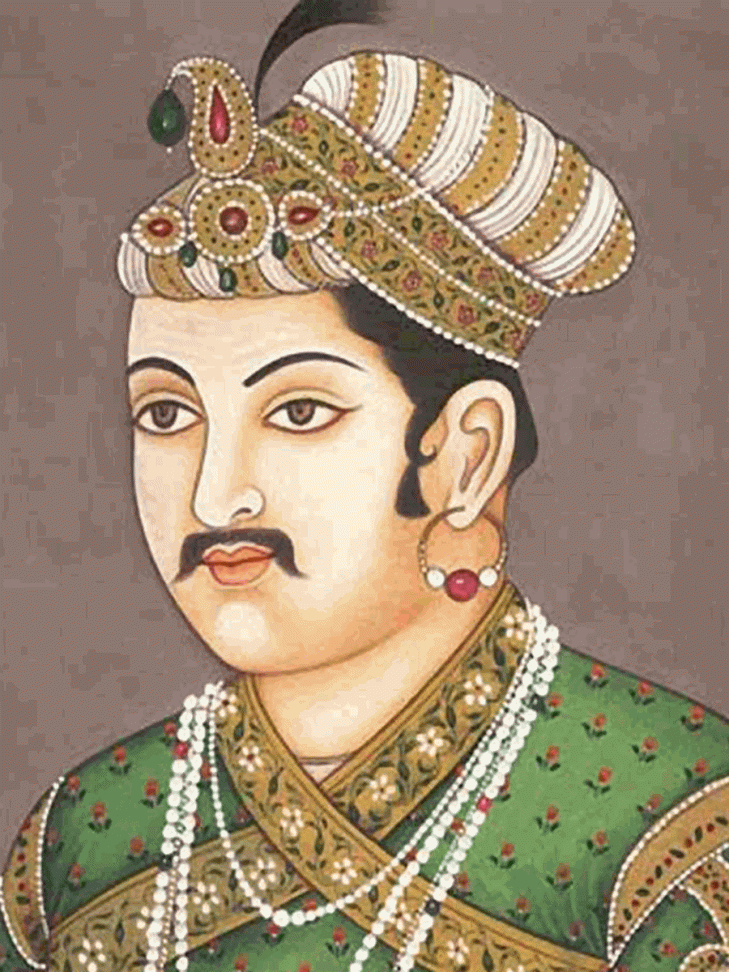
Muhammad Zahir al-Din Babur (r. 1526-1530) laid the foundation of the dynastic rule; however, his grandson Jalal al-Din Muhammad Akbar (r.1556-1605) is considered the builder of the empire. Born in Umarkot, India in 1542, Akbar succeeded as ruler of the empire at the age of fourteen years. Although Akbar was born into a Sunni Muslim family, he received an education by two Persian scholars on religious matters, which likely had an impact on his tolerant vision for Mughal society.
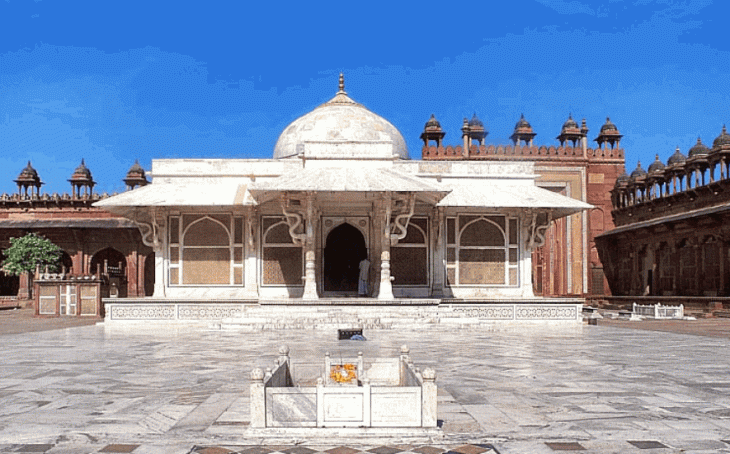
Concerned about the lack of a son, Akbar turned away from Orthodox clergymen, seeking the blessing of the well-known Sufi Sheikh Salim Chishti in the village of Sikri, a short distance from his capital in Agra. The Sheikh blessed the monarch, foretelling the birth of three sons. During her pregnancy, Akbar re-settled his wife, a Rajput Hindu princess, to Sikri, where their son was born in 1569; they named him Salim, after the Sheikh. In gratitude to the saint, Akbar began to build a royal complex in Sikri, along with forts, mosques, and mausoleums, transferring his capital there in 1571.
When the Sheikh died, Akbar had a mausoleum built for him in the courtyard of the mosque complex.
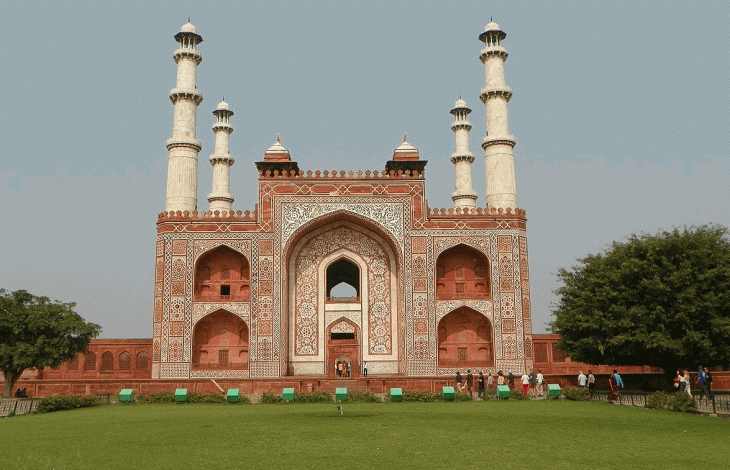
In addition, to commemorate his military victory in Gujarat, Akbar re-named the city to Fatehpur (‘City of Victory’) Sikri. To further celebrate his military victory in Gujarat, Akbar commissioned the building of the Buland Darwaza (‘Victory Gate’), completed in 1601, at the eastern entrance to the mosque complex.
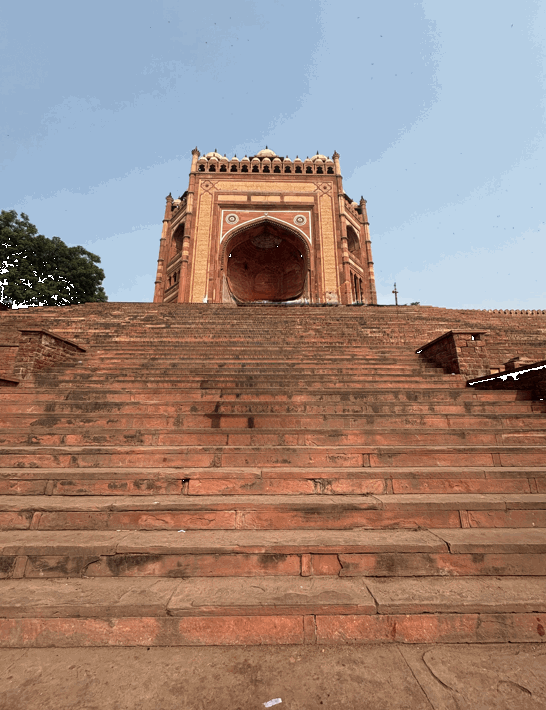
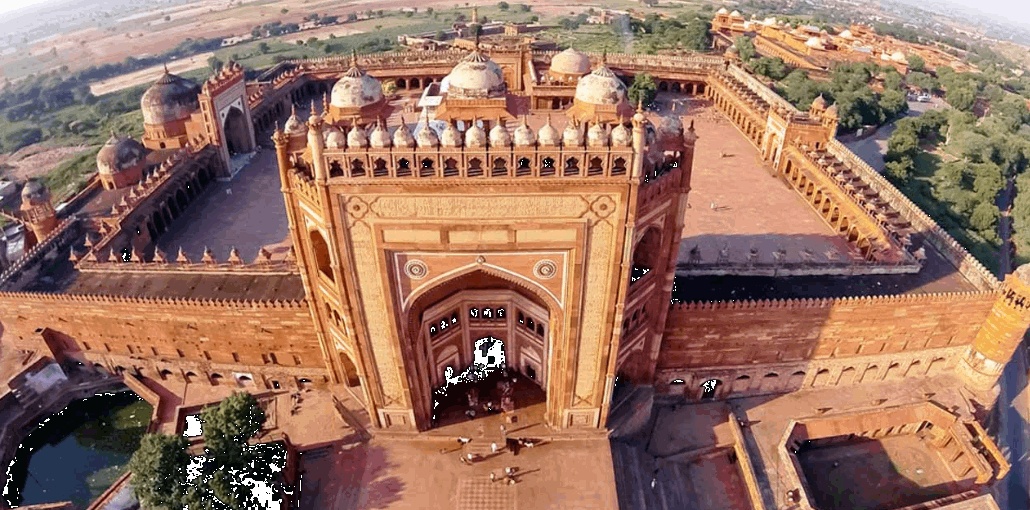
Arguable the highest gate in the world at 54 metres, situated atop a flight of 52 steps, it forms the grand entrance to Fatehpur Sikri. Etched on the archway is a teaching of Hazrat Isa (Jesus):
“Isa, son of Mary, said: This world is a bridge. Pass over it, but build no houses on it. He who hopes for an hour may hope for eternity. The world endures but an hour. Spend it in prayer, for the rest is unseen” (Considine).
This illusionary nature of the world taught by Hazrat Isa is in alignment with the tenets of many faiths including Hinduism (maya), and Islam:
Whatever you are given is no more than temporary material of this life. What GOD possesses is far better and everlasting, for those who believe and trust in their Lord (Quran 42:36).
The life of this world is no more than illusion and vanity, while the abode of the Hereafter is far better for the righteous. Do you not understand? (Quran 6:32).
To further strengthen his pluralistic policies, Emperor Akbar met Christian delegates from Goa in 1576, led by Father Julianes Pereira who was the Bishop of Cochin and Vicar-General of Satgaon to acquaint him with Christianity. Father Pereira, who was well versed in Quran, reminded Akbar of Surah Mariam [Mary] that mentions Jesus.
Dr. Considine states “Akbar had his son Murad instructed in the New Testament. According to Akbar’s court companion Abdel Kadir, Murad started his New Testament lesson by stating “In the name of Christ” instead of the usual Islamic gesture “In the name of God.” One of Akbar’s greatest legacies is the Ibadat Khana, or “House of Worship.” Established in 1575 in the city of Fatehpur Sikri, the Khana originally served as a forum for open debate among Sunni Muslims. Following several petty debates which turned Sunni men against each other, Akbar changed the Khana into an edifice where people of all religions could gather to participate in interfaith dialogue. In the Khana and elsewhere, Akbar “would recognize no difference between [religions], his object being to unite all men in a common bond of peace,” as noted by historian Muhammad Abdul Baki… In challenging people to open their minds to knowledge outside of their own religious traditions, Akbar insinuated that no single religion has a monopoly on the truth.” (Huffpost).
Manya Rathore notes “the discussions in the Ibadat Khana convinced Akbar that all religions had elements of truth, and they all led to the same Supreme Reality” (World History Encyclopedia).
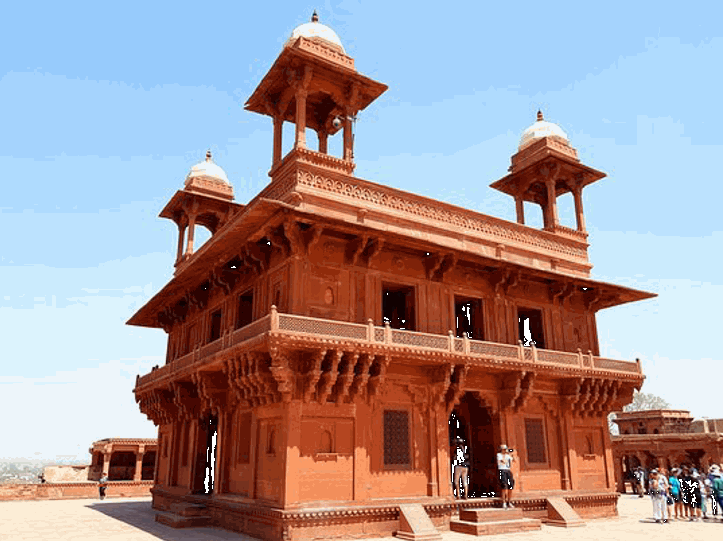
Justice Katju, former Supreme Court judge of India, notes that “in 1578, Akbar invited Parsi theologian Dastur Mahyarji Rana for a detailed discourse on Parsi religion… His interactions with Sikhism included contacts with Guru Amar Das and Guru Ram Das” (Medium).
Author Ira Mukhoty states “it was a very rare phenomenon to have a monarch who was ready to accept people from different faiths and to listen to them” (History TV video).
His pluralistic policies accorded Hindus freedom of worship, also attending many Hindu festivals himself (Madras Courier).
An avid patron of the arts, Emperor Akbar established centres of artistic production for the court, illustrated manuscript studios, a translation academy, and workshops for textiles, carpets, jewellery, and metalwork. Persian artists sought employment at Akbar’s court, bringing with them an enhanced attention to detail and sophisticated use of colour.
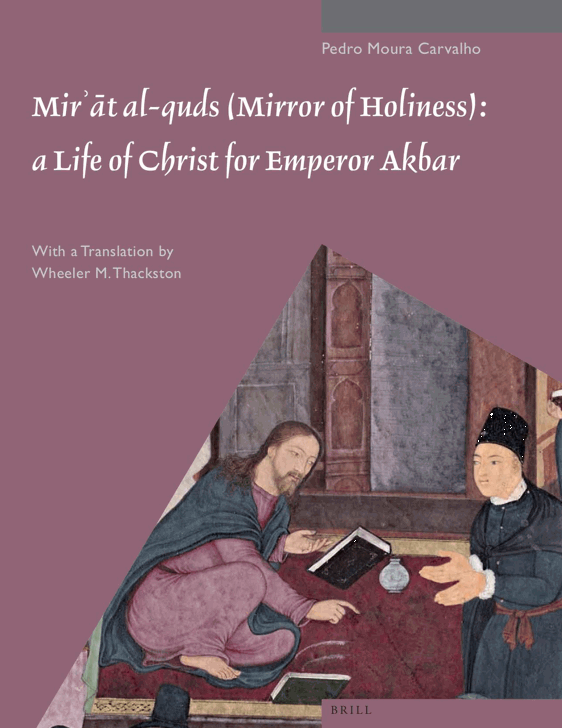
The monarch commissioned royal manuscripts that incorporated Persian, Indian, and European elements, creating a distinct Mughal style which was further developed and refined by his successors. In 1574, Akbar “created a bureau of Records and Translation at Fatehpur Sikri to translate important texts, including Hindu epics, into Persian – the official language of the Mughal state – and to illustrate them in the royal workshops” (Haider). In addition, Akbar commissioned paintings of the Life of Christ, written in Persian for the monarch by Father Jerome Xavier in collaboration with a scholar at the Mughal court (Victoria and Albert Museum) The text is translated to English by Wheeler M. Thackston (Archnet).
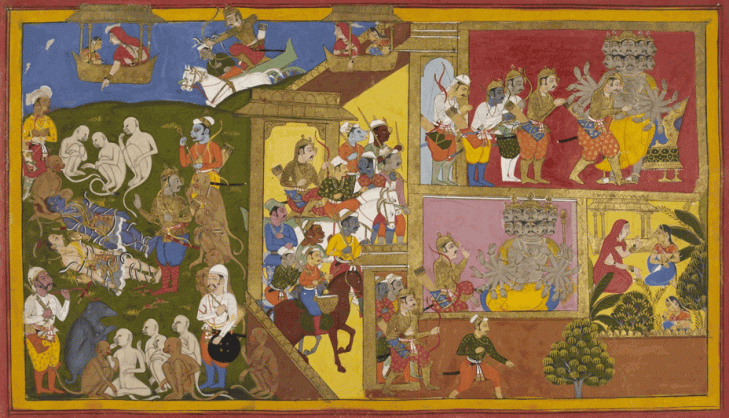
The Muslim artisan Sahib Din painted the largest illustrated Ramayana – one of the sacred Hindu scriptures (Madras Courier).
Although Akbar was illiterate and possibly suffered from dyslexia, his chronicles describe him as having a “good memory for the books” that were read to him daily. By the year 1605, Akbar had collected 24,000 volumes, which were catalogued according to content, author, calligrapher, and language – Hindi, Persian Greek, Arabic, and Kashmiri.
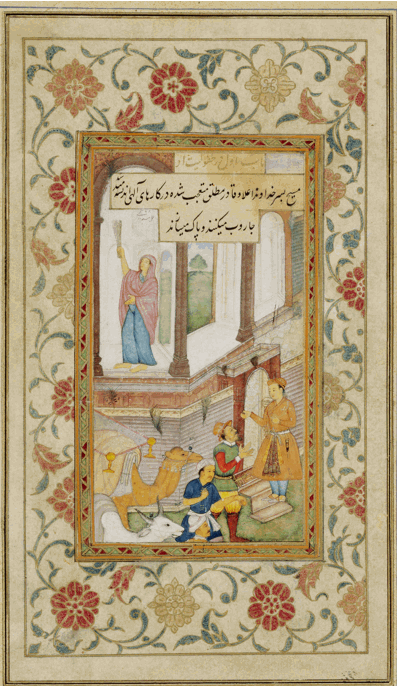
The first prime minister of India Jawaharlal Nehru (r. 1947-1964), in his book Discovery of India, states “Akbar became the great representative of the old Indian ideal of a synthesis of differing elements and their fusion into a common nationality … So long as his successors kept in line with this policy and with the genius of the nation, their empire endured. When they broke away and opposed the whole drift of national development, they weakened and their empire went to pieces”(p 142).
Nehru adds “Akbar had built so well that the edifice he had erected lasted for another 100 years in spite of inadequate successors…. The impact of the invaders from the north-west and of Islam on India had been considerable. It had pointed out and shown up the abuses that had crept into Hindu society—the petrifaction of caste, untouchability, exclusiveness carried to fantastic lengths. The idea of the brotherhood of Islam and of the theoretical equality of its adherents made a powerful appeal, especially to those in the Hindu fold who were denied any semblance of equal treatment. From this ideological impact grew up various movements aiming at a religious synthesis” (p 265). “Akbar” argues Nehru “was a symbol of India’s unity” (Discovery of India p 344).
Historian and co-founder of the world’s largest writers’ festival (the annual Jaipur Literature Festival). William Dalrympt notes “the form that the buildings in Fatehpur Sikri took directly reflects the syncretism and liberalism in the second half of Akbar’s reign…Fatehpur Sikri showcased medieval India’s cultural confluence from Gujarati craftsmanship to Rajputi fort-planning and architecture” Dalrympt adds that “Fatehpur Sikri is an expression in stone of Akbar’s spiritual ideas” (History TV video). Fatehpur Sikri is a UNESCO World Heritage Site.
In 1584, Akbar moved his capital to Lahore (in modern-day Pakistan), where he died in 1605 and was succeeded by his son Salim, better known as Janagir, who continued his father’s pluralistic policies. Akbar’s mausoleum lies in Bihishtabad (“Abode of Paradise”) outside modern-day Agra.
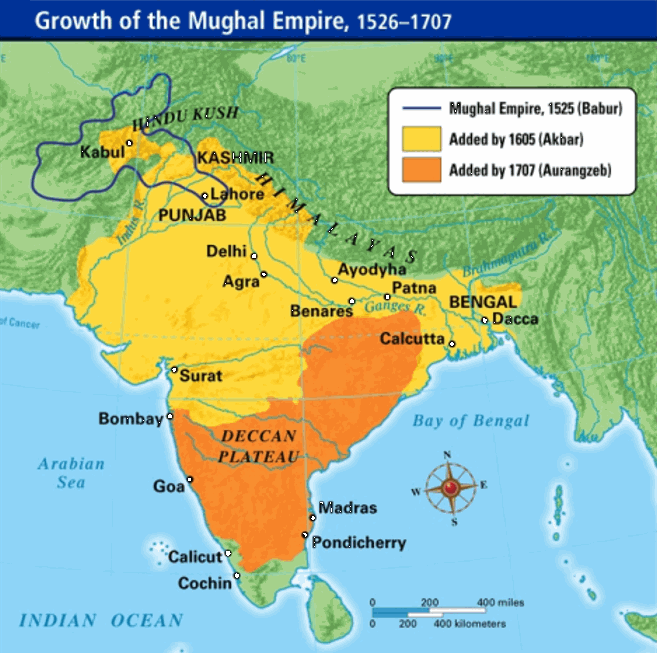
While Akbar established a sprawling kingdom through military conquests, he was well known for his religious tolerance, formulating policies to promote harmony among the citizens of the empire. Territorially, the empire reached its peak during the reign of his grandson Khurram, known as Shah Jahan (r.1628-1658), who had an appetite for architecture, commissioning some of the finest monuments on the Indian landscape, including the Taj Mahal, Moti Masjid, among others.
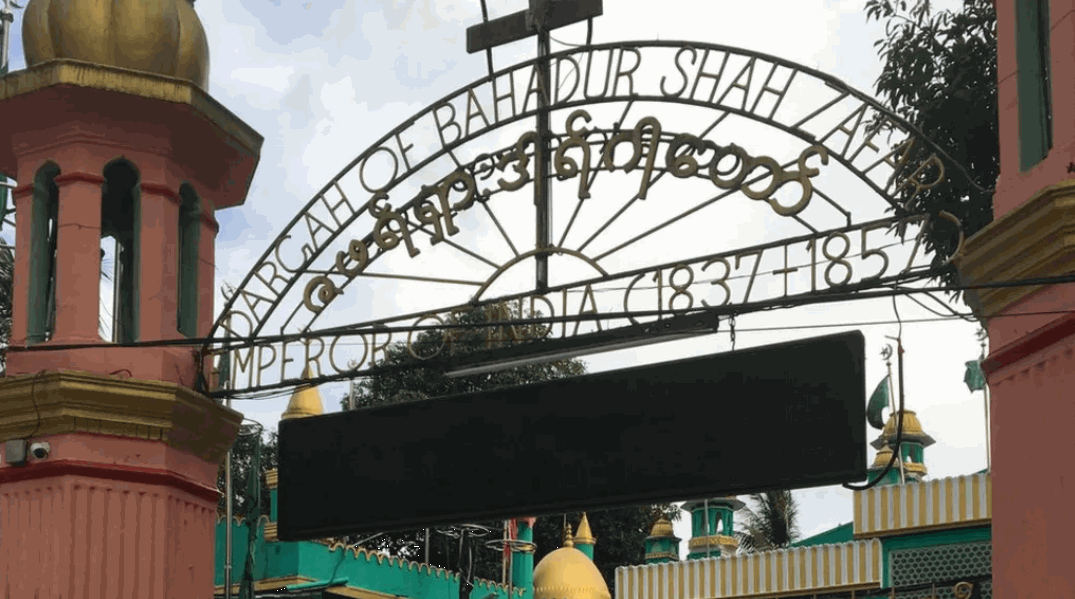
The empire began to decline during the reign of Shah Jahan’s son and successor Aurangzeb (r. 1658-1707), largely due to his intolerant policies. It was during his reign that the empire was invaded by the British, who rapidly divided the subcontinent, exiling the last Mughal Emperor Bahadur Shah II (r. 1837-1857), who used the pen name Zafar to write poetry, to Burma (modern-day Myanmar). “Zafar was a remarkable man,” historian William Dalrymple, author of The Last Mughal, told the BBC, who “valued the importance of Hindu-Muslim unity” (BBC).
“One of the great stumbling blocks to the advance of pluralism, in my view, is simple human arrogance. All of the world’s great religions warn against self righteousness – yet too many are still tempted to play God themselves – rather than recognising their humility before the Divine.”
Mawlana Shah Karim al-Hussaini Aga Khan IV, Paris, France, 15 June 2007
Speech
Contributed by Nimira Dewji, who also has her own blog – Nimirasblog – where she writes short articles on Ismaili history and Muslim civilisations.
Sources:
History TV : Why a Quote Attributed to Jesus Is Engraved on Akbar’s Fatehpur Sikri Gateway? Youtube (12 minutes)
Arathi Menon, A Page from the Mewar Ramayana, Smarthistory: The Centre for Public Art History
Akhil Jonnalagadda, Translating Theology: A Textual Examination of Akbar’s Religiosity, Rice University (PDF)
Craig Considine, Finding Tolerance in Akbar, the Philosopher-King, HuffPost
Justice Markandey Katju, Why I Regard Mughal Emperor Akbar as the Father of the Indian Nation, Medium, Human Stories & Ideas
Navina Najat Haidar, Ramayana, with a Mughal Brush, The Hindu
Philippa Vaughan “Decorative Arts” Islam: Art and Architecture Edited by Markus Hattstein and Peter Delius, Konnenman, p 484
Simeon Netchev, Mughal India, World History Encyclopedia
Stephen Markel, The Use of Flora and Fauna Imagery in Mughal Decorative Arts
Akbar, the Great Mughal, Nature
Akbar (Abu-Ul-Fath Jalal-Ud-Din-Muhammad Akbar; Akbar the Great, Science, Civilization, and Society
Akbar (Abu-Ul-Fath Jalal-Ud-Din-Muhammad Akbar; Akbar the Great), Indian National Centre for Ocean Information
Fatehpur-Sikri, UNESCO World Heritage Convention
Mewar Ramayana: The Largest Illustrated Ramayana, Madras Courier
 Ismailimail
I continue to be amazed at your insights, Nimira!
LikeLike
THE WORLD OF TODAY VERY BADLY NEEDS RULERS/GOVERNMENT HEADS LIKE AKBER THE GREAT ; BELIEVING IN HUMANITY, EQUAL OPPORTUNITY, RELIGIOUS TOLERANCE AND HARMONY AND DEVELOPMENT.
LikeLiked by 1 person