By Dr Mohamed Keshavjee
In a thought-provoking presentation made in the presence of the Indian High Commissioner to Trinidad and Tobago HE Pradeep Rajpurohit on Saturday 10 August 2024, Dr Mohamed M Keshavjee, Gandhi peace awardee for 2016 spoke of the universality of Mohandas Karamchand Gandhi and his relevance for all times. Dr Keshavjee was speaking to leading members of the Port of Spain civil society at a function organised by the Mahatma Gandhi Institute of Cultural Cooperation of Trinidad and Tobago in collaboration with the Gandhi Sewa Sangh and the Indo Caribbean Thought Forum.

Dr Keshavjee highlighted Trinidad’s unwitting, catalytic role in ensuring that the African freedom movements were informed by Gandhian principles of nonviolence. The lives of two men who shared a number of things in common show how this happened.
Mohandas Karamchand Gandhi, known famously as the Mahatma, was born in 1869 in Gujarat in India. Soon after qualifying as a barrister, he found himself working in South Africa as an assistant to white lawyers who had been retained by a wealthy Indian Muslim immigrant merchant, Dada Abdulla Jhaveri, who was suing his business partner Sheth Haji Khan Mohamed over a contract worth some 40,000 pounds. Gandhi’s services were as an interpreter to help Abdulla, a fellow Gujarati, to communicate more easily with his white South African lawyers. Gandhi arrived in Durban in May 1893 — oblivious of the plight of thousands of Indian indentured labourers who had been imported into the country from 1860 onwards to work in the cane fields of Natal under inhuman conditions which the celebrated British historian Hugh Tinker referred to as “ a new system of slavery”.
Within a fortnight of his arrival Gandhi experienced racism in the court in Durban and soon thereafter on the railway going from Durban to Pretoria where the case had been filed. Gandhi alighted at Pietermaritzburg station on the 7th of June only to find himself manhandled and physically evicted from the train. Hailing a stagecoach to continue the journey north he was beaten up again. While lying on the platform Gandhi pondered his predicament — he had to make a choice. He decided to stay and fight for the cause of justice. The rest is history. In the words of Nelson Mandela to an Indian friend, “You gave us Gandhi and we gave you the Mahatma [in the making]”.
During those early years while Gandhi established one of the oldest political parties in Africa — the Natal Indian Congress — Henry Sylvester Williams, a Trinidadian Black lawyer, found himself in England as a law student at Gray’s Inn. Here he came into contact with Alice Kinlock from South Africa who had travelled to England to champion the cause of Black miners working in the diamond mines of South Africa.

Through Kinlock’s influence Williams was drawn into the activities of the African (later the Pan-African) Association through which Williams organised the first Pan-Africanist Conference at London’s Westminster Hall in 1900 which was attended by such luminaries as Dr W.E.B. Du Bois and Dadabhai Naoroji, the first Indian to become a Member of Parliament in England and a political mentor to Gandhi. Under Kinlock’s influence Williams went to South Africa where became the first Black lawyer to be admitted to the Bar of the Cape colony — something that Gandhi wrote about in his newspaper the Indian Opinion on 15 November 1903. Pan-African Conferences continued to be held in places such as Paris, London and New York in subsequent years. However, the most significant was the one held in Manchester in 1945 where eminent Trinidadian social theorist CLR James asked his friend George Padmore to meet Kwame Nkrumah, a newly-arrived African student in England who would become a leading protagonist in the African freedom struggle.

Padmore, who was the organisational genius behind the 1945 Conference, also invited to Manchester Jomo Kenyatta of Kenya, Hastings Banda of Nyasaland and Peter Abrahams of South Africa. All of them were students in Britain at the time.

Within 12 years the Gold Coast attained its political independence as Ghana with Kwame Nkrumah as its first Prime Minister. Within another decade some 40 African countries followed suit — all following the Gandhian principle of non-violence which Nkrumah had adopted as his “Positive Action” on 8 January 1950. In Kenya in 1963, Kenyatta, after spending nine years in jail as a political prisoner, adopted the Gandhian principle of forgiveness. In neighbouring Tanganyika, Julius Nyerere followed Gandhian principles and, in Zambia, Kenneth Kaunda acknowledged that Gandhi’s teachings “went straight to my heart”. In South Africa’s long struggle against apartheid, leading stalwarts such as Albert Luthuli, Yusuf Dadoo, Monty Naicker, Maulvi Cachalia and Nana Sita were staunch Gandhian supporters. Their philosophy influenced Nelson Mandela, Walter Sisulu, Oliver Tambo, Ahmed Kathrada and Albie Sachs.
Gandhi’s philosophy influenced not only major African leaders but also political activists in the USA such as W.E.B. Du Bois and Martin Luther King Jr, for whoom “Jesus showed the idea, but Gandhi gave us the method. Gandhi unpacked the life of Jesus more than anybody in history”.
Keshavjee asked, “what is it about this man Gandhi that inspired leaders who had never met him personally and who had operated in different circumstances in different times?” Perhaps here we are looking at Gandhi the principle and Gandhi the vision. “Gandhi”, he said, “had morphed into something beyond himself.” And here it must be remembered that he did not want to be monumentalized. He conceded that he was human and that he was fallible. The beauty was his humility to acknowledge that he could be wrong. He did not believe in one truth but experimented with truth — not the truth.
Dr. Keshavjee emphasised that though Trinidad is a small island it was still able to transmit Gandhi’s philosophy to Africa. This shows that millions of others can do the same.
Commenting on the presentation, leading Trinidadian anthropologist Dr Kumar Mahabir said, “The presentation helped us connect the dots and showed us how the struggle for human dignity in the Caribbean was a joint one and that both the so-called end of slavery and the infamous indentured system were part of a continuum of the colonial legacy of exploitation. Therefore, there is a need for a genuine commitment to pluralism where all cultures must be given equal respect and equal treatment”.
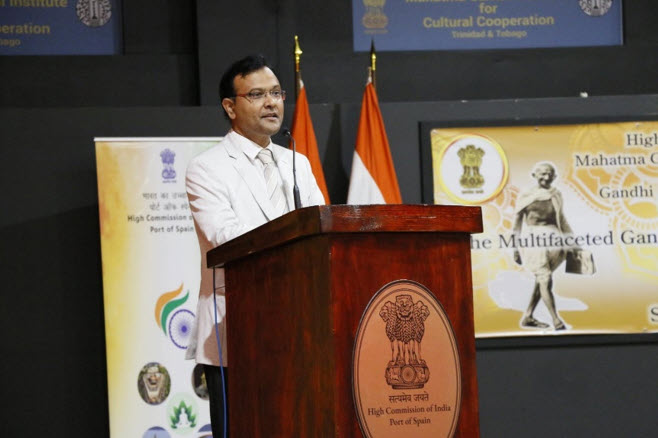


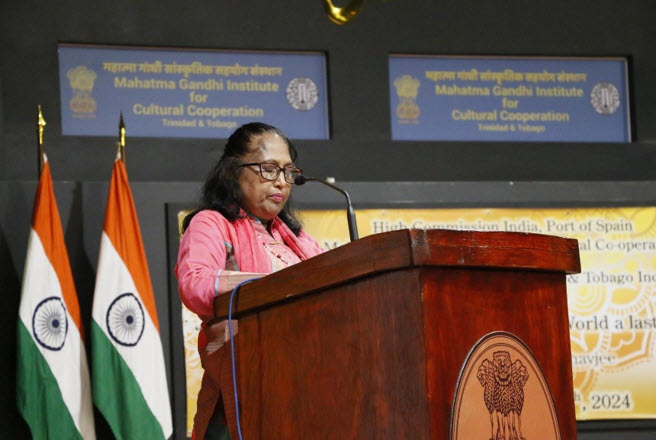
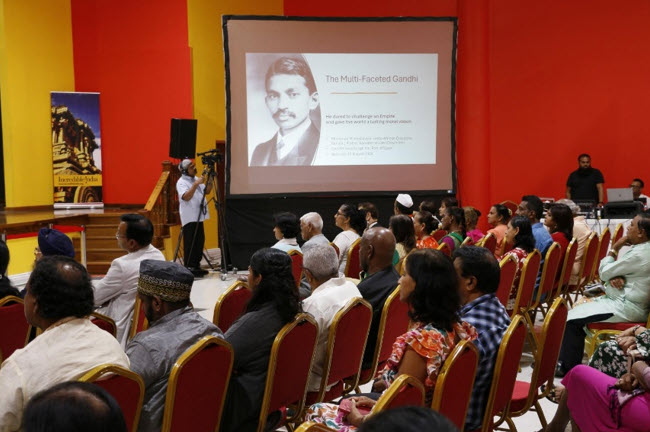
Credit the MGICC – Trinidad and Tobago
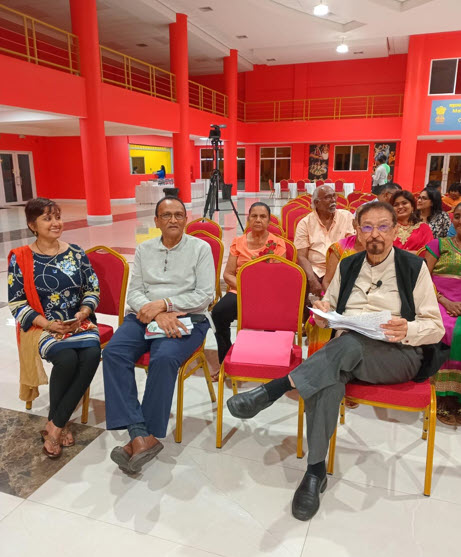

 Ismailimail
Hi
Ya Ali Madad. Very interesting you sharing for Mohandas Karamchand Gandhi of Satyagraha to Africa’s Freedom Movements.
LikeLike