There is no benefit in recitation without contemplation;
there is no benefit in worship without comprehension.
Imam Ali
Prophet Muhammad frequently sought moments of contemplation by retreating to a cave on Mount Hira. In the year 610, during the month of Ramadan, he underwent a profound spiritual experience that included a vision and a voice. On this night the Prophet’s “heart and soul were permanently illuminated and effaced by the Holy Spirit and the Light of the Qur’an. Thus, the Prophet became the “speaking Qur’an” … and for the next twenty-three years, he expressed, rendered, and articulated the spiritual Light of the Qur’ān in the form of revealed discourse (tanzīl, qur’ān)” (Ismaili Gnosis).
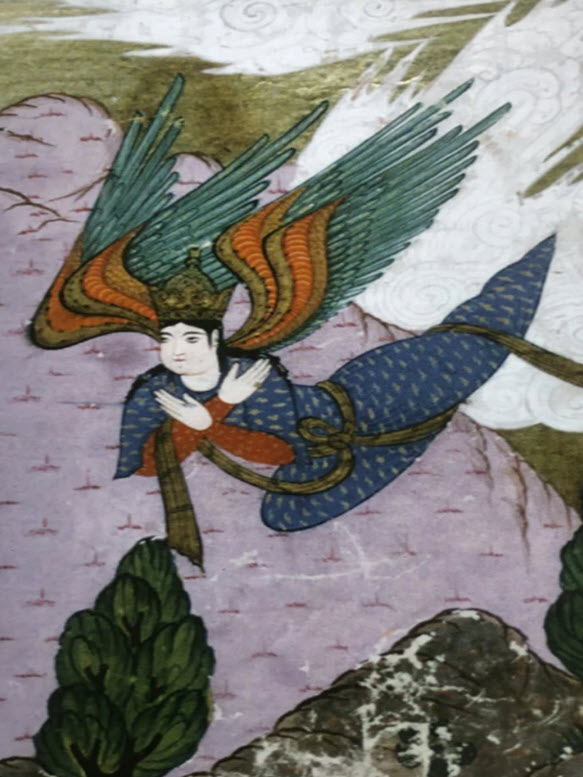
(The following are abstracts from Ismaili Gnosis – Iqra: Muhammad Meditated Upon the Name of God as the Qur’an was Revealed)
The first revelation was:
Iqrā’ bi-smi rabbika’lladhī khalaqa
Khalaqa al-insāna min ‘alaqin
Iqrā’ wa rabbuka al-Akramu
Alladhī ‘allama bi’l-qalami
‘Allama’l-insān ma lam ya‘lam
Generally translated as
Read: In the name of your Lord Who created
Created man from a clot
Read: And your Lord is most Generous
Who has taught by the Pen
Has taught man that which he knew not (96:1-5).
According to most interpretations, the Prophet was being told by God to read the verses of the Qur’an which Angel Gabriel was conveying to him. “This interpretation implies that “the verse contains a general command to the Prophet to start delivering his prophetic message “in the Name of his Lord” (Rubin).
Many scholars interpret iqra bi-smi rabbika as ‘to call the Name of the Lord’ (Rubin). In the Qur’an, “the Name, or rather “the most beautiful Names of Allah” stand for the various aspects of His infinite power as the creator of the world and as the divine source of bounty and benefaction. For instance [59:23-24 tr. Arberry]: “He is God, the Creator, the Maker, the Shaper, to Him belong the Names Most Beautiful. All that in the heavens and the earth magnifies Him…” Hence, “the command to “recite” the Name of the Lord means to recount His greatness, as the origin of man’s existence and intelligence” (Ibid).
In other verses of the Qur’an, the words bi-smi rabbika appear
Fasabbiḥ bi-smi rabbika al-‘aẓīmi
“Then praise the Name of your Lord, the Supreme” (56:74, 56:96; 69:52).
Wa-udhkuri isma rabbika wa tabattal ilayhi tabtīlān
“And remember the Name of your Lord and devote yourself to it/Him devotedly” (73:8).
Wa-udhkuri isma rabbika bukratan wa aṣīlān
“And remember the Name of your Lord morning and evening” (76:25).
These verses, among others, are instructing the Prophet to praise or remember the Name (ism) of their Lord. Thus the Prophet was being told to perform a specific ritual – the recitation of a particular Name of God. Thus the words iqra bi-smi rabbika mean “remember/invoke the Name of your Lord.” This means when the Prophet was in the Cave of Hira, the first revelation was actually telling him to engage in the remembrance (dhikr) of the Name of God – and a very specific name as evidenced by the term rabbika (your Lord rather the Lord) which suggests an intimate connection between the Prophet and God… As he retreated regularly to the Cave of Hira, it appears that the Prophet was already engaged in certain spiritual practices and disciplines – which included the invocation and recitation of a specific Name of God – what is today known as dhikr … the bedrock of spiritual praxis throughout Shi’ism and Sufism (Ismaili Gnosis).
Another early surah of the Qur’an – which came to the Prophet a few years after the first revelation – repeats the instruction for the Prophet to perform a specific recitation (qur’an) of a weight Word (qawl) – the Name of God in a meditation during the night:
Yā ayyuhā’l-muzzammilu
Qumi al-layla illā qalīlan
Niṣfahu awi unquṣ minhu qalīlan
Aw zid ‘alayhi wa-rattili al-qur’ān tartīlan
Innā sanulqī ‘alayka qawlan thaqīlan
Innā nāshi’ata al-layli hiya ashaddu waṭan wa-aqwamu qīlan
Innā laka fī’l-nahāri sabḥan tawīlan
Wa-udhkhuri isma rabbika wa-tabbattal ilayhi tabtīlan
O ye who wraps himself
Rise up during the night except a little
Half of it or less from it a little
Or add to it and recite the recitation with measured rhythm
Indeed, we will cast upon you a weighty Word
Indeed, the rising of the night is very hard and most potent and more suitable for the Word
Indeed for you in the day is prolonged occupation
And invoke the Name of your Lord and devote yourself to it with devotion (73:1-8)
The Prophet is told to rise for a special night meditation to recite a special Word (qawl); the recitation (al-qur’an) of this Word (the term al-qur’an refers to this particular recitation…) is to be done in a rhythmic tone which probably involves a specific breathing pattern; the Word to be invoked in this meditation is the Name of God … (Ismaili Gnosis).
The invocation of the Divine Name (ism ilahi) or Word (kalima; qawl) recurs in the story of several Prophets. In the Qur’anic story of the appointment of Prophet Adam, what gives Adam precedence over the angels is the fact that God taught him … the Divine Names – the Most Beautiful Names of God – by which Adam attained spiritual superiority over the angels:
Wa ‘allama ādama’l-asmāa kullahā thumma ‘araḍahum ‘alā’l-malāikati faqāla anbiūnī bi-asmāi hāulāi in kuntum ṣadiqīna
“And He taught Adam all the Names. Then He said to the angels: ‘Inform me of the Names of these if you are truthful” (2:31).
In other verses (38:72-73 and others), the Qur’an refers to the “Spirit” (al-ruḥ) that God breathed into Adam after which the angels prostrated before him. This means that the Names of God and the Spirit are one – the Spirit comprises the inner reality of the Names. Henry Corbin remarks that:
The term ruḥ is derived from the word riḥ (breath) and the actual recitation of the Divine Name (ism Allah) is actually a form of ‘breathing’ – indeed, this is the noblest form of breathing. And therefore, the Divine Spirit (ruḥ) or Breath (riḥ) which was given to the Prophet Adam took the form of the invoked Divine Name. In other words, the Prophet Adam attained his spiritual rank above the angels due to his internalization of the Divine Spirit which takes places through the invocation (dhikr) of the Names of God.
In the story of Noah, the Ark of Noah which leads the believers to salvation in both worlds runs its course by means of the Name of God:
Wa-qāla irkabū fīha bi-smi’llahi majrahā wa-mursāhā inna rabbī laghafūrun raḥīmun
“And he (Noah) said: ‘Embark in it (the Ark). The Name of God is its course and its anchorage. Verily, my Lord is the Oft-Forgiving, the Merciful’” (11:41).
The Qur’an also relates that God tested the Prophet Abraham by means of certain “Words” (kalimat). These Words refer to the Divine Names by which Abraham ascended the ranks of spirituality until God appointed him as the Imam of the time:
Wa-idhi ibtalā ibrāhīma rabbuhu bi-kalimātin fa amtammahunna qāla innī jā‘iluka li’l-nāsi imāman qāla wa min dhurriyyatī qāla lā yanālu ‘ahdī al-ẓalimīna.
“And remember when Abraham was tried by his Lord by certain Words and he fulfilled them. He said: ‘Verily, I appoint you Imam of humankind.’ He (Abraham) said: ‘And of my descendants?’ He (God) answered: ‘My covenant is not with the unjust.’” (2:124).
In the story of Mary and Jesus, the Qur’an describes how Mary received the Spirit of God – due to which she gave birth to Prophet Jesus (66:12). The Qur’an also refers to Jesus as a Word (kalimah) from God which He breathed into Mary (4:171).
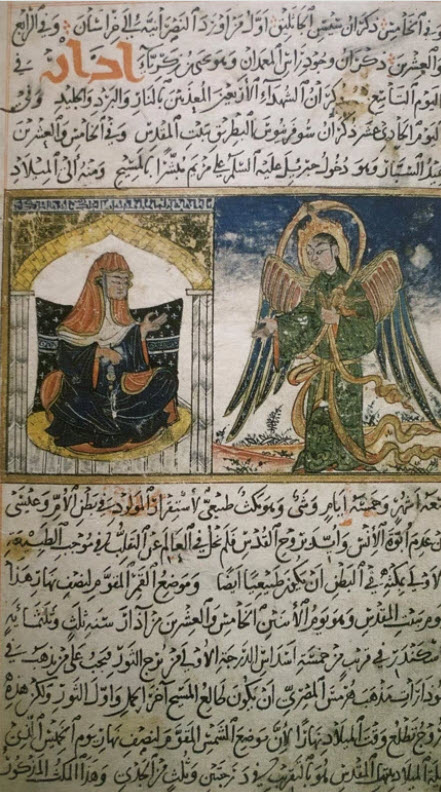
The great Prophets of God attained their exalted status by means of the Name of God which was received by them in the form of a Word (kalimah; qawl) that embodies the Divine Spirit…. the Prophets had to undergo a process of spiritual training, initiation, and development by means of the Word or Name of God to actualize their souls’ perfection for the function of prophethood.
Visit Ismaili Gnosis for a detailed discussion of Iqra: Muhammad Meditated Upon the Name of God as the Qur’an was Revealed
In his composition Kalmaa kaho re momino Pir Satgur Nur, the earliest Pir to have been sent to the Indian subcontinent, instructs to recite the kalmaa with a pure heart.
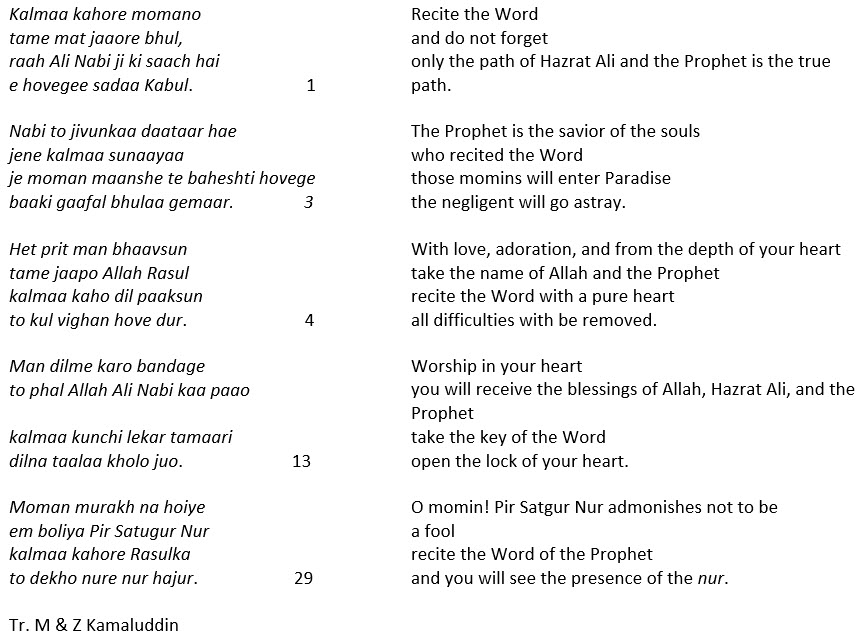
Click here to listen to the ginan.
More on ginans here.
Sources:
Azim A. Nanji, “The Prophet, the Revelation, and the Founding of Islam,” The Muslim Almanac, Gale Research Inc., Detroit, 1996
Mahmoud Ayub, “The Qur’an in Muslim Life and Practice,” The Muslim Almanac, Gale Research Inc., Detroit, 1996
Reza Shah-Kazemi, Spiritual Quest: Reflections on Qurʾānic Prayer According to the Teachings of Imam ʿAlī, I.B. Tauris, London, 2011
Uri Rubin, Iqra bi-smi-rabbika (PDF)
Ismaili Gnosis, Iqra: Muhammad Meditated Upon the Name of God as the Qur’an was Revealed
Contributed by Nimira Dewji, who also has her own blog – Nimirasblog – where she writes short articles on Ismaili history and Muslim civilisations
 Ismailimail