…he [Ali ibn Abi Talib] was a prince to whom God gave much knowledge and wisdom.”1
Attar
“Ali b. Abi Talib, may God beautify his profile, is the secret mystery of the gnostics…and the whole Muslim Community agree that Ali b. Abi Talib represents the breaths of inspiration of all the prophets…He has sayings the like of which no one prior to him ever uttered and after him the like of which no one has expressed.” 2
Bukhari
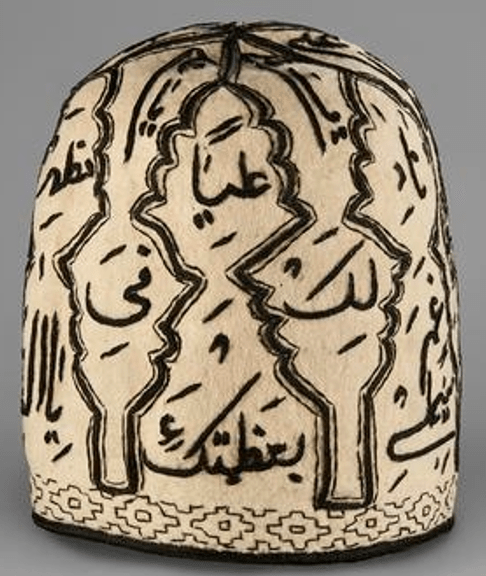
Hazrat Ali ibn Abi Talib (d. 661 CE) was the first cousin and son-in-law of the Prophet; the fourth of the four Rightly Guided Caliphs (al-khulafa’ al-rashidun); and the first Imam of the Shi‘i Muslims deemed to be appointed by divine mandate. The word Shi‘i is derived from the term shi‘at Ali, meaning “partisans of Ali.”
Imam ‘Ali was about five years old when he was taken into the household of Prophet Muhammad and, from this time until the death of the Prophet, was his constant companion and a distinguished scribe of the continuous revelations. In one of his sermons, Imam Ali mentions the intimacy of the relationship between them:
“When I was but a child he took me under his wing … I would follow him [the Prophet] as a baby camel follows the footsteps of its mother. Every day he would raise up for me a sign of his noble character, commanding me to follow it. He would go each year into seclusion at [the mountain of] Hira. I saw him and nobody else saw him. .. I saw the light of the revelation and the message, and I smelt the fragrance of prophecy” (Nahj, p.300; Peak, p.393, cited in Justice and Remembrance p 13).
Sources agree that Hazrat Ali played a foundational role in the development of the Islamic intellectual sciences as a whole – jurisprudence (fiqh), theology (kalam), Qur’anic interpretations (tafsir), rhetoric (balagha), grammar (nahw), calligraphy (khatt), the mystical knowledge associated with Sufism, as well as sciences such as numerology (jafr) and alchemy (al-kimya). Reza Shah-Kazemi notes “the Prophet’s definition of Ali as the ‘gate’ to prophetic wisdom… takes on the appearance of both a description of what Ali was in relation to the Prophet in their own age, and also a prophecy of the role Ali would play in relation to the subsequent unfolding of the sciences of the tradition—all such sciences being understood as so many formal, outward manifestations of the essential, inward spirit of the Islamic revelation…”(Justice and Remembrance p 12).
Lewisohn quotes the Persian philosopher Allamah Tabataba’i (d. 1981):
“Despite the cumbersome and strenuous difficulties which absorbed his time, he left behind among the Islamic community a valuable treasury of the truly divine sciences and Islamic intellectual disciplines… In his talks and speeches he expounded the most sublime Islamic sciences in a most elegant and flowing manner. He established Arabic grammar and laid the basis for Arabic literature. He was the first in Islam to delve directly into the questions of metaphysics…in a manner combining intellectual rigor and logical demonstration…he was so devoted to metaphysics and gnosis that even in the heat of battle he would carry out intellectual discourse and discuss metaphysical problems” (The Sacred Foundations of Justice in Islam p 144).
Hazrat Ali’s standing in Muslim tradition is evidenced by the numerous narratives that relate to the period of his Caliphate and earlier, and also by a monumental compilation of his discussions, sermons, and epistles titled Nahj al-balagha (The Way of Eloquence). Compiled by al-Sharif al-Radi (d.1016), a renowned Shi’i scholar of Abbasid Baghdad, the Nahj al-balagha, considered a masterpiece of Arabic prose literature, has been the object of numerous commentaries, abridgements, and studies. Corbin states “after the Quran and the hadith of the Prophet, it is the most important work not just for the religious life of Shiism in general, but for its philosophical thought” (History of Islamic Philosophy p 35).
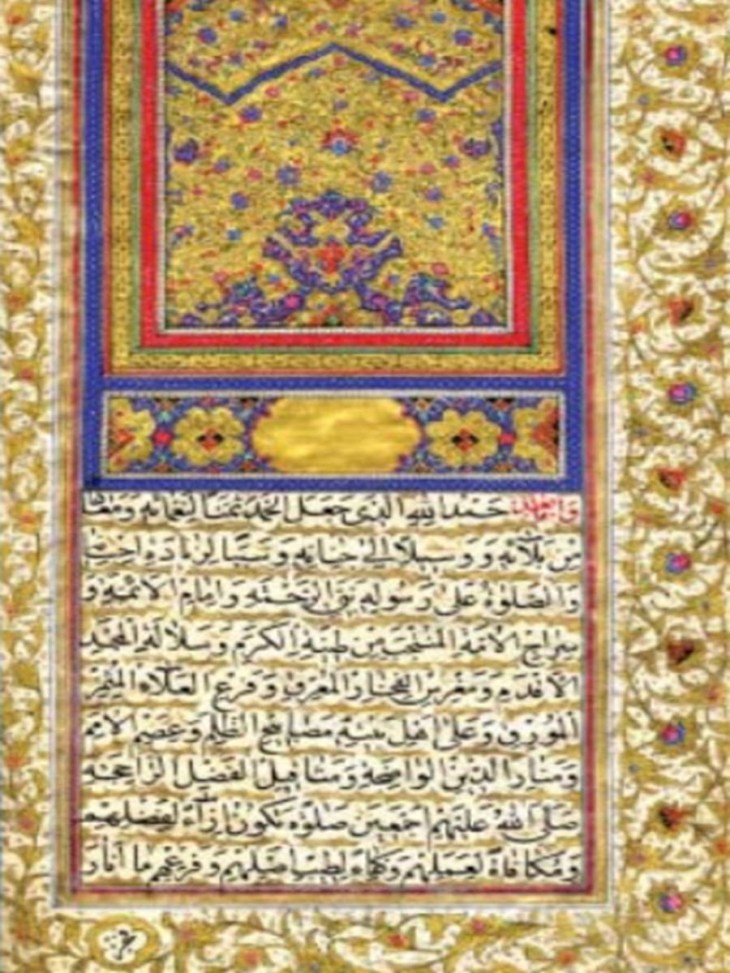
Hazrat Ali’s teachings, which inspired the spiritual life of Muslims through the centuries, were translated into numerous languages across the Muslim regions, including the Kalam-e Mawla (‘Discourse of Mawla Ali’), a poetic rendition in Hindustani. Compiled in the 17th or 18th century, it comprises 327 verses divided into 23 thematic sections.
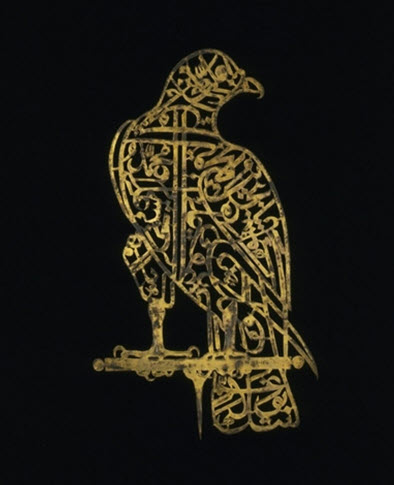
Hazrat Ali is credited as the developer of the Kufic script, the oldest style of Quranic calligraphy, named after the city of Kufa in Iraq, where Hazrat Ali resided and where the script is believed to have originated. Hazrat Ali taught that each letter of the alphabet has not only an outward form, but also an inner meaning. Hence, each letter of a word is believed to contain divine power, and therefore, the discipline of writing has spiritual significance. Hazrat Ali is regarded as “the first master of calligraphy” (Sharify-Funk).
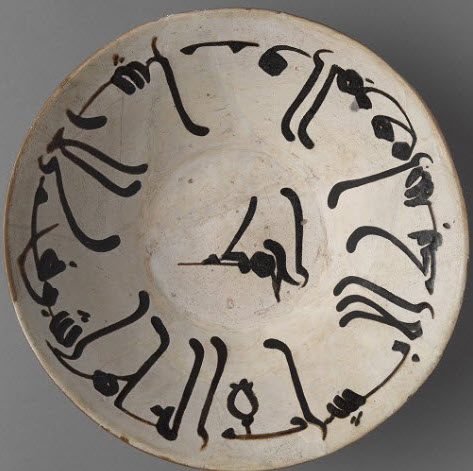
The intellectual and spiritual legacy of Ali b. Abi Talib is widespread and can be found amongst all Muslims regardless of their school of interpretation. In almost all Sufi tariqas, Hazrat Ali forms a link in the chain of spiritual masters reaching back to the Prophet. Through his teachings, practical guidance, and the exemplary life that he led, “Ali ibn Abi Talib is regarded as a paragon of wisdom, piety and virtue, and is not only a great Muslim but a great religious leader whose universal message … is relevant for all time” (Appendix, The Sacred Foundations of Justice in Islam, p 149).
(See Virtues of Knowledge)
Mawlana Shah Karim Aga Khan IV highlighted the enduring relevance of Hazrat Ali’s teachings:
“From the very beginnings of Islam, the search for knowledge has been central to our cultures. I think of the words of Hazrat Ali ibn Abi Talib, the first hereditary Imam of the Shia Muslims, and the last of the four rightly-guided Caliphs after the passing away of the Prophet (may peace be upon him). In his teachings, Hazrat Ali emphasised that “No honour is like knowledge.” And then he added that “No belief is like modesty and patience, no attainment is like humility, no power is like forbearance, and no support is more reliable than consultation.”
Notice that the virtues endorsed by Hazrat Ali are qualities which subordinate the self and emphasise others – modesty, patience, humility, forbearance and consultation. What he thus is telling us, is that we find knowledge best by admitting first what it is we do not know, and by opening our minds to what others can teach us.”
Commencement Ceremony of the American University, Cairo, Egypt, June 15, 2006
Speech
Sources:
1Farid al-Din Attar (d. 1230), Tadhkirat al-awliya, cited by Lewisohn in The Sacred Foundations of Justice in Islam, Edited by M. Ali Lakhani, World Wisdom, 2006 (p 114)
2Abu Ibrahim Isma’il ibn Bukhari (d. ca. 870) cited by Lewisohn in The Sacred Foundations of Justice in Islam, Edited by M. Ali Lakhani, World Wisdom, 2006 (p 113)
Henry Corbin, History of Islamic Philosophy, Kegan Paul International, London, 1993
Meena Sharify-Funk, Geometry of the Spirit: Sufism, Calligraphy, and Letter Mysticism
Reza Shah-Kazemi, Justice and Remembrance, Introducing the Spirituality of Imam ‘Ali, I.B.Tauris Publishers, London, 2006
Contributed by Nimira Dewji, who also has her own blog – Nimirasblog – where she writes short articles on Ismaili history and Muslim civilisations.
 Ismailimail
Mubaraki on the occasion of YAWM-e ALI. Shabash Nimira for the amazing Article about Hazrat Ali (S.A.S)
I went through it and I learnt a lot. Inshallah I will try to read it when I have more time. Shukhar Mowla
LikeLike
Dear Nimira
Mubaraki for an amazing article on YAWM-E-ALI
Mowla bless you. Ameen
LikeLike
Thank you so much for inspiring us with this exquisite knowledge. May Mowla bless you all.Ameen
LikeLike