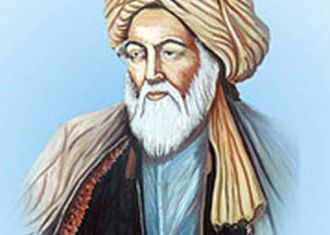
Nasir Khusraw (1004- ca.1077) was born in Qobadiyan in the eastern Iranian province of Khurasan. He did well at school, learning Persian and Arabic as well as sciences, literature, mathematics, philosophy, religious sciences, and history. Following his family’s tradition, Nasir joined the government bureaucracy in a financial capacity, perhaps as tax collector. Nasir enjoyed to travel and “relished the opportunity to see new places and admire the accomplishments of the human hand and mind. In his travels, he turned his keen eye towards both the physical and administrative structures put in place by each society, such as city walls, irrigation canals and road surfaces in one, and taxation conditions, employment practices and shop rental policies in another” (Hunsberger, The Ruby of Badakhshan p 5).
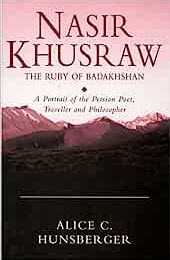
“But, for Nasir Khusraw a more urgent current ran under such delights of the world, namely his aching desire to have some purpose, some answer to the question of why all this exists” (Ibid). At the age of about forty, Nasir experienced a restlessness, a spiritual upheaval, that he describes in his Safarnama (‘Travelogue’) as “a powerful dream that shocked him out of his ‘forty years’ sleep’.
The poet reports that he began his consciously organised search for wisdom … a search which involved reading books and listening to those who were learned in an array of fields, including both physics and metaphysics…. But all his questioning of the learned men in the major schools of Islamic thought proves fruitless” (Ibid. p 56). Nasir Khusraw was particularly troubled by the ‘verse of the oath’ (Q 48:10):
“Once I happened to read in the Qur’an the ‘verse of oath,’
The verse in which God said that His hand was stretched above,
Those people who swore allegiance ‘under the tree’
… I asked a question from myself, what happened to that tree, that hand;
Where can I now find that hand, that oath, that place?
The answer to this was only ‘There is now neither the tree, nor that hand;
That “hand” has been scattered, the assembly has dispersed.
[…]
how has it come about that today there is neither that hand nor those men?
The word of God, surely, cannot turn out to be untrue.
Whose hand should we touch when swearing allegiance to God?
Or should not (divine) justice treat equally those who came first and those who came later?
Was it our fault that we were not born at that time?
Why should we be deprived of personal contact with the Prophet, thus being (unjustly) punished?”
(Ibid. p 56-58).
The verse “seems to give special status to those who lived at the time of Prophet Muhammad, those who were able to personally give their allegiance to God and His Prophet. This refers to a specific historical event in the early years of the Prophet’s ministry. Six years after the migration from Mecca to Medina (the hijra), the Prophet and a number of his followers gathered under a tree in a place called Hudaybiyya. When the Prophet asked for the allegiance of his followers, they all placed their hands on the Prophet’s hand according to the Arab custom, thus demonstrating their fealty. That God accepted their oath is evident in the words ‘God’s hand is over their hands.’
For Nasir Khusraw, this stretching out of God’s hand must occur in timeless time as well. God must be eternally stretching out His hand for those who pledge their fealty to Him. It is incomprehensible to him that at any point in history God would pull back His Hand. For him it is inconceivable that this oath is not still being demanded of believers of God … For, to those under the tree at Hudaybiyya, God promised Paradise. So if there is no such tree now, no person to whom to give allegiance with outstretched hand, then presumably there is no Paradise for those who came after that moment in time” (Ibid. p 56-57).
Nasir’s “searching and inner discontent lasted until it all came together in the conviction that the answers to these ultimate questions could be found in the doctrines of the Ismaili Shi’i faith” (Ibid. p 5). “According to Nasir, there must always be someone at whose hand the covenant of God could be pledged. This, he decided, was the Imam descended from the Prophet’s family, al-Mustansir [Fatimid Caliph] of Cairo , the sovereign of a mighty empire” (Virani, The Ismailis in the Middle Ages p 135).
The Shi’a
The Shi’a believed that “the Islamic message contained inner truths that could not be understood through human reason and therefore, the successor was also responsible to explain the message of Islam. A person with such qualifications, according to the Shi’a, could belong only to the Prophet’s family (ahl al-bayt), ‘whose members alone could provide the legitimate channel for explaining and interpreting the teachings of Islam. The Shi’a emphasised the importance of the Imam’s kinship to the Prophet as prerequisites for possessing the required religious knowledge (‘ilm) and authority…the Shi’a also held that after Ali the leadership of the Muslim community was the exclusive prerogative of Alid, descendants of Ali belonging to the ahl al-bayt” (Daftary, A Short History of Ismailis p 24).
[Ismailis are the only Shia community who, throughout history, have been led by a living, hereditary Imam in direct descent from the Prophet. More about the Shi’a here).
Nasir Khusraw in Fatimid Cairo
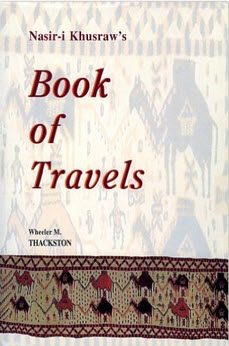
Nasir Khusraw resigned from his job and on March 5, 1046,1 set off on a journey to Mecca, keeping a detailed record of his travels in his Safarnama. In August 1047,2 he arrived in Cairo, the capital of the Fatimids and the heart of Ismaili power and intellectual life, where he stayed for three years. He studied Ismaili doctrines with leading scholars, including al-Mu’ayyad a-Shirazi (d. 1078), whom he credits for his conversion to Ismailism.
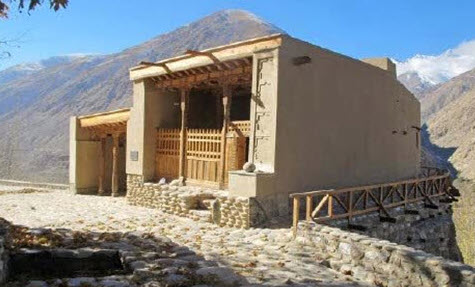
Returning home as head of the Ismaili administration of his province, Nasir’s successes endangered his life, causing him to flee from his native land to Yumgan in the mountainous region of Badakshan, to the court of an Ismaili prince, where he stayed for the remainder of his life, composing his numerous works.
The Ismailis of Badakshan (now divided between Tajikistan and Afghanistan) along with communities in Hunza and other northern areas of Pakistan, as well as in the Sinkiang (Xinjiang) region of China, regard Nasir Khusraw as the founder of their communities. A literary tradition based on his writings sustained the Ismaili community of Central Asia in their faith in the areas under the Soviet system, when they were not permitted to practise their faith, and did not have direct contact with the Imam of the time or with other Ismaili communities.
As head of the Ismaili da’wa, Nasir produced a number of works on Ismaili doctrines including Wajh-i din (The Face of Religion), which is considered “the most explicit in terms of religious instruction, offering a full explanation of Islamic commandments and duties and their esoteric meaning or ta’wil (Hunzai, Pearls of Persia p12).
The main corpus of his poetry is collected in the Diwan, comprising poetry in the qasida form relating to a wide range of ethical, theological, and philosophical themes. Hunsberger notes that the main purpose of Nasir Khusraw’s poetry is “to open the reader or listener’s inner eye to universal truths and thereby save their souls from the Hell of ignorance” (The Ruby of Badakshan, p xvii). Forty poems were translated by P. L. Wilson and G. R. Aavani in 1977 and in 1993, Annemarie Schimmel translated and discussed key themes in selected verses.
A rare copy of the Diwan was gifted to Mawlana Hazar Imam during his Diamond Jubilee visit to western Canada in May 2018.

Further Reading and Video: The Concept of Knowledge in Nasir-i Khusraw’s Philosophy at Ismaili Gnosis
Sources:
1Alice C. Hunsberger, Nasir Khusraw, The Ruby of Badakhshan, I.B. Tauris in association with The Institute of Ismaili Studies, London, 2000 p 92
2The Institute of Ismaili Studies Secondary Curriculum Muslim Societies and Civilisations Vol. 2 p 245
Faquir Muhammad Hunzai, “The Position of ‘Aql in the Prose and Poetry of Nasir-i Khusraw,” Pearls of Persia, Edited by Alice C. Hunsberger I.B. Tauris in association with The Institute of Ismaili Studies, London, 2012
Farhad Daftary, The Isma’ilis Their history and doctrines, Cambridge University Press, 1990
Shafique N. Virani, The Ismailis in the Middle Ages, Oxford University Press, 2007
Contributed by Nimira Dewji, who also has her own blog – Nimirasblog – where she writes short articles on Ismaili history and Muslim civilisations. When not researching and writing, Nimira volunteers at a shelter for the unhoused, and at a women’s shelter. She can be reached at nimirasblog@gmail.com
 Ismailimail
Khasraw developed a way with words in writing Book of Travels that made this a far more compelling read than I expected.
LikeLike