Source: Literary Hub By Theodore McCombs
WHAT WE CAN LEARN FROM THE CONFERENCE OF THE BIRDS
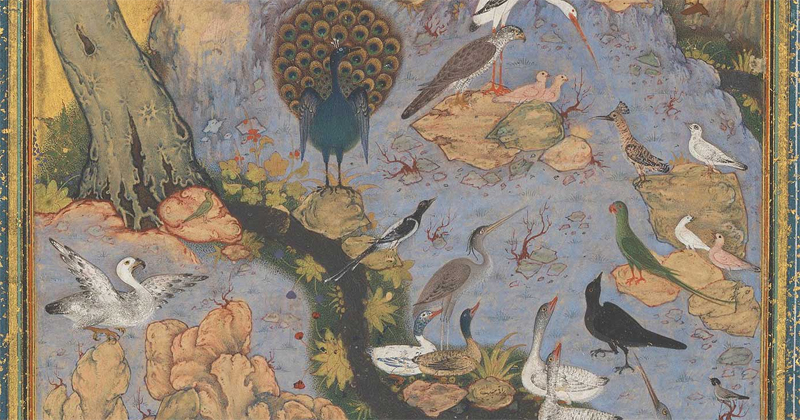 “That anyone has ever been able to surpass one of the great figures of the Divine Comedy seems incredible, and rightly so,” wrote Jorge Luis Borges, in his Nine Essays on Dante; “nevertheless, the feat has occurred.” Borges was speaking of the medieval Iranian poet Attar’s allegorical epic, Manteq al-Tayr, or The Conference of the Birds, and the magnificent image that caps the poem, of the mythical bird-deity of Persian literature, the Simorgh. Writers from Rumi to Borges to Porochista Khakpour have drawn on Attar and his sublime Simorgh, a vision of coherence in a divided world. Over eight centuries later, and with an exciting new translation released, by Iranian-American poet Sholeh Wolpé, Attar’s Simorgh still speaks to our moment of change and challenge: a moving and unsettling ideal from a very different, but very relevant time and place.
Farīd Ud-Dīn Attar, a pharmacist and poet in 12th-century Nishapur, Iran, composed The Conference of the Birds as a Sufi allegory for the soul’s journey to the Divine, with the Simorgh cast as the great king of the birds of the world.
Read more – Dated: May 24, 2017


