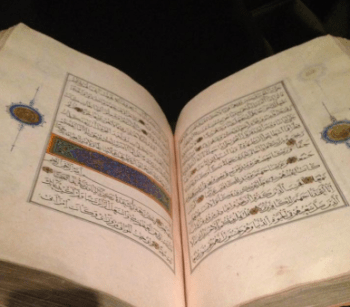
 The first major Quran exhibition in the United States opened its doors in Washington, D.C., this weekend, at the Smithsonian Institution’s Arthur M. Sackler Gallery of Art. The exhibit, entitled “The Art of the Qur’an: Treasures from the Museum of Turkish and Islamic Arts,” goes on display at a timely moment, amid the lively political debate over the nature and place of Islam in the United States.
[…] The Quran itself was originally copied in Cairo, Egypt, during the Fatimid period (909-1171 CE) in 1028, when the Ismaili Shia Fatimid dynasty was preeminent throughout much of the Islamic world. According to the Smithsonian Institution:
…as a symbol of Fatimid religious authority and political power, Caliph al-Mustansir bi’llah presented this manuscript to Ali al-Sulayhi, the Yemeni ruler of the Sulayhids (1047–1138). The exchange likely took place in 1062, when al-Sulayhi pledged religious and political allegiance to the Fatimid caliph. After that, the lucrative trade routes of the Red Sea and Indian Ocean, which the Sulayhids controlled, became integrated within the larger Fatimid sultanate.
Source: By Akhilesh Pillalamarri, October 25, 2016 – The Diplomat

 Ismailimail