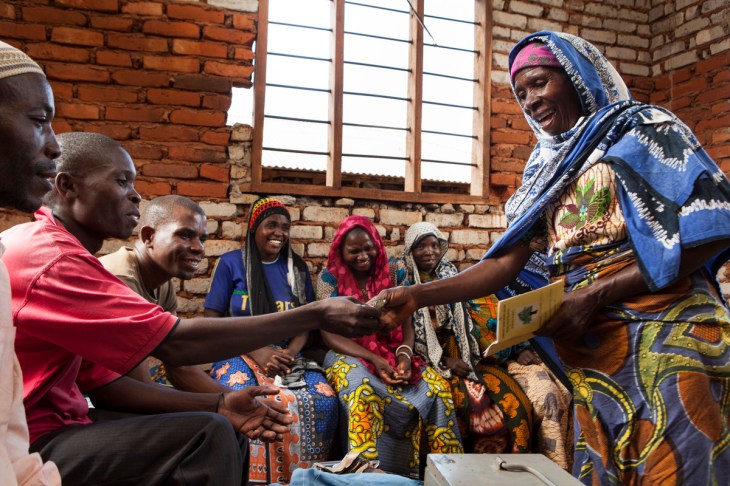
In the Lindi region of southern Tanzania, for example — where I worked as a research analyst for the Aga Khan Foundation last year — a group of Muslim women have gathered every week for the past six years to perform the simple act of saving together, taking loans from each other with interest and sharing in the profits.
In collaboration with the government of Tanzania, under its MKUKUTA poverty alleviation programme, the Coastal Rural Support Programme in Tanzania, or CRSP(T), takes a market development approach to support rural livelihoods and improve the quality of life through increased rural income. Pictured is a Community-based Savings Groups (CBSGs) in Kirangerange, Tanzania. AKDN / Lucas Cuervo Moura
The money they received helped them to buy food during the lean season before the harvest, set up small businesses, renovate their houses, and send their children to school.
They also have a social fund to which each member contributes so that they can get an interest-free grant to cover emergency medical and funeral expenses.
– Manini Sheker, award winning journalist
Can religion be a positive force for social change?
MANINI SHEKER 5 July 2016
Faith is neither a poison pill nor a silver bullet, but understanding its significance is crucial.
In February 2014 the Guardian joined forces with Mama Cash and the Association for Women’s Rights in Development (AWID) to focus on exploring the issues that are most important to women, girls and transgendered people across the world. While the resulting series brought into focus important work to advance women’s rights and gender equality, it failed to consider one fundamental aspect of women’s lives — religion. In fact the lack of coverage of religion as a positive force for social change is pervasive among most news outlets.
Perhaps this negligence is pardonable: after all, religion plays an important role in driving conflict, and various forms of religious oppression can and do have a corrosive impact on women’s rights and freedoms. But this neglect also hampers our understanding of the ways in which religion and spirituality can be a powerful force for personal and political transformation. From the mass mobilization of Christian women to end fourteen years of civil war in Liberia to the founding of Islam-inspired grassroots organizations to advance women’s empowerment and civic dialogue in Bosnia-Herzegovina, faith-inspired movements are playing a critical role in safeguarding women’s rights.
Manini Sheker is a PhD candidate in social anthropology at the University of Sussex. She holds degrees from the Universities of Oxford and Toronto and in 2011 was a finalist in the Guardian’s International Development Journalism competition. Manini was also awarded the Ngo Human Welfare Prize by Oxford University in 2013. Follow her on twitter @ManiniSheker.