The Timurids were a dynasty of Central Asian nomadic origin that dominated the Middle East and Central Asia in the fourteenth and fifteenth centuries. The founder of the dynasty, Timur Leng, took Samarkand from the Mongols in 1369 and established his capital there. He brought the most gifted builders of the time to the city, making Samarkand dazzle with the splendour of its magnificent buildings, fusing different artistic traditions to create a new international architectural style, initiating one of the most brilliant periods in Islamic art. The grand scale of Timur’s building projects with architectural complexes created a permanent impact on the form of Samarkand for centuries to come.
The Timurid architectural style influenced the development of later Islamic architecture, particularly the Safavids (ruled Persia 1501–1732), and the Mughals (ruled the Indian Subcontinent from 1526–1858). Under the reign of Timur’s grandson Ulugh Beg, who was a mathematician and an astronomer, Samarkand developed into a prominent cultural centre attracting scholars and craftsmen from all over Asia. In 1417, he founded and developed the central Registan, literally the “place of sand,” with a complex of religious buildings and caravanserais. Only his principle madrasa survives to this day.

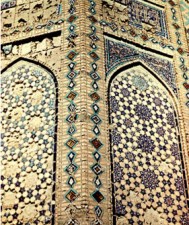
The most striking characteristics of Timurid architecture are the rich turquoise glaze of the tiles and the large scale geometric patterns that covered wide areas of walls like a carpet.
In 1992, the awards for the Aga Khan Award for Architecture were presented in Registan Square. The Aga Khan Trust for Culture was also involved with the authorities in Samarkand to revitalize the Timurid city, which is a World Heritage Site.
Sources:
Sergej Chmelnizkij. “Characteristics of Timurid Architecture,” Islam: Art and Architecture Edited by Markus Hattstein and Peter Delius. Konemann Cologne, 2000
Suzan Yalman, The Art of the Timurid Period (ca. 1370–1507), in Heilbrunn Timeline of Art History. New York: The Metropolitan Museum of Art
The Timurids and the Turkmen, The David Collection
Compiled by Nimira Dewji
 Ismailimail