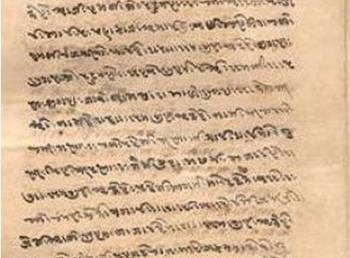
Ginans are poetic compositions which have been a central part of the religious life of the Nizari Ismaili community of the Indian subcontinent that today resides in many countries around the world. The term ginan is derived from the Sanskrit jnan, translated as ‘knowledge’ or ‘wisdom.’
Ginans served as secondary texts in the local languages to convey the teachings of the Qur’an and the esoteric Ismaili interpretation to non-Arabic speaking peoples. They were composed by Pirs and Saiyads, or preachers, who came to the Indian subcontinent as early as the eleventh century. Saiyads were distinguished from Pirs, a title which was interpreted as indicating formal appointment by the Imam. Most of the seventeen Saiyads who authored Ginans were descended from Pir Hasan Kabirdin’s son Imamshah or his other children.
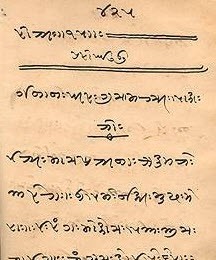
Ginans were composed from the thirteenth to the nineteenth centuries, by about thirty da’is, at a time when the written literary tradition was flourishing in the Indian subcontinent, with well-known figures such as Narasimha Maeta (15th century), Mirabai (1498-1557), and Narhari (17th century), Kabir (1440-1518), and Guru Nanak (1469-1539). Composition of devotional and mystical poetry among Muslims, especially the Sufis, was also developing at this time.
The language of the Ginans is mixed; its vocabulary is derived from Arabic and Persian, as well as Sanskrit and languages descended from it (mainly Gujarati). Ginans are distinguished not by their content, but by the melody (raga) and the names of the accepted author that appears in the last verse of every Ginan, similar to the rasa, a prevalent medium in Gujarat from the twelfth century on. The rasa, which was recited to a raga, was a frequently used medium for religious instruction and to express specific emotional feelings; each composition always ended with the name of the composer and with prayers for forgiveness.
Ginans are meant to be sung, therefore, music is an important characteristic of Ginans and vital for invoking specific emotional states; many manuscripts indicate their connection to rituals such as before daily prayer or at funerals.
Very popular in the Gujarati folk life is the garbi, a folk dance, with the word applied to the song as well as the singing party itself. The individuals move around in a circle and sing to the accompaniment of a rhythmical clap of hands and feet. Pir Shams composed twenty-eight Garbis.
Sources:
Azim Nanji, The Nizari Isma’ili Tradition in the Indo-Pakistan Subcontinent, Caravan Books, New York, 1978
Aziz Esmail, A Scent of Sandalwood: Indo-Ismaili Religious Lyrics. London: Curzon in association with The Institute of Ismaili Studies, 2002
Ginans, A Tradition of Religious Poetry, The Institute of Ismaili Studies (accessed December 2015)
Compiled by Nimira Dewji
 Ismailimail
Pir Shamas, who had long hairs, used to deliver his compositions (Ginans and Garbis) on the crossing of streets, dancing and singing. He started his work in 13th century. Can we call him “Pioneer”?
LikeLike