Finally, let me mention one other point of profound connection that we should ponder, and that is the connection across cultures. Think for example, of those who designed this complex. On one side, looking at the Museum, we see the work of a Japanese master. On the other side, looking at the Centre, we see the work of an Indian architectural giant. And in between we recognize the masterpiece of a young landscape artist of Lebanese descent.
– His Highness the Aga Khan at the Inauguration of the Aga Khan Park, Toronto, 25 May 2015.
In Pictures: Charles Correa’s Legacy

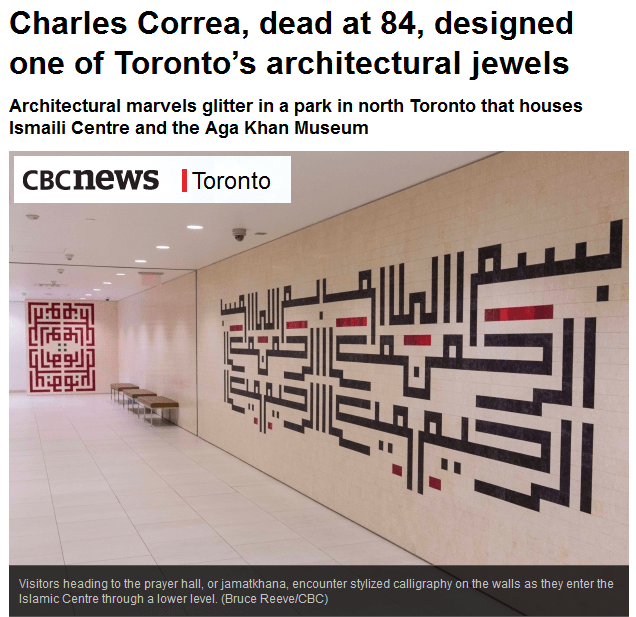
Charles Correa: The inclusive line
The architect’s were lines that included the city, the passer by, the sea and the sky, never isolated them.
Read here at www.dailyo.in/arts/charles-correa
I became an architect because of toy trains: An essay by Charles Correa
BBC: India architect Charles Correa dies
Architect Charles Correa dies at 84 – The Times of India
Charles Correa, India’s ‘Greatest Architect’, Dies at 84 – NDTV
Charles Correa, face of contemporary architecture in India, dies – Hindustan Times
Charles Correa, considered one of India’s greatest architects, was a founding member of the Aga Khan Award for Architecture
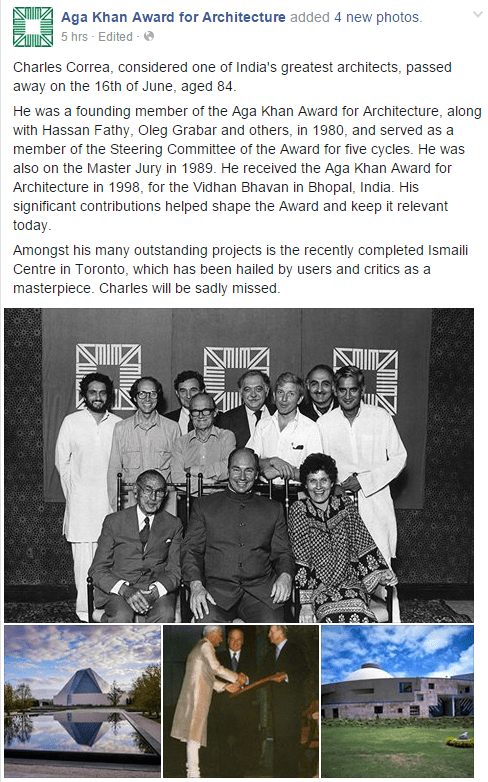
Uncube Magazine dedicates an issue to Charles Correa and his work in 2013, including a major interview.
Click here to read www.uncubemagazine.com

Aga Khan Award for Architecture’s Introduction:
CHARLES CORREA is an Indian architect, planner, activist, and theoretician who studied architecture at the Massachusetts Institute of Technology (MIT) and the University of Michigan. He has taught and lectured at many universities, both in India and abroad, including MIT, Harvard University, the University of London, and Cambridge University, where he was Nehru Professor. Mr. Correa is known for the wide range of his architectural work in India and on urbanisation and low-cost shelter in the Third World, which he articulated in his 1985 publication, The New Landscape. His architectural designs have been internationally acclaimed and he has received many awards including the Royal Institute of British Architects Gold Medal (1984), the Indian Institute of Architects Gold Medal (1987), the International Union of Architects Gold Medal (1990), and the Praemium Imperiale for Architecture from the Japan Art Association (1994). Professor Correa was a member of the 1980, 1983, 1986, and 2001 Award Steering Committees, and of the 1989 Award Master Jury. He was presented an Aga Khan Award for Architecture during the 1998 cycle as the architect of Vidhan Bhavan in Bhopal, India.
ArchNet’s Tribute

Standing tall: Charles Correa’s ICONIC buildings – www.rediff.com
Not just another brick in the wall
Tribute HARESH PANDYA Outlook India: Charles Correa, India’s Best Known Architect
Charles Correa – Ismailimail Archive
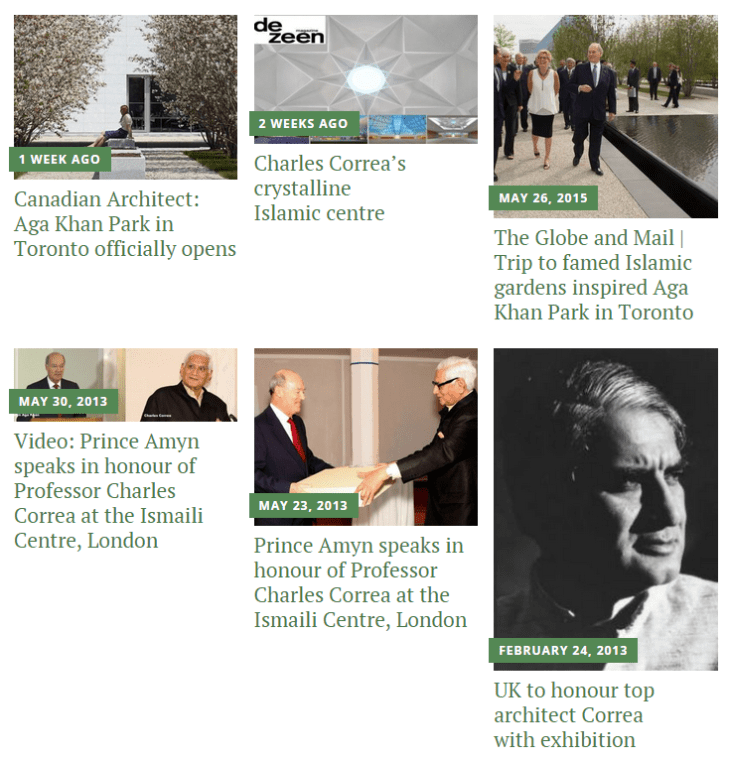

 Ismailimail
The world will miss an architect of his caliber. When the Aga Khan selects professionals to work with him, he selects from the best that is to found in this world and Charles Correa fits that criteria. He served his calling well and now may Allah rest his soul in peace.
LikeLike