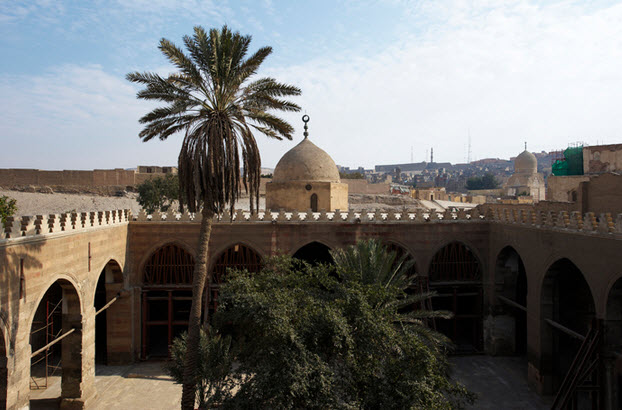
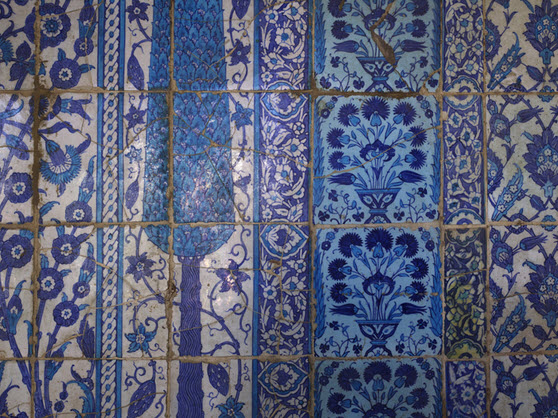
The Aqsunqar Mosque in Cairo was built in 1347 by Amir Aqsunqur, governor of Tripoli and Syria (1294-1314). The mosque is an early Mamluk religious architecture, associating a mausoleum and a mosque with a large courtyard for prayer. In 1652, the Ottoman ruler, Amir Ibrahim Agha Mustafazan, initiated a restoration campaign of the mosque that had fallen into decay, and re-decorated the interior with the vivid blue floral-patterned Iznik tiles that gave the mosque its popular name.
The complex comprises three architectural styles marking the intervention of three significant patrons: Sultan Kujuk for whom the original mausoleum was built; Ami Aqsunqur, who developed the courtyard mosque and had his mausoleum built on the south; and Ibrahim Agha Mustafazan, who renovated the mosque and added his mausoleum.
In 1992, a major earthquake damaged many of Cairo’s monuments including the Aqsunqar Mosque, which was subsequently closed due to its unsafe structure. The conservation of this project, co-funded by the World Monuments Fund and the Aga Khan Trust for Culture, was begun in June 2009 and completed at the end of 2012. As part of Al-Darb al-Ahmar urban regeneration project, the restoration was managed and coordinated by the Aga Khan Cultural Services-Egypt, the local agency of the Aga Khan Trust for Culture in coordination with the Supreme Council of Antiquities. The restored Mosque was inaugurated by Mawlana Hazar Imam on May 2, 2015.
References:
Amir Aqsunqur Funerary Complex, Archnet
World Monuments Fund
Research by Nimira Dewji

