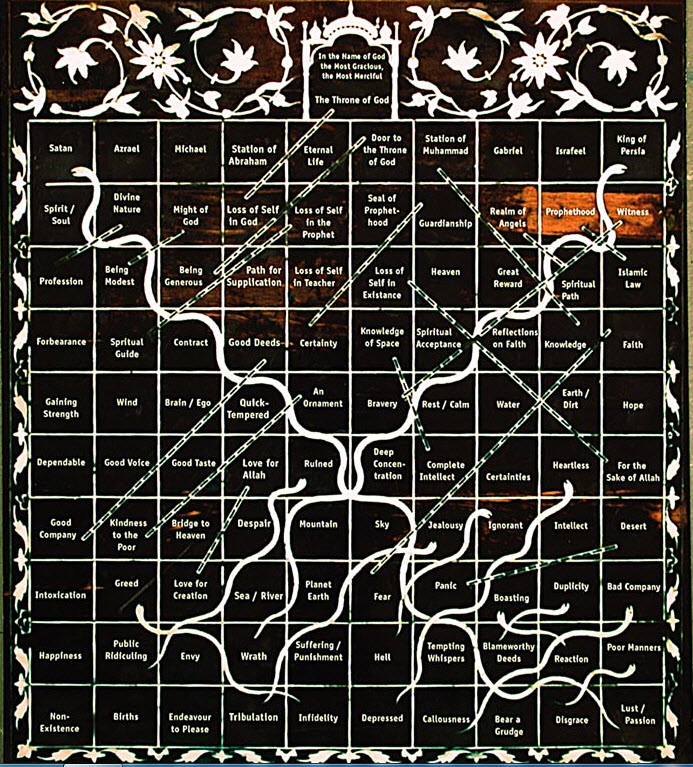
The Game of Knowledge, teaches the players about Islam.
The players embark on journeys during which they will learn that the upward path of the spiritual seeker is a gradual one.
The goal is to reach the top central square – Heaven.
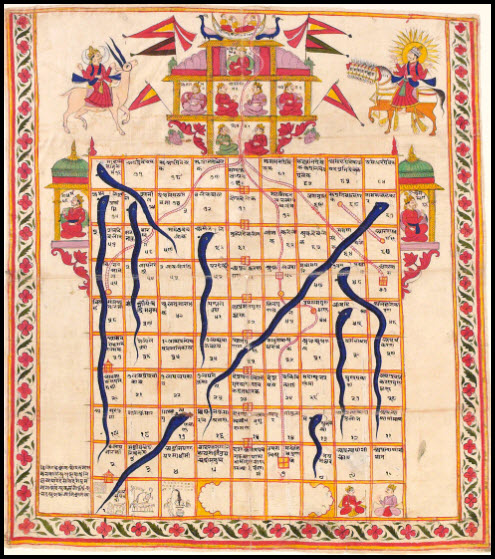
The popular board game Snakes & Ladders is believed to have originated in India in the second century, and may have been based on the ancient game of dasapada – dasa a Sanskrit word meaning ten – and was played on a board of 10×10 squares. The Jains called their version gyanbazi or gyanbaji which means Game of Knowledge.
The game was played widely in India by the name of Moksha Patamu which aimed to teach morality based on Hinduism. The board was covered with symbolism: the top featured gods, angels, and majestic beings while the remainder of the board was covered with pictures of animals, flowers, and people. The ladders represented virtues such as generosity, faith, and humility, while the snakes represented vices such as lust, anger, murder, and theft. The lesson of the game was that a person can attain salvation (moksha) through good deeds, whereas by doing evil one will inherit rebirth to lower forms of life.
There were more snakes than ladders on the board as a reminder that a path of good is much more difficult to tread than a path of evil and sins. The players attained moksha by reaching the last square (number 100). There were many versions of the game, each based on different belief systems.
The game was introduced in England in 1892, possibly by John Jaques to reinforce the largely Protestant tradition of edifying morality games based on rewarding virtues and punishing vices; they named it Snakes and Ladder. The inscriptions included the virtues of penitence, kindness, and pity and the vices included dishonesty, cruelty, and slander. Milton Bradley introduced the game into the United States as Chutes and Ladders. By the early 1900s, the inscriptions had disappeared and the playing area became a simple numbered track.
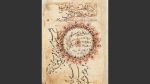
The Muslim version, also known as the Game of Knowledge, teaches the players about Islam. “The meanings of the individual words on the board are often debated because they were written over a century ago, and what might appear apparent today may, in fact, have been interpreted differently at the time of writing.”*
The players embark on journeys during which they will learn that the upward path of the spiritual seeker is a gradual one. The game starts at the left of the bottom row on the square inscribed ‘Adam’, and continues across each successive row to the top row inscribed with the names of the archangels. Each square is inscribed with a description of one hundred different states of humans. As the players proceed from lower to higher squares, more advanced spiritual states are encountered. The goal is to reach the top central square – Heaven.
References:
*The Spirit of Islam, exhibited at the Museum of Anthropology, University of British Columbia
Elliott Avedon Virtual Museum of Games, University of Waterloo
Research by Nimira Dewji
 Be the First to Know – Join Ismailimail
Get breaking news related to the Ismaili Imamat, the world wide Ismaili Muslim community and all their creativity, endeavors and successes.
Inspired? Share the story
Want to inspire? Send your stories to us at Ismailimail@gmail.com
Subscribe and join 19,000 + other individuals – Subscribe now!
Earlier & Related – Nimira Dewji at Ismailimail Archives:
- Mawlana Shah Karim: “The relationship between the Imam and his Jamat is a deep and continuing bond”
- Mawlana Hazar Imam was gifted manuscripts on architecture of Andalusia, a Knowledge Society of its time
- Mawlana Hazar Imam Designates Ismaili Center Houston as Darkhana for US Jamat, the ninth Darkhana
- Imam Hasan ala dhikrihi’l-salam appointed Sinan as his deputy in Syria
- The arts of the Fatimids, Mawlana Hazar Imam’s ancestors, continue to inspire
- Rumi: “The light that lights the heart is the Light of God”
- Pir Sabzali: “Hearing the farman, their eyes brimmed over with tears of joy”
- Al-Tusi: “The ‘nass’ is not in order to make him an Imam; it is … so that people should recognise him as such”
- Mawlana Hazar Imam Aga Khan V: “The Shia Ismaili Muslim community, of which I am the Imam, has been established in Syria for more than 1,000 years”
- Mughal Emperor Akbar’s pluralism is evidenced by an inscription of Hazrat Isa’s teaching on his “Victory Gate”











![[Music in Islam] Is listening to music unlawful?](https://ismailimail.blog/wp-content/uploads/2014/08/music-in-islam.jpg?w=150)

 Ismailimail
Reblogged this on Zahra's Blog.
LikeLike