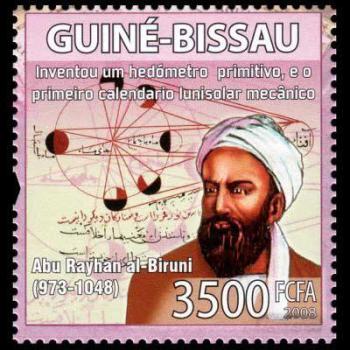
Al-Biruni, was born in 973 in Khwarizm, Uzbekistan. His father, a distinguished mathematician and astronomer, introduced him to astronomy and geometry at a young age. He subsequently studied the astronomy of the stars, classified the celestial bodies (planets and fixed stars) by order of magnitude, and observed the stars’ apparent motions around the poles; his list included 1,029 stars. Having constructed a globe of the earth, the first in Central Asia, Al-Biruni was the first to arrive at a simple formula for measuring the earth’s circumference proposing the heliocentric model – that the earth revolved around the sun. His works discussed the then debatable theory of the earth’s rotation on its axis and made accurate determination of longitudes and latitudes.
Al-Biruni’s extensive travels took him to India where he studied Sanskrit, Hinduism, and Indian sciences and culture. He produced some of the greatest works in Islamic science such as his masterpiece, the Masu’udic Canon, and historical works such as the Chronology of Ancient Nations, which is devoted to a universal anthropological account of various cultures. The Chronology of Ancient Nations is partly historical and partly an ethnographic study that retains its full significance to this day. He was also the founder of the discipline of comparative religion as shown in his work India, written in 1051.
Al-Biruni also earned the title of father of Arabic pharmacy for his work in pharmacy, which he distinguished as a separate discipline from medicine. In his last work, Pharmacology, he classified the physical features of plants, animals and minerals, and compiled an alphabetical list of medicinal herbs and their uses.
A famed map maker, meteorologist, physicist, philosopher, and historian, Al-Biruni holds the distinction of being one of the greatest mathematicians and historians of humanity. He died in 1048 having written more than 150 works in various fields. Al-Biruni had a vast impact on science in the East and was known as a symbol of learning in the eleventh century.
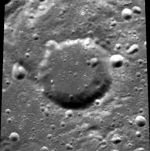
A lunar crater is named after Al-Biruni. To view the location of this crater, visit http://planetarynames.wr.usgs.gov/Feature/146.
Commemorative stamps issued marking a millennium of Al-Biruni’s scientific contributions


Reference:
“Al Biruni”, The UNESCO Courier, June 1974
Research by Nimira Dewji
Earlier & Related:
 Be the First to Know – Join Ismailimail
Get breaking news related to the Ismaili Imamat, the world wide Ismaili Muslim community and all their creativity, endeavors and successes.
Inspired? Share the story
Want to inspire? Send your stories to us at Ismailimail@gmail.com
Subscribe and join 19,000 + other individuals – Subscribe now!
Earlier & Related – Nimira Dewji at Ismailimail Archives:
- Mawlana Shah Karim: “The relationship between the Imam and his Jamat is a deep and continuing bond”
- Mawlana Hazar Imam was gifted manuscripts on architecture of Andalusia, a Knowledge Society of its time
- Mawlana Hazar Imam Designates Ismaili Center Houston as Darkhana for US Jamat, the ninth Darkhana
- Imam Hasan ala dhikrihi’l-salam appointed Sinan as his deputy in Syria
- The arts of the Fatimids, Mawlana Hazar Imam’s ancestors, continue to inspire
- Rumi: “The light that lights the heart is the Light of God”
- Pir Sabzali: “Hearing the farman, their eyes brimmed over with tears of joy”
- Al-Tusi: “The ‘nass’ is not in order to make him an Imam; it is … so that people should recognise him as such”
- Mawlana Hazar Imam Aga Khan V: “The Shia Ismaili Muslim community, of which I am the Imam, has been established in Syria for more than 1,000 years”
- Mughal Emperor Akbar’s pluralism is evidenced by an inscription of Hazrat Isa’s teaching on his “Victory Gate”
- Moment in Time | 1 January 1931 – Ivanow, the pioneer of Ismaili Studies, began to work for Sir Sultan Muhammad Shah Aga Khan III
- Imam Hasan Ali Shah Aga Khan I’s migration to the Indian subcontinent initiated the modern phase of Nizari Ismaili history
- Ibn al-Haytham, a pioneer of modern optics, influenced Renaissance art and architecture
- Fabricated tales based on fear and ignorance instigated hostility towards the Nizari Ismailis (2/2)
- Fabricated tales based on fear and ignorance instigated hostility towards the Nizari Ismailis (1/2)






![[Music in Islam] Is listening to music unlawful?](https://ismailimail.blog/wp-content/uploads/2014/08/music-in-islam.jpg?w=150)



 Ismailimail