”In legend and in reality Samarqand is a source of inspiration to those who love good buildings and great cities.
Your city has given to all the world the remarkable legacy of the Timurid expansion.
The two generations of inspired building by Timur and his grandson, Ulugh Beg, have shown us how determined patronage and the skills of different schools and practice can be brought together to create great architecture.”
– His Highness the Aga Khan
Registan Square, Samarqand, Uzbekistan September 19th, 1992
Samarqand lies in a vast oasis in southeastern Uzbekistan. The valley was the region’s heartland and attracted many inhabitants dating back to the first millennium BC, making Samarkand one of the earliest centres of civilization in Central Asia.
In the fourteenth century, the city experienced a period of growth and splendour as the capital of the Timurid Empire. Timur took Samarqand from the Mongols in 1369, and established his capital there, making Samarqand dazzle with the splendour of its magnificent buildings. He brought the most gifted builders of the time to the city, fusing different artistic schools and traditions to create a new international style – now known as the Timurid style of architecture. This architecture style influenced the development of later Islamic architecture, particularly the Safavids of Iran and the Mughals in India. Under the reign of Timur’s grandson Ulugh Beg, who was a mathematician and an astronomer, Samarqand developed into a great cultural centre attracting scholars and craftsmen from all over Asia. Ulugh Beg’s school of astronomy and observatory were famous throughout Central Asia and beyond. In 1417, he founded and developed the central Registan, literally the “place of sand,” with a complex of religious buildings and caravanserais. Only his principle madrasa survives to this day. Despite the frequent dynastic changes, Samarqand never lost its prestige and religious significance among the country’s inhabitants.
In 1992, the fifth awards of the Aga Khan Award for Architecture were presented in Registan Square. The Aga Khan Trust for Culture was also involved with the authorities in Samarkand to revitalize the Timurid city, which is a World Heritage Site.
*A Muslim dynasty, founded by Timur Lang (Tamerlane,) which ruled Persia and Transoxiana (1370–1507). Transoxiana included present-day Uzbekistan and parts of Turkmenistan, Tajikistan, and Kazakhstan.
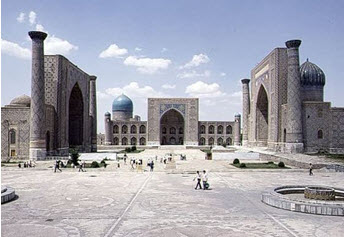
 In the fourteenth century, the city experienced a period of growth and splendour as the capital of the Timurid Empire. Timur took Samarqand from the Mongols in 1369, and established his capital there, making Samarqand dazzle with the splendour of its magnificent buildings. He brought the most gifted builders of the time to the city, fusing different artistic schools and traditions to create a new international style – now known as the Timurid style of architecture. This architecture style influenced the development of later Islamic architecture, particularly the Safavids of Iran and the Mughals in India. Under the reign of Timur’s grandson Ulugh Beg, who was a mathematician and an astronomer, Samarqand developed into a great cultural centre attracting scholars and craftsmen from all over Asia. Ulugh Beg’s school of astronomy and observatory were famous throughout Central Asia and beyond. In 1417, he founded and developed the central Registan, literally the “place of sand,” with a complex of religious buildings and caravanserais. Only his principle madrasa survives to this day. Despite the frequent dynastic changes, Samarqand never lost its prestige and religious significance among the country’s inhabitants.
 Be the First to Know – Join Ismailimail





![[Music in Islam] Is listening to music unlawful?](https://ismailimail.blog/wp-content/uploads/2014/08/music-in-islam.jpg?w=150)


 Ismailimail