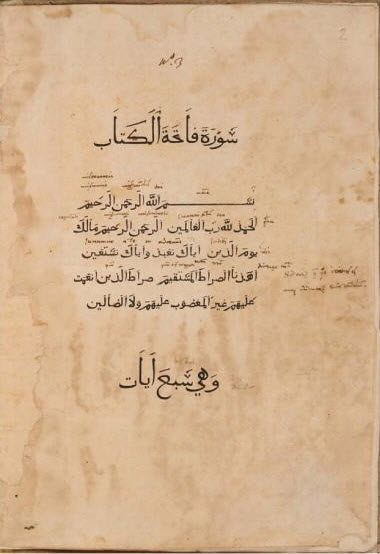
Image: Edinburgh University Press
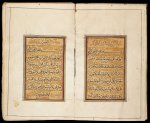
Calligraphy was considered the supreme art, the one valued most highly in Islamic culture. The sacredness of the Qur’an led to its transcription in a beautiful hand, and this sanctity explains why handwritten copies remained popular and why printed editions of the Qur’an were so slow to be accepted.
While translations of the Qur’an into Slavic, Belorussian, and Polish languages were undertaken from the fifteenth to the seventeenth centuries, the first copies were printed by the Venetian brothers Paganino and Alessandro Paganini in 1537-8. It seems they were printed as a private edition and probably intended for Christian monasteries. All copies of the Paganini edition were thought to have perished until the 1980s when a single remaining copy was discovered in the library of the Frati Minori di San Michele ad Isola in Venice.
The first copies of the Qur’an were printed by Muslims two hundred and fifty years later in St. Petersburg in Russia, at the request of Catherine the Great (Empress of Russia from 1762-1796), through a specially prepared script by one of the best calligraphers; this edition was printed several times in St. Petersburg until 1798. It is estimated that from 1803 to 1859, one hundred and fifty thousand copies of the Qu’ran were printed; many of these copies were carried by merchants to various parts of the world.
The Qu’ran was printed on a large scale in Cairo in 1923-4.
References:
Sheila S. Blair, Islamic Calligraphy, Edinburgh University Press, 2006
Edinburgh University Press
Research by Nimira Dewji
 Be the First to Know – Join Ismailimail
Get breaking news related to the Ismaili Imamat, the world wide Ismaili Muslim community and all their creativity, endeavors and successes.
Inspired? Share the story
Want to inspire? Send your stories to us at Ismailimail@gmail.com
Subscribe and join 18,000 + other individuals – Subscribe now!
Earlier & Related – Nimira Dewji at Ismailimail Archives:
- Mawlana Shah Karim: “The relationship between the Imam and his Jamat is a deep and continuing bond”
- Mawlana Hazar Imam was gifted manuscripts on architecture of Andalusia, a Knowledge Society of its time
- Mawlana Hazar Imam Designates Ismaili Center Houston as Darkhana for US Jamat, the ninth Darkhana
- Imam Hasan ala dhikrihi’l-salam appointed Sinan as his deputy in Syria
- The arts of the Fatimids, Mawlana Hazar Imam’s ancestors, continue to inspire






![[Music in Islam] Is listening to music unlawful?](https://ismailimail.blog/wp-content/uploads/2014/08/music-in-islam.jpg?w=150)



 Ismailimail