The permanent gallery will house some 1,000 pieces of art belonging to the Aga Khan and his family, including portraits, textiles, miniatures, manuscripts, ceramics, tiles, medical texts books and musical instruments representing more than 10 centuries of human history and a geographic area stretching from the Iberian Peninsula to China.
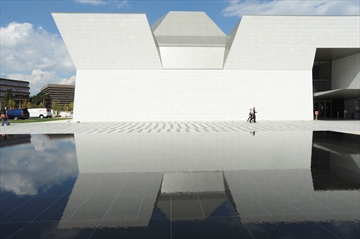
The Brazilian granite gleams under the hot September sun, the 45-degree angled building reflecting and absorbing light as it casts a shadow on itself.
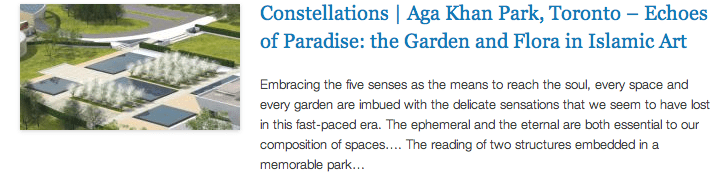
Rows of mature trees line the parkland, designed by landscape architect Vladimir Djurovic, where water slowly flows from four giant pools. A number of benches allow for those seeking quiet tranquility to take in the vast green space.
The doors will publicly open to the Aga Khan Museum Thursday, Sept. 18 on Wynford Drive, after breaking ground in May 2010.
The 17-acre, $300-million development in the Don Mills Road and Eglinton Avenue area, which also includes the Ismaili Centre Toronto, is the site of the former Bata Shoe headquarters. The museum will be the first in North America dedicated to Islamic arts and cultures.
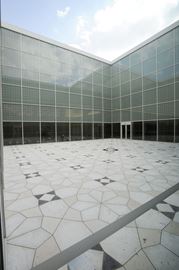
The heart of the museum – the courtyard – provides enough light to keep the immediate area bright all day long, with a modern interpretation of patterned wooden screens known as mashrabiya lining the glass walls.
A world map on the wall will allow visitors to better understand where the art comes from, Kana’an said, adding pieces reflect the types of stories the museum wanted to tell.
One of the pieces is a 15th century water fountain from Egypt, which was likely used in an upper-middle-class home or palace as a natural air conditioner.
And the earliest surviving manuscript of the Qanun of Ibn Sina, an encyclopedia of medieval medical knowledge taught in European medical schools until the 18th century, will be available for viewing.
Blue and white 14th century jars from either Egypt or Syria used to transport medicinal herbs and spices are in the company of other ceramics from that era.
The Iranian ceramics were clay based, as only China had access to porcelain back then. (Muslims) were fascinated by something they didn’t have, .. There was always a back and forth between the Muslim world and China. China played a big role because of the trade.
– Ruba Kana′an, Head of Education and Scholarly Programs – Aga Khan Museum
Kana’an said the museum has been in talks with Ontario school boards to see how its teachings can be used in the curriculum, adding teacher training by the museum will be offered several times annually.
“We wouldn’t have a beautiful park if it was downtown … It’s an accessible space and the land was available. Toronto made sense because of its diversity and pluralism. The most fascinating thing, is it allows the discovery of things we didn’t know, or weren’t sure of. The idea is to make the arts of Islam better known. There is always a need for information on any topic, this just happens to be art.”
– Azim Alibhai, Chief Communications Consultant – Aga Khan Museum
via Aga Khan Museum to open Sept. 18 at Don Mills and Eglinton on North York Mirror.
More Related stories at North York Mirror:
- 2011-01-05: View future Aga Khan centre at exhibition
- 2010-10-26: Canada a global leader in promotion of pluralism: Aga Khan
- 2010-03-31: Aga Khan witnesses Ismaili Centre groundbreaking in North York
Accelerate your Awareness – Explore, Discover and Learn more about the Aga Khan Projects in Toronto
 Ismailimail
Wish I could be there
LikeLike