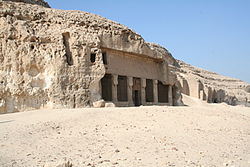
 Istabl Antar archaeological site is on the verge of disappearing due to lack of proper protection
The site includes living quarters dating from the foundation of the city in 20 H/642 AD up to the end of the Umayyad dynasty in 132 H/750 AD and the most ancient Islamic mausolea known so far in the whole Islamic world, erected between 132 H/750 and 144-145 H/762 AD. It also contains the most ancient remains of the plan of a mosque in Egypt, and one of the most ancient of the Arab world, also constructed between 132 H/750 and 144-145 H/762 AD. (The plan of the mosque of Amr in Al-Fustat has been redrawn and reconstructed a number of times and is therefore more recent than the one of the site of Istabl Antar.)
The mausolea were reused and modified by the Fatimid family following the orders of Taghrid, the wife of the Fatimid Caliph Al-Muizz and mother of the Caliph Al-Aziz after their arrival in Egypt in 362 H/973 AD. The deceased buried in these mausolea, who will probably end up in a rubbish dump, as happened to the remains of the dead of the Ayn Al-Sîra cemetery (1991) or those of the Fatimid caliphs when Khan Al-Khalili was built in the Mamluk days.

 Ismailimail