Thursday 26 – Saturday 28 March – BP Lecture Theatre
This three-day international conference tries to ascertain what Shiʿa Islam is and whether we can identify art and material culture that is inherently Shiʿi. Papers cover topics from shrine and mosque architecture and manuscript painting to iconography, ritual and cinema.
Sponsored by The Institute of Ismaili Studies
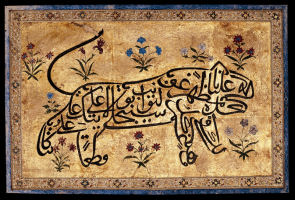
Programme:
“They said: Do you wonder at Allah’s bidding? The mercy of Allah and His blessings are on you, O People of the House (Ahl al-Bayt), surely He is Praised, Glorious.”
Holy Qur’an, 11:73
The Arabic phrase ‘Ahl al-Bayt’ or ‘People of the House’ is mentioned twice in the Holy Qur’an and, in one instance, refers specifically to the family of the Prophet Muhammad. For Shi‘a Muslims, the term refers to the Prophet’s daughter, Fatima, her husband, Imam ‘Ali ibn Abi Talib, who was the Prophet’s cousin and first Shi‘i Imam (leader), their two sons, Imam Hasan and Imam Husayn, and subsequently to their descendants. Today, Shi‘a Muslims reside predominantly in the Middle East, with sizable minorities in South and Central Asia, making up 10% of the world’s culturally diverse Muslim population. Although, like all Muslims, the Shi‘a have always been and remain ethnically, culturally and even religiously diverse, their shared beliefs and practices which centre on reverence for the Prophet and his descendants have greatly impacted Muslim material culture.
Who are the Shi‘a? Can we identify art, architecture and material culture that is inspired by Shi‘i traditions from around the world and throughout history? These questions are explored in an intellectually stimulating and visually enthralling three-day international conference. Covering topics from shrine and mosque architecture, manuscript painting, and religious iconography, to ritual expressions and contemporary cinema, the papers also span a wide geographic area from West Africa and the Middle East to Southeast Asia and China.
More…
http://www.iis.ac.uk
http://www.britishmuseum.org
“Shah ‘Abbas: The Remaking of Iran” (19 February – 14 June 2009), visit British Museum webpage.

 Ismailimail