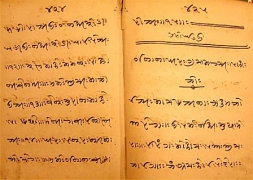
The word Ginan is derived from Sanskrit.
Derived from the Sanskrit word jnana meaning contemplative knowledge, Ginans are a large corpus of hymns and poems composed in a variety of Indic languages (including Gujarati, Sindhi, Punjabi, and Multani) and attributed to a series of dais (preachers) who taught the Ismaili interpretation of Islam in the Indian Subcontinent beginning in the twelfth century.
Scholars agree that Ginans were originally transmitted orally although it is not known whether the recording existed simultaneously – the earliest copy identified so far dates to 1736. The Nizari Ismailis of the Indian Subcontinent recorded the Ginans in Khojki script to preserve and protect their literature. The Khojki script used by the Nizari Ismailis was probably an adaptation of existing scripts, and not a new creation. Historical evidence suggests that about thirty dais composed Ginans over six centuries; the existing collection comprises about 800 Ginans of varying lengths. It is believed that Imam Ali Shah (d.1885) had assigned the task of collecting and compiling the manuscripts to some of the members of the Jamat in order to preserve the manuscripts. The Institute of Ismaili Studies has a collection of 200 volumes of manuscripts in Gujarati and Khojki. These can be viewed at

 Ismailimail
yes i remember,, its nice,,,i hope new generation also start taking interest in it. good luck.
LikeLike
yes we ismailies remember …..its very good ………..i assure the generation alsa start to interestin it and also recite ……i pray that type of person who encourage the culture and traditions….
thanks….
LikeLike