Indeed, those who pledge allegiance to you (O Prophet) – in fact they pledge allegiance to Allah.
The Hand of Allah rests on their hands. So whoever breaks his oath, he only breaks it to his own detriment and whoever fulfills the covenant he has made, Allah will bestow on him a great reward (Quran 48:10)
The central theological doctrine of the Ismailis, in common with all Shi’i communities, is based on the belief in the permanent need of humankind for a divinely guided Imam who, after Prophet Muhammad, would be the authoritative teacher and guide of the community in all their spiritual and secular affairs. This doctrine further taught that the Prophet himself had designated his cousin and son-in-law, Ali b. Abi Talib, who was the Imam of the time, as his legatee and successor, by an explicit designation (nass) under divine command. After Hazrat Ali, the Imamate would be transmitted from father to son by the rule of nass among the descendants of Hazrat Ali and his spouse Fatima, the Prophet’s daughter. And after his son Hazrat Husayn b. Ali, it would continue in the Husaynid Alid line until the end of Time.
The Imam-murid relationship in the Shia Ismaili tradition is founded on the core principles of walaya (devotion to the Imams directly descended from the Ahl al-Bayt and bay’ah (allegiance).
Say (O Prophet): I ask you for no reward, save love of the near of kin
(Quran 42: 23)
Love for Imam
Mawlana Ja’far al-Sadiq (d.765):
“Everyone who bears love to us will be with us on the Day of Resurrection. He will be under our protection and be our companion in all stations (in Paradise). Doubly do I swear by God, God purifies the heart of everyone who loves us…”
(Secondary Curriculum, Faith and Practices in Islamic Traditions Volume I p 167)
Mawlana al-Mu’izz (d. 975):
“Indeed, even when you are physically away from us, our souls are together, in our mutual love for each other and in our affection for you and in your affection to us. Whoever of you is not like that, he will not benefit from this closeness, as closeness cannot just be in physical terms but also needs to be in spirit. Your souls… are close to us, even if our bodies and locations are apart. The closeness in wilaya is more precious than closeness in blood relationships” (Ibid).
Al-Maqrizi (d.1442)
A Sunni Egyptian scholar, al-Maqrizi dedicated much of his vast scholarship to the study of Egypt. “His works recorded Egyptian history from the time of its Muslim conquest to his own era, displaying particular pride in all things Egyptian. Al-Maqrizi’s interest in the Fatimids [Ismaili Imams who ruled over various parts of the Islamic regions 909-1171] was inextricably linked to his pride in and loyalty to Egypt, his homeland. His admiration for the dynasty may have been partly aroused by the way they had reversed Egypt’s chronic political and economic decline, and its dependence on the Abbasids” (Jiwa, Towards a Shi Mediterranean Empire p 33).
(See Imam al-Mu’izz’s reforms)
Maqrizi’s interest in the Fatimids, notes Jiwa, is also due to “his implicit recognition of the Fatimids as legitimate descendants of the Prophet, the Ahl al-Bayt, and therefore deserving his respect and admiration…” (Ibid).
Quoting Maqrizi:
“When I observed that most people were remiss in acknowledging the legitimacy of the family of the Prophet, that they opposed what legitimacy they possessed, that they tarnished their glory, and were ignorant of their station relative to God Most High, I desired to produce a tract about this matter that demonstrates the greatness of their glory and that guides the God-fearing to the mightiness of their powers.”
(Ibid. p 34 Cited from his Kitab ma’rifat ma yajibu, in Cobb, ‘al-Maqrizi, Hashimism, p 75)
From al-Maqrizi’s Itti’az al-hunafa:
“One cold blustery winter’s day in al-Mansuriyya, al-Mu’izz summoned several Kutama shaykhs….He stood in a large square room carpeted in felt, wearing a robe over his clothes. Open doors led to a library…. Then he said:
“…I thought of sending for you so that you could see what I do when I am away from you and far from your eyes. My status exceeds yours only because I have responsibility over your affairs on earth and because God has singled me out as your Imam….”
Mawlana Shah Karim (d. 2025):
“The relationship between the Imam and his Jamat is a deep and continuing bond. But the outside world may only appreciate the depth of it on such happy occasions as this.”
Dinner in celebration of Imam’s Silver Jubilee
Delhi, India, 14 January 1983
Speech

The authority of the Imam in the Ismaili Tariqah is testified by Bay’ah by the murid of the permanent spiritual bond between the Imam and the murid.
This allegiance unites all Ismaili Muslims worldwide in their loyalty, devotion, and obedience to the Imam within the Islamic concept of universal brotherhood.
The Constitution of the Shia Imami Ismaili Muslims, Clause D
The Imam’s Ta‘lim lights the murids’ path to spiritual enlightenment and vision. In temporal matters, the Imam guides the murids, and motivates them to develop their potential.
The Constitution of the Shia Imami Ismaili Muslims Clause F
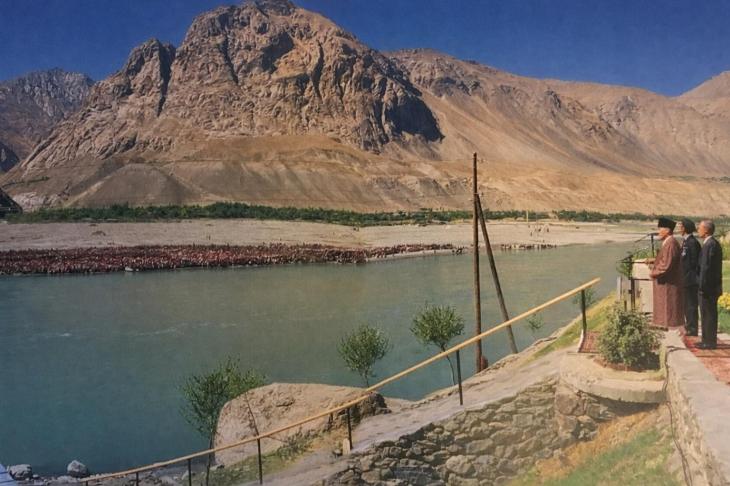
“..the love of the Imam knows no physical boundaries. No mountain, no river, no desert can stop the love of the Imam for his Jamat worldwide.”
Mawlana Shah Karim
Ishkashim, Tajikistan, 4 November 2008
TheIsmaili

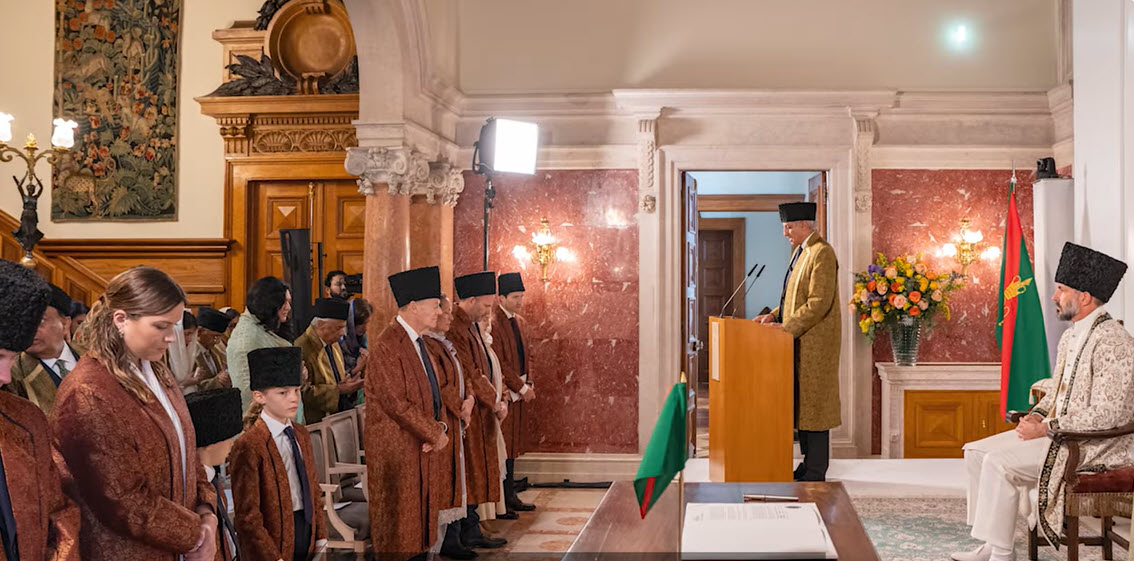
On 11 February 2025, Mawlana Hazar Imam Shah Rahim graciously accepted the Bay’ah from the global jamat at the Takht-nishini held at the Diwan of the Ismaili Imamat in Lisbon, Portugal.
Sources:
Farhad Daftary, The Ismailis Their History and Doctrines, Second Edition, Cambridge University Press, 1990
Towards a Shi’i Mediterranean Empire, Fatimid Egypt and the Founding of Cairo Translated by Shainool Jiwa, I.B. Tauris, London, 2009
Contributed by Nimira Dewji, who also has her own blog – Nimirasblog – where she writes short articles on Ismaili history and Muslim civilisations.
 Ismailimail