“O Messenger, deliver [to the people] what has been revealed to you from your Lord, and if you do not do so, then you will not have delivered His message; and Allah will protect you from the people” (5:67).
Mawlana Hazar Imam, Shah Rahim Al-Hussaini, succeeded his father as the 50th Imam of the Nizari Ismailis, on 4 February 2025.
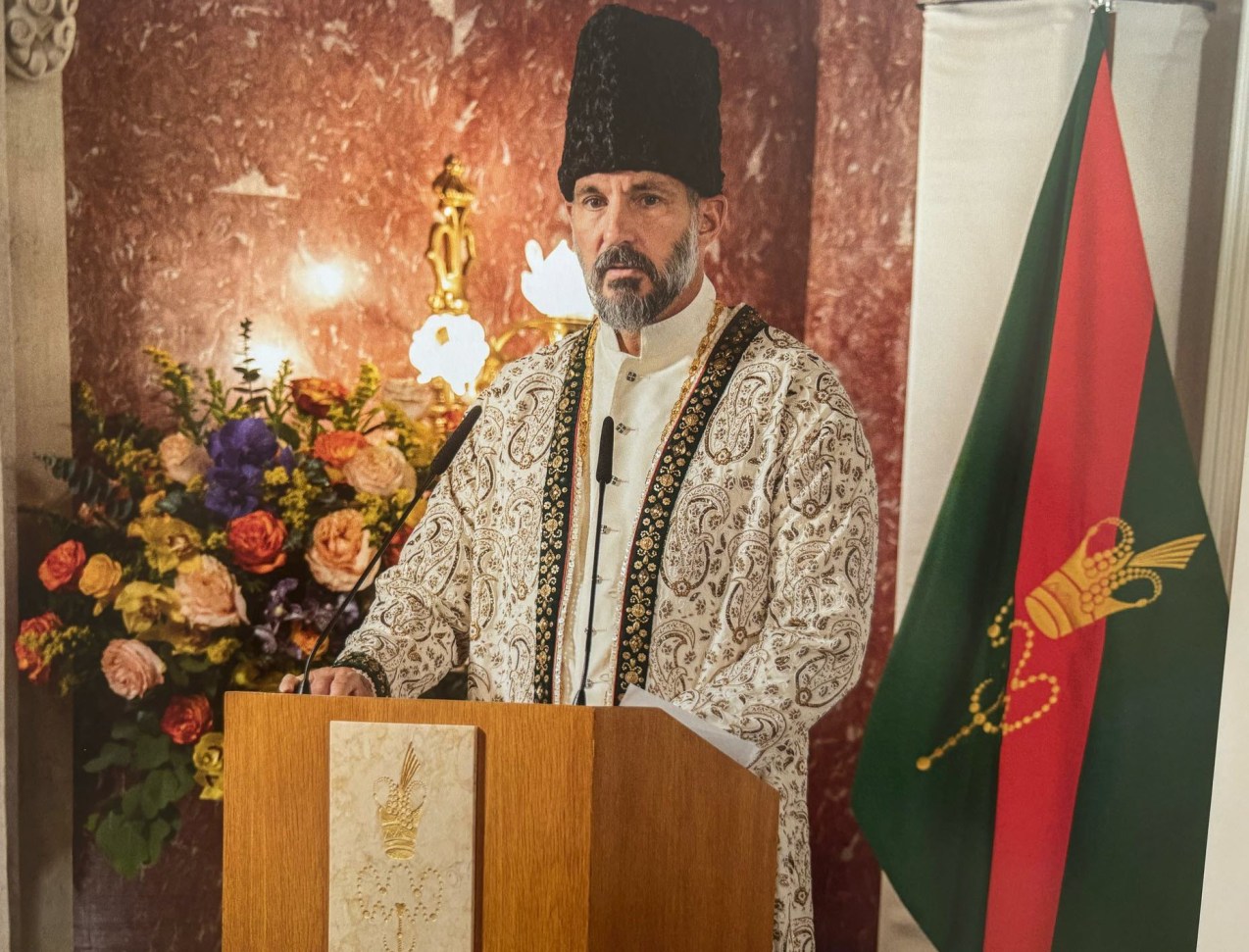
Imamate
The central theological doctrine of the Ismailis, in common with all Shi’i communities, is based on the belief in the permanent need of humankind for a divinely guided Imam who, after Prophet Muhammad, would be the authoritative teacher and guide of the community in all their spiritual and secular affairs. This doctrine further taught that the Prophet himself had designated his cousin and son-in-law, Ali b. Abi Talib, who was the Imam of the time, as his legatee and successor, by an explicit designation (nass) under divine command. After Ali, the Imamate would be transmitted from father to son by the rule of nass, or designation, among the descendants of Ali and his spouse Fatima, the Prophet’s daughter. And after his son Husayn b. Ali, it would continue on the Husaynid Alid line until the end of time. (The Ismaili Imams p 2).
When a group of Meccans doubted Hazrat Ali’s lineage to the Prophet, questioning his leadership, Imam Ali said:
“People, I belong to a group who care not if they are criticized when their actions are for the sake of God! Our mark is the mark of those who uphold the truth of God’s word, our speech is the speech of the virtuous. We inhabit the night with prayer, we are beacons of light during the day. We hold fast to the Qurʾan, keeping alive God’s ways and the practices of his Messenger. We never behave with arrogance, never conduct ourselves with conceit, never cheat, are never corrupt. Our hearts are in paradise, while our bodies are occupied here with doing good.”
(Nahj al-Balagha tr. Qutbuddin p 461)
Al-Maqrizi (d.1442)
A Sunni Egyptian scholar, al-Maqrizi dedicated much of his vast scholarship to the study of Egypt. “His works recorded Egyptian history from the time of its Muslim conquest to his own era, displaying particular pride in all things Egyptian. Al-Maqrizi’s interest in the Fatimids [Ismaili Imams who ruled over various parts of the Islamic regions 909-1171] was inextricably linked to his pride in and loyalty to Egypt, his homeland. His admiration for the dynasty may have been partly aroused by the way they had reversed Egypt’s chronic political and economic decline, and its dependence on the Abbasids” (Jiwa, Towards a Shi Mediterranean Empire p 33).
(See Imam al-Mu’izz’s reforms)
Maqrizi’s interest in the Fatimids, notes Jiwa, is also due to “his implicit recognition of the Fatimids as legitimate descendants of the Prophet, the Ahl al-Bayt, and therefore deserving his respect and admiration…” (Ibid).
Quoting Maqrizi:
“When I observed that most people were remiss in acknowledging the legitimacy of the family of the Prophet, that they opposed what legitimacy they possessed, that they tarnished their glory, and were ignorant of their station relative to God Most High, I desired to produce a tract about this matter that demonstrates the greatness of their glory and that guides the God-fearing to the mightiness of their powers.”
(Ibid. p 34 Cited from his Kitab ma’rifat ma yajibu, in Cobb, ‘al-Maqrizi, Hashimism, p 75).
The Nurturing of Imams
The foremost Ismaili jurist of Fatimid times and founder of Ismaili jurisprudence, Qadi al-Nu’man, entered the service of Imam al-Mahdi, founder of the Fatimid dynasty, in 925. He served the first four Fatimid Caliph-Imams in North Africa, in various capacities, eventually appointed by Imam al-Mansur in 948 to the position of chief judge of the state. The fourth Fatimid Caliph-Imam al-Mu’izz confirmed al-Nu’man in that post. When Imam Al-Mui’zz transferred the Fatimid capital to Cairo, a city he founded, Al-Nu’man accompanied Imam to Cairo, where he died in 974 and was buried.
Idris Imad al-Din (d.1468), chief da’i of Yemen, in his Uyun al-akhbar (tr. By Shainool Jiwa) reported on the nurturing of Imams:
“Al-Nu’man has said: “From a young age, al-Mu’izz li-Din Allah had a special status with his grandfather al-Qa’im.Al-Qa’im used to keep al-Mu’izz in his company, was close to him and confided in him in the absence of his father [al-Mansur]. Al-Mu’izz was his messenger and ambassador to the people, conveying commands and prohibitions and anything else. Whenever al-Qa’im was alone al-Mu’izz was with him and whenever al-Mu’izz was absent al-Qa’im would send for him.
(An Anthology of Ismaili Literature p 60)
Similarly, Imam al-Mansur held the same position with his grandfather al-Mahdi and was inseparable from him, Al-Mahdi used to confide secrets to al-Mansur and no one was privy to what transpired between them…One day al-Mu’izz noted a similarity to this [relationship], saying that al-Mahdi bi’llah used to nurture al-Mansur with wisdom (hikma) and prepare him for the imamate, just as al-Qa’im did with him” (Jiwa, Founder of Cairo p 54).
In his work, Maqrizi states:
“One day al-Qa’im bi-Amr Allah, upon him be peace, was in his father al-Mahdi’s majlis (gathering), seated in front of him, His son, al-Mansur, was standing in front of his grandfather, when al-Mahdi said to him, ‘Bring me your son,’ that is al-Mu’izz li-Din Allah. So his nursemaid brought him. He was one year old or a little older. Al-Mahdi took him on his lap and kissed him, Then he said to his son al-Qa’im bi-Amr Allah, ‘O Abu’l-Qasim, there is not a gathering more illustrious on earth than this one, as four imams are gathered here,’ that is, al-Mahdi himself, his son al-Qa’im, his grandson al-Mansur, and his great-grandson al-Mu’izz li-Din Allah.
Additionally, the parasol bearer (sahib al-mizalla), Abu’l-Fadl Raydan told me that al-Mahdi gathered them in a cloak and said, ‘The Prophet of God, may God bless him and grant him peace, gathered in his garment three imams*, in addition to himself, but in this cloak there are four imams” (Towards a Shii Mediterranean Empire p 2)
*This refers to Ali b. Abi Talib and his two sons, al-Hasan and al-Husayn (Ibid. p 29 note 70).
Nass
“Among the Shia the formal designation conferred by an existing Imam upon his successor, appointed from among his sons or other male progeny who are descended directly from the first imam, Ali Ibn Abi Talib, and the Prophet’s daughter, Fatima. Imam Ali is believed to have received his designation from Prophet Muhammad” (Dictionary of Islam p 131).
Mawlana Hazar Imam was designated in conformity with the historical Shia Imami Ismaili tradition and practice of nass. On the concept of nass, Nasir al-Din Tusi (d. 1274), the most celebrated Shi’i scholar of the thirteenth century in Islamic lands, states:
“The designation [nass] which is made is not in order to make him an Imam; it is only made so that people should recognise him as such ….” (Paradise of Submission p 12).
View Youtube – From Shah Karim to Shah Rahim by Dr. Khalil Andani
Contributed by Nimira Dewji, who also has her own blog – Nimirasblog – where she writes short articles on Ismaili history and Muslim civilisations.
Sources:
Azim Nanji, Dictionary of Islam, Penguin Books, 2008
Fahad Daftary, The Ismaili Imams, Bloomsbury, 2020
An Anthology of Ismaili Literature, A Shi’i Vision of Islam, Edited by Hermann Landolt, Samira Sheikh, & Kutub Kassam, I.B. Tauris, London, 2008
Towards a Shi’i Mediterranean Empire, Fatimid Egypt and the Founding of Cairo Translated by Shainool Jiwa, I.B. Tauris, London, 2009
Paradise of Submission: A Medieval Treatise on Ismaili Thought, Edited and Translated by S.J. Badakhchani, 2004
The Founder of Cairo, An English Translation of the text on Al-Mu’izz from Idris Imam al-Din’s Uyun al-Akbar, Translated by Shainool Jiwa, I.B.Tauris, London, 2013
 Ismailimail