By Alex Ballingall , Ottawa Bureau
Saturday, August 19, 2023
Canada’s top nuclear safety official travelled to Ukraine in secret. Here’s what she saw:
During her three days in Ukraine, Rumina Velshi signed a new memorandum of understanding between Canada’s nuclear commission and its Ukrainian counterpart.
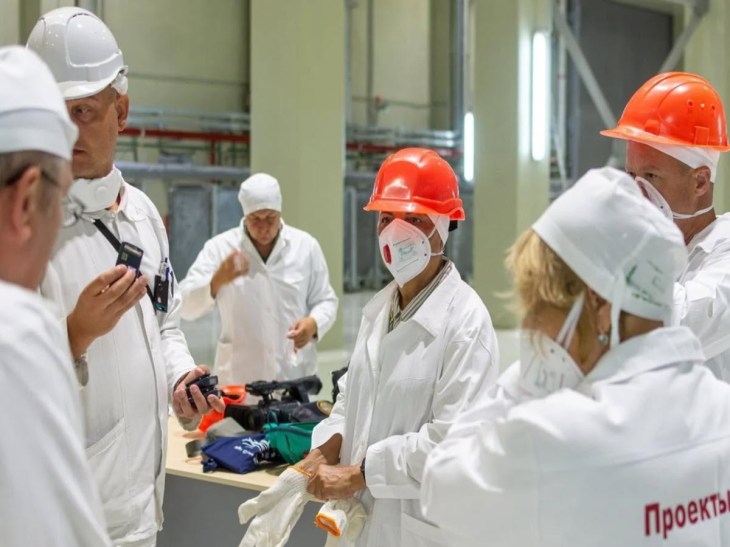
There had been many checkpoints on the road to Chernobyl. But finally, Rumina Velshi stood before the great hulk of concrete that entombs the wreckage of Reactor Number 4.
Chills shot down her spine.
Canada’s top nuclear safety official had arrived at the place synonymous with the disasters she is charged to avoid — the same horrors of nuclear radiation she hopes her secret trip to war-torn Ukraine this week will help keep from occurring once again.
“It just hit me between my eyes,” said Velshi, the president of the Canadian Nuclear Safety Commission. “Not that I ever needed a reminder, but (it shows) just how important our mandate is, how we need to do everything in our power to prevent something like this from ever happening again.”
In an exclusive interview, Velshi spoke of the strange and discomfiting experience of travelling on official business to the eastern European theatre of war. During her three days in Ukraine, Velshi signed a new memorandum of understanding between Canada’s nuclear commission and its Ukrainian counterpart, the SNRIU.
She could have done that remotely, but Velshi said she wanted to travel to Ukraine to show “support and solidarity” with the country defending itself against the Russian invasion. As chair of the Commission on Safety Standards at the International Atomic Energy Agency (IAEA), Velshi also wanted to see first-hand how Ukraine’s nuclear officials are trying to protect their nuclear power plants in a time of conflict, when one major facility — the Zaporizhzhia nuclear power plant — is held by Russian occupiers with barely any information trickling out to international observers.
“What my eyes have really been opened up to is how little we know about what is going on there,” Velshi said by phone from a hotel in Lviv, a western Ukrainian city where she spent the final day of her visit amidst regular blasts of air raid sirens.
“It’s still occupied,” she added, “and the international community is allowing it to happen.”
Out of concern for Velshi’s safety, the nuclear commission did not publicize her trip and did not want news of her visit to be made public until after she left Ukraine on Friday. To get there, Velshi took a 13-hour train from Poland to Kyiv, where she stayed for two nights while she met with Ukrainian officials and visited the Chernobyl site more than 100 kilometres to the north. From there, she drove with Ukrainian handlers to Lviv before embarking by train again to return to Poland.
Velshi described the “surreal” experience of riding towards the capital at night with all the lights in the train turned off. She felt some “trepidation,” she said, while looking out at the vast darkness through her window, knowing war was raging in the distance amid the ever-present threat of airstrikes.
In Kyiv, Velshi said she met with Ukrainian officials, and visited a government district with such strict security measures that it felt like a “ghost town.” Sandbags were piled in the streets, and she had to pass through a back entrance and a labyrinth of corridors before meeting with officials. Many of them, she said, were dressed in the familiar green T-shirt and khakis made famous by Ukraine’s president, Volodymyr Zelenskyy.
Among the topics of discussion was how to ensure the country’s nuclear reactors stay safe and secure during the conflict, and how to restore confidence in the safety of the country’s power plants that has been “shaken given the weaponization” of the facilities during the war, Velshi said.
Based on what she saw and heard in Ukraine, all the nuclear power plants controlled by the country are safe. Velshi said they are now equipped with “robust” systems to intercept incoming missiles and drones.
But the major concern is the Zaporizhzhia plant held by the Russians. According to Velshi, all contact between the plant and its Ukrainian operator and nuclear safety officials have been cut off. The only reports coming out are from the few officials from the International Atomic Energy Agency who have been allowed in. But Velshi read one of their reports while in Ukraine, and said it doesn’t include enough information to be sure that the plant is safe.
“There is serious concern concerning equipment degradation, lack of competent oversight, and the well-being and availability of adequate qualified staff — very serious concern,” she said.
To help address this, Velshi said there is an effort to assemble a “broader team” of international nuclear experts — excluding ones from Russia and Ukraine — to station themselves at the plant to allow for better reporting. If that happens, Velshi said Canadian nuclear experts would be available to participate.
As she prepared to leave Ukraine on Friday, Velshi said she was relieved she never felt under direct threat, and never had to scramble into an underground bunker during an air raid.
But the experience changed her, she said. She will return to Canada with a renewed sense of purpose, especially after visiting the site of the devastating nuclear disaster at Chernobyl.
“It will give me impetus to speak out more,” she said, “be bolder, be braver.”
Source: Toronto Star

 Ismailimail