Lost libraries and hidden histories, resplendent jewellery and immersive soundscapes: this year’s engaging exhibitions take visitors from 10th-century Cairo to 21st-century Baghdad
Toronto, January 31, 2018 — The Aga Khan Museum bounds into its fourth year with a full slate of exhibitions that display sumptuous artworks — and convey significant ideas. The five special exhibitions that the Museum is hosting over the next 15 months each take a unique approach, from exploring multiple senses and revealing hidden histories, to replenishing lost libraries, celebrating sartorial splendour, and engaging with Mid-East modernity. However, they all showcase, with creativity and flair, the ongoing contributions of Islamic civilizations to world culture, from the 10th century to the 21st.
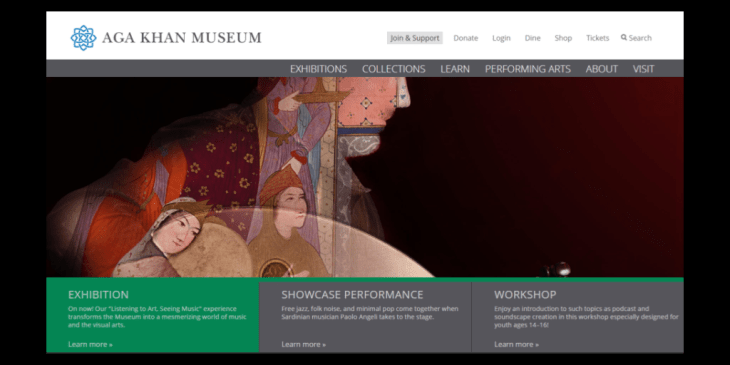
Continuing to April 22, 2018: Listening to Art, Seeing Music
A handmade Mongolian yurt in the Museum’s central courtyard acts as the heart of this unique, multi-sensory experience, opened on January 20. Spaces throughout the Museum come alive through and with music, including the auditorium lobby, where an interactive multimedia installation by UK-based geometer Sama Mara and composer Lee Westwood allows visitors to translate music into visual art compositions, and the first-floor gallery, where Pakistani-American artist Shahzia Sikander’s mixed-media installation, Disruption as Rapture, offers a meditative encounter. The interventions also include immersive musical soundscapes and video installations featuring music from the Museum’s performing arts programs, combined with intimate displays of Middle-Eastern instruments and related artworks from the Museum’s Permanent Collection.
March 10 to July 2, 2018: The World of the Fatimids
Luminous ceramics, intricate carvings shaped from rock crystal, and artifacts decorated with Kufic calligraphy embellished with vines and leaves: the luxury objects in this exhibition bear witness to a remarkable dynasty that fostered the arts and the sciences, yet is little known in North America. At their height in the 10th and 11th centuries, the Fatimids enriched — from the capital they founded, al-Qahirah, or Cairo — one of the world’s most pluralistic civilizations, influencing thought and life throughout the Mediterranean, Europe, and the Near East. What makes Fatimid Egypt so compelling a thousand years later is also what makes it a landmark exhibition for the Aga Khan Museum: the pluralism the Fatimids subscribed to can continue to inspire us today.
July 14 to August 19, 2018: 168:01 – A Library Rising from the Ashes, Wafaa Bilal
In 2003, the College of Fine Arts at the University of Baghdad lost their entire library due to looters who set fire to the collection during the invasion of Iraq. In 1258, the library of Baghdad’s House of Wisdom, or Bayt al-Hikma, was thrown into the Tigris River by soldiers during a Mongol siege and, according to legend, bled ink into the river for seven days, or 168 hours. For artist Wafaa Bilal, 168:01 refers to the first moment when grief is transformed into a call to action, the beginning of a struggle to move forward from the ashes of ruin. Visitors to Bilal’s installation, a library of empty white books, encounter a memorial of loss whose austere palette has been transformed into a platform for change. Aimed at restoring the lost archive of the College, 168:01 positions visitors as potential participants. Each visitor who donates a book to the exhibition, from a list compiled by faculty and students, receives a white book in return, and at the end of the exhibition, all donated books will be shipped to the College.
August 18, 2018 to January 27, 2019: Fit for a Prince: Jewelled Adornments of the Indian Courts from The Al-Sabah Collection, Kuwait
Vogue declared men’s jewellery and accessories a top trend for 2018 — but as Fit for a Prince will demonstrate, this is a trend with deep roots across time and geography. The exquisitely crafted objects on display, decorated with gems such as diamonds and carved from semi-precious stone like jade, reflect the splendour and opulence of life at the courts of the Mughals and their contemporaries, who ruled India from the 16th to 19th centuries. As great patrons of the jewelled arts, which blended Indian, Persian, and Central Asian traditions, they contributed to a flowering of creativity and craftsmanship. Paintings from the Aga Khan Museum’s Collection, showing hunts and battles, receptions and gardens, set the scene for the jewelled artworks and reveal how passionate Mughal princes were about art and beauty, adorning themselves magnificently, both to feast and to fight.
September 22, 2018 to February 17, 2019: Between Tradition and Modernity: The Arts of 19th-Century Iran
Burgeoning new technology, converging cultural traditions, seismic social change: that could describe the forces at work in contemporary Canada, but applies equally to 19th-century Iran, the focus of this timely and fascinating exhibition. Adapted from an exhibition organized by the Louvre, and featuring art produced when Western innovations and artistic expression were influencing local traditions, Between Tradition and Modernity reveals stories of a culture in flux. A wide selection of artifacts, including life-sized portraits, lithographed books, and photographs, along with objects such as musical instruments, metalwork, and ceramics, represent a society that was, in turns, resisting, engaging, and embracing change.
https://www.agakhanmuseum.org/
The Aga Khan Museum in Toronto, Canada, has been established and developed by the Aga Khan Trust for Culture (AKTC), which is an agency of the Aga Khan Development Network (AKDN). The Museum’s mission is to foster a greater understanding and appreciation of the contribution that Muslim civilizations have made to world heritage while often reflecting, through both its permanent and temporary exhibitions, how cultures connect with one another. Designed by architect Fumihiko Maki, the Museum shares a 6.8-hectare site with Toronto’s Ismaili Centre, which was designed by architect Charles Correa. The surrounding landscaped park was designed by landscape architect Vladimir Djurovic.

 Ismailimail
It would be a great bonus if the museum, along with its wonderful exhibits, could make transcripts of lectures and talks held at the museum -perhaps even a library with books, journals etc. – available for access to a worldwide audience.- wishing you all a fulfilling and happy day, every day………..
LikeLike
Agree with that. I think, the lectures and the talks will give to the exhibits one of those special extras.
LikeLike