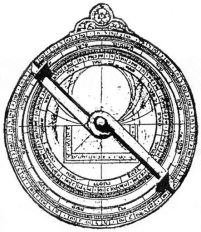
 Excerpt from:
IIS Publication: The Fatimids and their Traditions of Learning
By Heinz Halm (1997) Page 94
“Based on the year 1473, [Rabi Abraham] Zacuto created his new tables, the Almanach perpetuum, which guided the Portuguese navigators on their expeditions along the west coast of Africa. It was also Zacuto who made the astrolabe which Vasco da Gama carried with him on board his flagship on his first voyage around the Cape of Good Hope to India in 1497-98. So it was the astronomical knowledge of a one-time resident of Alamut (Iran) which helped the Europeans find the sea – route to India and usher in the dawn of a new era in the world history.”

 Ismailimail
It is important to know what the inspiration for and driving force behind these scientific discoveries and inventions were. I quote but a few excerpts that establish the root motivation unequivocally:
“A thousand years ago, my forefathers, the Fatimid imam-caliphs of Egypt, founded al-Azhar University and the Academy of Knowledge in Cairo. In the Islamic tradition, they viewed the discovery of knowledge as a way to understand, so as to serve better God’s creation, to apply knowledge and reason to build society and shape human aspirations”(Aga Khan IV, Speech, 25th June 2004, Matola, Mozambique.)
In this context, would it not also be relevant to consider how, above all, it has been the Qur’anic notion of the universe as an expression of Allah’s will and creation that has inspired, in diverse Muslim communities, generations of artists, scientists and philosophers? Scientific pursuits, philosophic inquiry and artistic endeavour are all seen as the response of the faithful to the recurring call of the Qur’an to ponder the creation as a way to understand Allah’s benevolent majesty. As Sura al-Baqara proclaims: ‘Wherever you turn, there is the face of Allah’.The famous verse of ‘light’ in the Qur’an, the Ayat al-Nur, whose first line is rendered here in the mural behind me, inspires among Muslims a reflection on the sacred, the transcendent. It hints at a cosmos full of signs and symbols that evoke the perfection of Allah’s creation and mercy”(Aga Khan IV,Speech, Institute of Ismaili Studies, October 2003, London, U.K.)
“Education has been important to my family for a long time. My forefathers founded al-Azhar University in Cairo some 1000 years ago, at the time of the Fatimid Caliphate in Egypt. Discovery of knowledge was seen by those founders as an embodiment of religious faith, and faith as reinforced by knowledge of workings of the Creator’s physical world. The form of universities has changed over those 1000 years, but that reciprocity between faith and knowledge remains a source of strength”(Aga Khan IV, 27th May 1994, Cambridge, Massachusets, U.S.A.)
“The God of the Quran is the One whose Ayats(Signs) are the Universe in which we live, move and have our being”(Aga Khan III, April 4th 1952, Karachi, Pakistan)
“Nature is the great daily book of God whose secrets must be found and used for the well-being of humanity”(Aga Khan III, Radio Pakistan, Karachi, Pakistan, February 19th 1950)
Kathalika yubayyinu Allahu lakum ayatihi la’allakum ta-‘aqiloona: “Allah thus makes clear to you His Signs that you may intellect”(Holy Quran 2:242)
“Behold! in the creation of the heavens and the earth; in the alternation of the night and the day; in the sailing of the ships through the ocean for the profit of mankind; in the rain which Allah sends down from the skies, and the life which He gives therewith to an earth that is dead; in the beasts of all kinds that He scatters through the earth; in the change of the winds, and the clouds which they Trail like their slaves between the sky and the earth; (Here) indeed are Signs for the people of intellect”(Noble Quran)
“Here is a relevant verse from the Noble Qur’an, cited by Nasir-i Khusraw, hujjat-i Khurasan in his Khawaan al-Ikhwaan : “It is He who created you from dust, then from a sperm drop, then from a blood clot, then He brings you forth as a child, then lets you reach your age of full strength, then lets you become old – though some of you die before – and then lets you reach the appointed term; and that haply you may find the intellect (la’allakum ta’qilun).”(Nasir Khusraw, 11th century Fatimid Ismaili cosmologist-philosopher-poet)
“One hour of contemplation on the works of the Creator is better than a thousand hours of prayer”(Prophet Muhammad, circa 632CE)
http://gonashgo.blogspot.ca/2008/09/400blogpost-four-hundred-knowledge.html?m=1
LikeLike