The Shahnama (The Book of King), composed by the Persian poet Firdawsi (940-1020) around the year 1000, comprises more than 60,000 rhyming couplets, telling the story of Persia from the time of creation to its conquest by Muslims in the seventh century. Partly legend, partly historic, it is also a manual on kingship, a collection of heroic tales, and a long essay on wisdom, love, warfare, and magic, structured around four successive dynasties, each representing the various phases of human history, seen from the Iranian perspective.
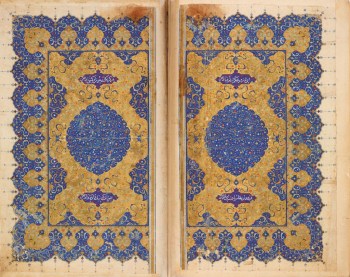
The first part tells of the mythical creation of Persia and its earliest mythical past; the second part tells of the legendary kings and heroes; the third part blends historical fact with legend, telling of the semi-mythical adventures of actual historical kings.
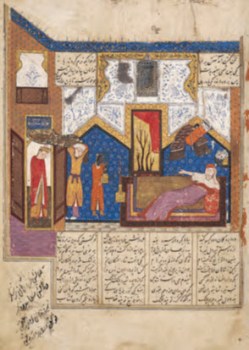
The Shahnama, enduring as a princely manual for wise and just kingship, was copied in all Iranian royal studios for rulers across the Persian-speaking regions including the Mughal empire. Among the numerous tales, the episode of Princess Tahmina’s visit to Rustam’s chamber was a popular story for illustrations.
Rustam is the celebrated hero of Iranian mythology, represented as the mightiest warrior known for his extraordinary strength, courage, and loyalty. When his horse Rakhsh (meaning ‘luminous’ in Persian) goes missing, Rustam searches far and wide for him eventually reaching the nearby kingdom of Samangan, where he asks the king for his assistance in locating the horse. While in Samangam, Rustam meets the king’s daughter Tahmina. One night the princess enters Rustam’s chamber to tell him that she wishes to marry him and bear his child, in return for finding his horse. Although caught by surprise, Rustam accepts her offer. The couple were married, Rustam found his horse, returned home unaware that he had father a son, Suhrab.
One of the most tragic episodes of the Shahnama, is the tale of Rustam and Suhrab.
Rustam had not seen Princess Tahmina for many years. When Rustam and Suhrab faced each other in battle, fighting on opposing sides, they did not know each other, although Suhrab had suspicions that Rustam might be his father. Rustam wrestled Suhrab, stabbing him fatally. To his horror, he recognised Suhrab as his son, from the arm bracelet that Suhrab was wearing; Rustam had given the bracelet to Tahmina several years earlier.
Sources:
Treasures of the Aga Khan Museum, Masterpieces of Islamic Art, AKDN (accessed July 2017)
Rostam marries Princess Tahmina, British Library (accessed July 2017)
Mathew Arnold, Sohrab and Rustum: An Episode, Librivox (accessed July 2017)
Compiled by Nimira Dewji
Related
 Ismailimail