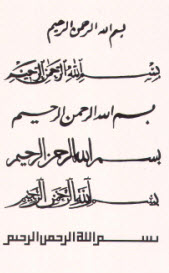
Calligraphy, from the Greek kallos (beauty) and graphein (to write) is the art of beautiful writing. Although the development of sophisticated calligraphy as an art form is not unique to Islamic culture, it has been used to a much greater extent and in varied ways, and in all art forms and materials in Islamic cultures.
Calligraphic inscription was not restricted to Qur’anic verses, but also included other religious texts, poems, court documents, and praises for rulers. During the seventh century, Kufic developed as a script for recording the revelation. The name is derived from the city of Kufa in Iraq, where it developed into an angular script with clear contours and symmetry; this style spread all over the world and became a universal script.
As Islam spread to regions where languages other than Arabic were spoken, the styles were influenced by the diverse artistic traditions of the regions. Subsequently, six styles were codified by vizier Ibn Muqla (d. 939) at the beginning of the tenth century in Baghdad, which served as a guide, and which were further developed: Naskhi, Muhaqqaq, Raihani, Tauqi, Riqa, and Thuluth
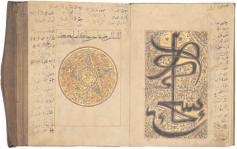
In China, a form of Arabic script had been developed, known as Sini, meaning ‘Chinese.’ The style descended from thuluth and refers to the rounded, flowing script, often with large variation between thick and thin strokes. It is often used for short calligraphic phrases rather than long texts, such as the phrase Subhan Allah (“Glorious is God”) as in the Qur’an on the right. The round Chinese good luck symbol is embedded in the middle of the star illumination.*
Sources:
* Treasure of the Aga Khan Museum Catalogue: Arts of the Book & Calligraphy
Calligraphic Tradition on Islam, The Institute of Ismaili Studies (accessed December 2015)
Strokes and Hairlines, Elegant Writing and its Place in Muslim Book Writing, McGill University, Digital Library (accessed December 2015)
Compiled by Nimira Dewji
 Ismailimail
Thanks to Nimira Dewji and Ismailimail, for sharing the plurality of calligraphic scripts.
LikeLike