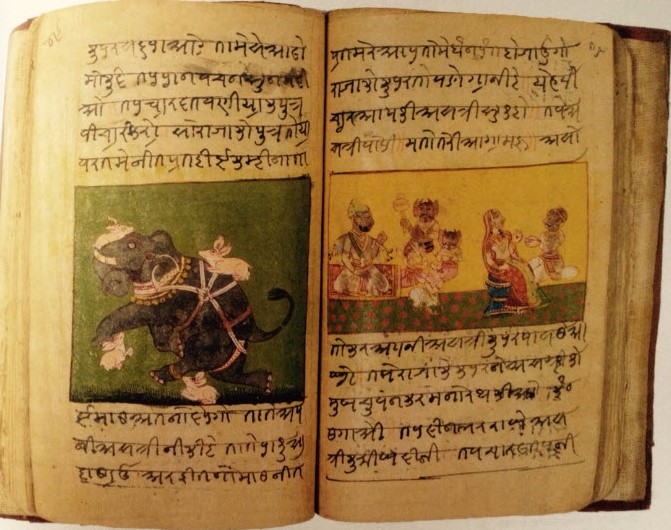
A long tradition of preparing princes to rule was the genre of literature known as ‘mirror for princes,’ fables with tales in which animals are the leading characters of the stories. These tales, thought to have been introduced to the Muslim world through India, were derived from the Indian Panchatantra (‘The Five Principles’) and Mahabharata written in Sanskrit around the year 200.
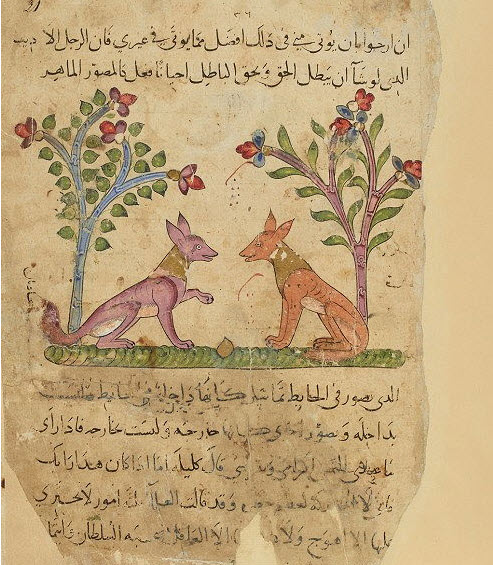
The tales were adapted and translated into numerous languages including Persian and Arabic, and were illustrated in Kalila wa Dimna manuscripts – from the thirteenth century onward in Arab lands, and from the fourteenth century in Iran.
The tales address the moral education of princes through two jackals, Kalila and Dimna, and a host of other animals as lead characters. These tales also illustrate “universal human strengths and weaknesses, as well as aspirations for justice and truth.”*
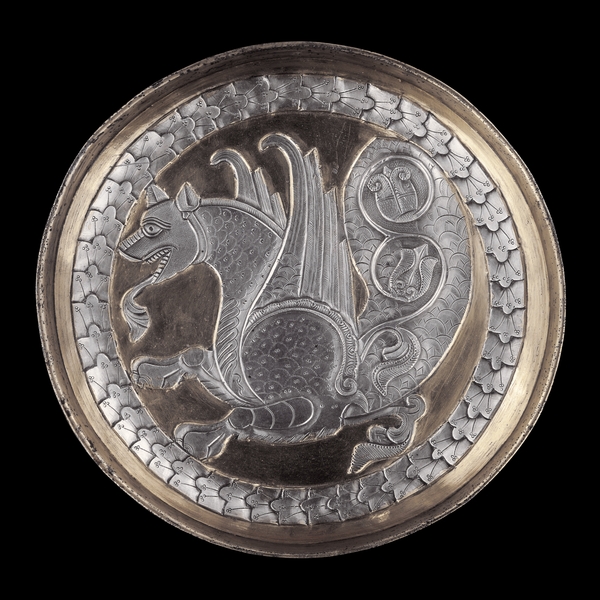
Persian fables were also influenced by other traditions. This silver dish shows a legendary dog-headed bird known as a senmurw. This creature first appears in the Late Sassanian period of the sixth century AD in embroidered roundels on textiles. In one tradition it sits on top of the ‘Tree of Life’ and, by beating its wings, causes the seeds to scatter across the earth.
The senmurw is found in modern Iran as the simurgh, the mythical bird of the Persian epic poem Shahnama, written by the Persian poet Ferdowsi between 977 and 1010. Simurgh is supposed to be so old that it has already seen the destruction of the world three times.**
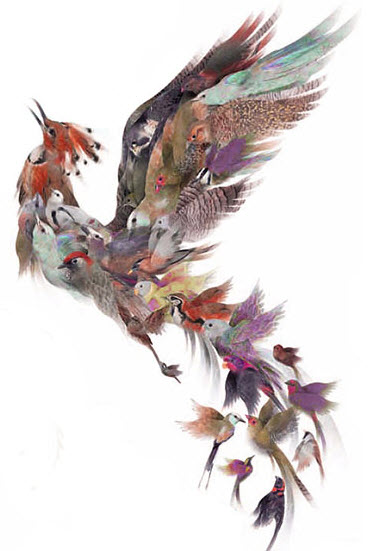
From the Persian, ‘si‘ (‘thirty’) and ‘murgh‘ (‘birds’), some traditions say the creature has thirty colours while others claim it is as large as thirty birds. The simurgh inherited its streaming tail feathers and long neck from the Chinese phoenixes introduced to Islamic art by the Mongols.
Tales of beasts are deeply rooted in pre-Islamic Iran, Central Asia, and India, however, their depictions on artwork and manuscript illustrations became popular from the twelfth century onward. Dragons in Persian paintings and artwork acquired common attributes – a meandering body, four feet, a horned head, and flaming shoulders after the Mongol conquest in the thirteenth century.
The beasts and stories in which they occur attest to the enduring interest in tales of wonder that continued well into the seventeenth century, long after people had ceased to expect to actually encountering such beasts.
References:
* Spirit & Life Catalogue, Masterpices of Islamic Art from the Aga Khan Museum Collection, Published by Aga Khan Trust for Culture
** The British Museum
Simurgh Legend
Compiled by Nimira Dewji
 Ismailimail