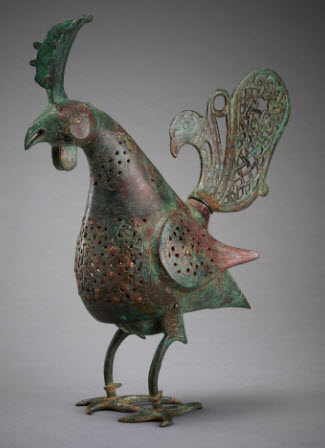
Metalwork has enjoyed great prestige in the Islamic world. Although most metalwork objects had utilitarian purposes and served the everyday requirements of their owners, many were regarded as status symbols. As in ancient times, household items made from bronze were valued for their durability and natural beauty. The early vessels used in Muslim societies were based on ancient models and were mostly cast, and their forms embellished with simple grooves; the shiny surfaces and colour nuances of the metals depended on the alloys used.
A variety of bronze alloys based largely on copper, but also using large proportions of tin, lead or zinc were widely used. Subsequently, these items particularly those regarded as status symbols, were inlaid with silver and gold rendering them significantly more valuable.
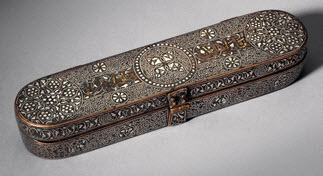
Aga Khan Museum (AKM609)
Metalwork objects that have survived from the tenth century onwards display the creativity of the artisans in turning simple objects into artistic works. During the thirteenth century, metalworking techniques and styles moved from their places of origin through migration of artists and the exchange of objects and ideas.
Steel, originally used to make armory and weapons, was first used extensively as a decorative element in the tomb of the Ilkhanid* ruler Oljeitu, built between 1307 and 1314 in Sultaniyya, Iran. Subsequently, elaborate screens and doors were added to shrines. These screens were also given as special gifts by rulers to shrines especially those of the Shia Imams and their descendants.
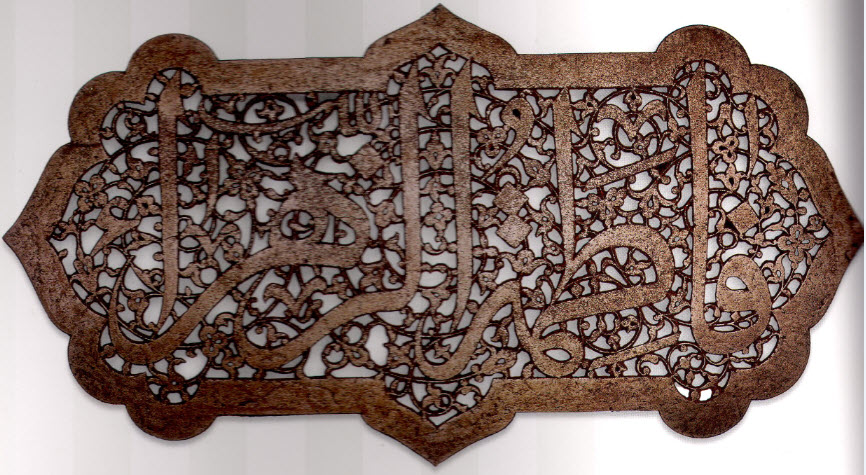
Aga Khan Museum (AKM616)
This plaque, in the Aga Khan Museum’s collection, was probably part of a shrine door. The inscription Fatima al-Zahra (“Fatima the Radiant”), the name of the Prophet’s daughter, is carved in thuluth script with an intricate floral background.
*The Ilkhanids ruled Iran, and eastern & central Turkey (1256-1388)
References:
Ruba Kana’an, “Highlights in the Permanent Collection,” Pattern and Light, Aga Khan Museum, Skira Rizzoli, New York, 2014
Almut von Gladib, “Islamic Metalwork,” Islam: Art and Architecture, Edited by Markus Hattsten and Peter Delius, Konemann, 2000
Compiled by Nimira Dewji
 Ismailimail