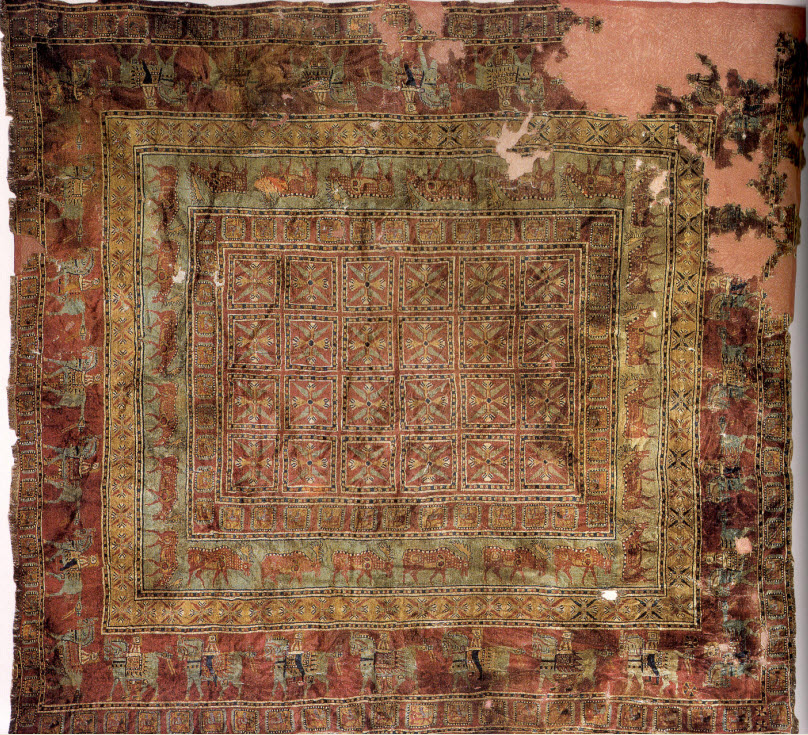
Carpets were probably first made by nomadic peoples to cover the earthen floor in their tents and to keep them warm. By the fifth century BC, carpet making was a highly artistic craft.
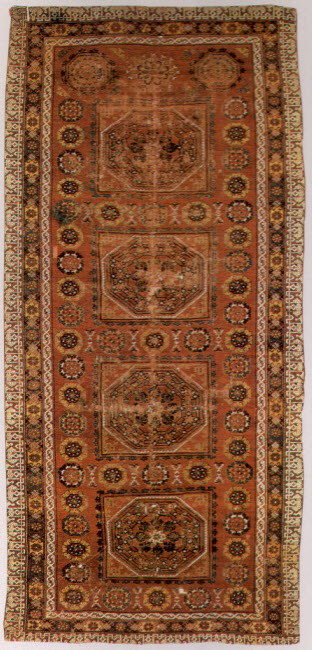
The oldest surviving carpet is believed to be one discovered in 1949 in the Pazyryk valley in southern Siberia, preserved in the tombs dating back 2,500 years. A few fragments of ‘Konya carpets,’ dating to the 14th century, were discovered in a mosque in Konya, in Anatolia (Turkey), hidden under the many layers of carpets on the floor of the prayer hall.
A second group of carpets, known as ‘animal carpets’ because they were dominated by designs of animals, are smaller than the Konya carpets. By the late 14th and early 15th centuries, these carpets seem to have been exported to Europe, as several are depicted in Italian paintings.
Under the Safavids (1501–1732 ), carpet production in Persia became a state enterprise, for domestic as well as foreign consumption. After 1860, Persian weavers adapted to a market which preferred room-sized carpets, runners, and area rugs. Large numbers of carpets were woven in a stronger, coarser technique, able to withstand usage from Europeans accustomed to wearing shoes and bringing dirt inside the house. These were called ‘Polonaise carpets’ because some of them bore the coat of arms believed to be that of the Polish Czartoryski family who had commissioned the carpets.
North Africa produced carpets for centuries, the earliest surviving carpets dating from the 19th century. There was also a long tradition of carpet production in Islamic Spain beginning around the 12th century. The growing popularity of Turkish carpets in Europe encouraged Spanish weavers to adopt Turkish motifs. A particularly noteworthy Spanish carpet is the ‘synangogue’ rug, dating from the 14th century that was used for seating and hanging beside the Torah ark as decoration.

(Image:Metropolitan Museum of Art)
Carpet production in the Indian subcontinent increased under the patronage of the Mughals (1526 – 1858). Early Mughal rugs closely resembled those from contemporary Persia; however, later in the 17th century, a distinct Mughal style developed – small flowering plants arranged in neat rows. Indian carpets travelled to the west and as far east as China and Japan, and were avidly collected in England and Portugal.
Wealthy patrons in Europe purchased carpets from Islamic lands as luxury goods. In the 14th century, images of these carpets began to appear in European paintings. Anatolian weavers produced large-pattern ‘Holbein-carpets’ for export to Europe. These carpets got their name because many are depicted in paintings by Hans Holbein the Younger (1497-1543). Initially the carpets were depicted in religious settings such as altar coverings, but they began to appear in portraits and still life paintings, reflecting the high social and economic status of the patrons. Many carpets have no record of date or place of origin. Early scholars devised a dating system based on carpets that appeared in paintings: Lotto, Ghirlandaio, Crivelli, and Memling are among the European painters whose names are now used to describe certain groups of carpets woven in Ottoman Turkey.
References:
Sheila Blair,Jonathan Bloom, “Islamic Carpets,” Islam: Art and Architecture Edited by Markus Hattstein and Peter Delius. Konemann, 2000
Marika Sardar, “Carpets from the Islamic World 1600-1800,” in Heilbrunn Timeline of Art History. New York: The Metropolitan Museum of Art.(Accessed April 2015)
Carpets of the East in Paintings of the West, Metropolitan Museum of Art (Accessed April 2015)
Research by Nimira Dewji
 Be the First to Know – Join Ismailimail
Get breaking news related to the Ismaili Imamat, the world wide Ismaili Muslim community and all their creativity, endeavors and successes.
Inspired? Share the story
Want to inspire? Send your stories to us at Ismailimail@gmail.com
Subscribe and join 22,000 + other individuals – Subscribe now!
Earlier & Related about Nimira Dewji from the Ismailimail Archives
 Mawlana Shah Karim: “The relationship between the Imam and his Jamat is a deep and continuing bond” - Indeed, those who pledge allegiance to you (O Prophet) – in fact they pledge allegiance…
 Mawlana Hazar Imam was gifted manuscripts on architecture of Andalusia, a Knowledge Society of its time - The fundamental reason for the pre-eminence of Islamic civilisations lay neither in accidents of history…
 Mawlana Hazar Imam Designates Ismaili Center Houston as Darkhana for US Jamat, the ninth Darkhana - (the light is lit) in houses of worship which God has allowed to be raised,…
 Imam Hasan ala dhikrihi’l-salam appointed Sinan as his deputy in Syria - Rashid al-Din Sinan, the greatest of the medieval Nizari Ismaili da’is in Syria, was born into a…
 The arts of the Fatimids, Mawlana Hazar Imam’s ancestors, continue to inspire - The official logo for Hazar Imam’s visits comprises the word nur, Arabic for light, repeated…
 Ismailimail
Imagine finding a previous carpet under other carpets! What a find. Reminds me of when people remove lino or carpet from a house and find beautiful timber underneath.
LikeLike