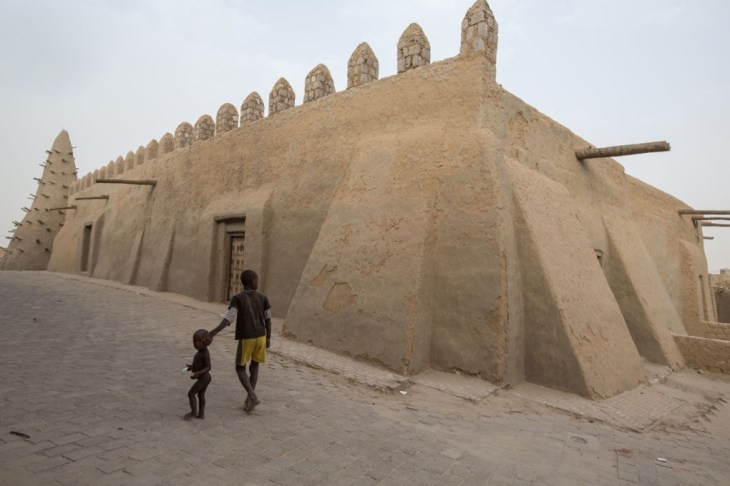
Constructed from the very earth on which it stands, Timbuktu’s oldest mosque is at the heart of daily life in the ancient city, loyally maintained by the proud descendants of its original builders.
“We have not had to do major patching up since 2006 when the Aga Khan’s restoration programme began.”
– Mahamane Mahanmoudou, the 77-year-old Djinguereber muezzin and mason-in-chief of the mosque
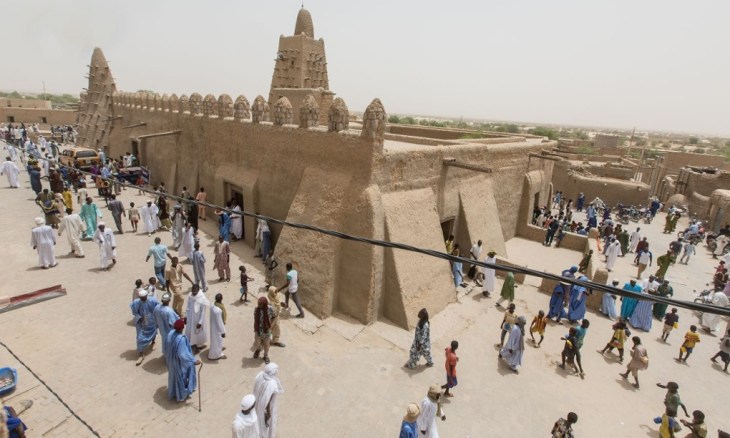
Timbuktu has never, to anyone’s knowledge, been the capital of any country. But its history, coupled with the pleasing sound of its three syllables, have made it a megalopolis in the human imagination ever since Emperor Moussa I built Djinguereber after returning from Mecca in 1327.
Takrit scribes in Cairo – through which the miles-long camel caravan of the king of the vast Mali Empire passed – said his wealth and generosity was unlike any they had seen. He gave away so much West African gold while on his travels that the value of the metal collapsed.
Retired headmaster and local historian Salem Ould Elhadje says no one knows where Kankou Moussa – the “king of kings” as he is known in Mali – established his capital, or even if he had one. But the trading centre Timbuktu – and in particular Djinguereber mosque – were certainly his pride and joy: “He established administrative buildings here, centres of scholarship and universities. He brought an Andalucian architect from Cairo to build Djinguereber. The protruding beams are a reminder of European buttresses. The conical minaret recalls the Egyptian pyramids.”
Discover, Explore and Learn more at:
The Guardian | Timbuktu’s Djinguereber mosque: a history of cities in 50 buildings, day 5
Earlier & Related about Mali from the Ismailimail Archives:
 Be the First to Know – Join Ismailimail
Get breaking news related to the Ismaili Imamat, the world wide Ismaili Muslim community and all their creativity, endeavors and successes.
Inspired? Share the story
Want to inspire? Send your stories to us at Ismailimail@gmail.com
Subscribe and join 21,000 + other individuals – Subscribe now!
Earlier & Related about The Guardian – History of cities in 50 buildings
 The Guardian | History of cities in 50 buildings, day 5 – Timbuktu’s Djinguereber mosque - Constructed from the very earth on which it stands, Timbuktu’s oldest mosque is at the…
 The Guardian | History of cities in 50 buildings, day 4 – Delhi’s 16th-century Purana Qila fort - Evolving alongside the rival powers of Delhi’s earliest rulers, Purana Qila exists as a window…
 The Guardian | History of cities in 50 buildings, day 7 – Timur’s Registan: noblest public square in the world? - The influence of this ancient Uzbek grand square stretches far across the world’s cities, from…
 The Guardian | History of cities in 50 buildings, day 2 – Citadel of Aleppo - In the oldest city in the world, Aleppo’s historic citadel offers a poignant and ongoing…
 Ismailimail
This building has always fascinated me
LikeLike