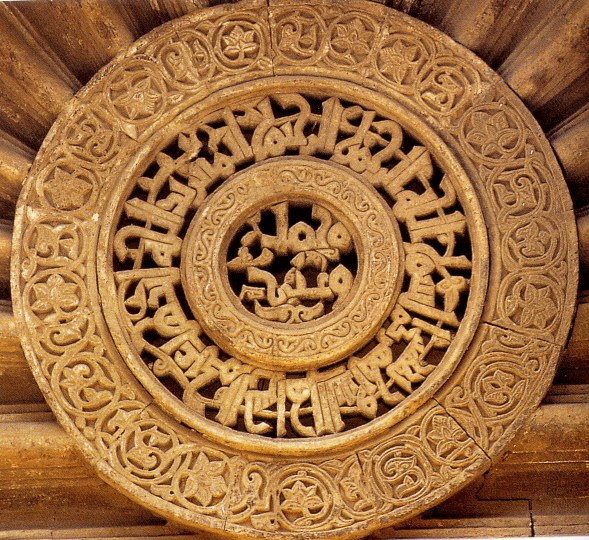
“There is no doubt that the artists of Egypt under the Fatimids were skilled to a degree that found no parallel in the handicrafts of Europe…. it is impossible to overlook the existence of an ancient skill in arts of all kinds in Egypt itself, and to ascribe much of the merits of the Mamluk work to the traditions of the Fatimids.”
Stanley Lane-Poole, The Art of the Saracens in Egypt,1886 *
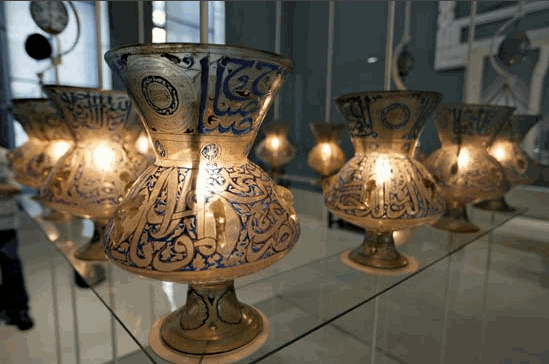
(Image: Encyclopaedia Britannica Online)
In the year 909, the Fatimid Imam al-Mahdi was proclaimed as caliph in present-day Tunisia, founding Fatimid reign. In 969, the Caliph-Imam Al-Mu’izz conquered Egypt, founding the city of Cairo, which became the capital of the empire in 973.
Named after the Prophet’s daughter, the reign of the Fatimids Caliph-Imams, for almost two centuries, is often referred to as a ‘golden age’ in Ismaili history. The Fatimids placed a high value on intellectual and artistic activities, attracting talented people from all over the world and Cairo became a flourishing centre of scholarship, learning, and the arts. The creativity of the Fatimid period is expressed in monuments of astounding variety and beauty as well as the many exquisite objects made from a range of materials.
Fatimid art – particularly textiles, ceramics, carved rock crystal, and metalwork – has been admired for centuries. The items were initially taken to Europe by merchants and Crusaders and then preserved as relics in churches and private collections.
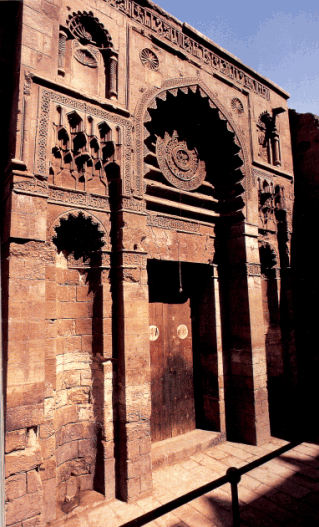
Many of the greatest Fatimid architectural achievements in palaces and mosques are known only by written descriptions. However, several surviving tombs, mosques, gates and walls, mainly in Cairo, retain original elements, although they have been extensively modified or rebuilt in later periods. Some of the notable existing examples of Fatimid architecture include the Great Mosque of Mahdiya,and the Al-Azhar Mosque, Al-Hakim Mosque, and Lulua Mosque of Cairo. A striking feature of Fatimid buildings in Cairo is the lavish decoration of the interior and exterior walls.
References:
*Jonathan M. Bloom, Arts of the City Victorious, Yale University Press in Association with The Institute of Ismaili Studies, 2007
Sibylle Mazot, Islam: Art and Architecture. Edited by Markus Hattstein and Peter Delius. Konemann. Cologne, 2000
Architecture of the Fatimid Period, Archnet
Research by Nimira Dewji
Related:
 Mawlana Shah Karim: “The relationship between the Imam and his Jamat is a deep and continuing bond” - Indeed, those who pledge allegiance to you (O Prophet) – in fact they pledge allegiance…
 Mawlana Hazar Imam was gifted manuscripts on architecture of Andalusia, a Knowledge Society of its time - The fundamental reason for the pre-eminence of Islamic civilisations lay neither in accidents of history…
 Mawlana Hazar Imam Designates Ismaili Center Houston as Darkhana for US Jamat, the ninth Darkhana - (the light is lit) in houses of worship which God has allowed to be raised,…
 Imam Hasan ala dhikrihi’l-salam appointed Sinan as his deputy in Syria - Rashid al-Din Sinan, the greatest of the medieval Nizari Ismaili da’is in Syria, was born into a…
 Ismailimail
http://www.onislam.net/english/reading-islam/research-studies/art-a-architecture/472965-early-sunni-shia-impact-on-art-and-architecture-.html?Architecture=
LikeLike