
The Alhambra Palace in Granada, Spain, the royal city of the Nasrids, comprises the most extensive remains of a medieval Islamic palace, and one of the most famous monuments of Islamic art. The Alhambra, whose name is derived from the Arabic Dal’at al-Hamra, ‘the red fort,’ perhaps because of the reddish clay of the surrounding terrain, was the palace complex of the Nasrid dynasty that ruled southern Spain from 1232 to 1492. The Nasrids were the last Muslim dynasty to reign in western Europe; they had made the city of Granada their capital, and the Alhambra was the kingdom’s seat of government.
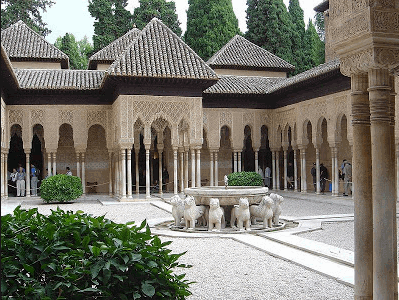
Founded by the first Nasrid sultan, Muhammad I, who came to power in 1232, the complex underwent frequent additions and changes during the thirteenth and fourteenth centuries. Although the earliest buildings can be dated back to the eleventh century, the present area of the Alhambra began to take shape under the Nasrids in the thirteenth century. Situated on a hill overlooking Granada, the Alhambra, a sprawling palace-citadel that once comprised residential quarters, court complexes, a bath, and a mosque, kept watch over the kingdom’s capital. The combination of the slender columns, fountains, water basins in the courtyards, especially the Court of the Lions, has captured the romantic imagination of visitors for centuries. According to the inscriptions, the combination of these elements represents a description of Paradise.
One of the most visited historic monuments, the Alhambra is on UNESCO’s World Heritage List. In 1998, the seventh awards of the Aga Khan Award for Architecture were presented at the Alhambra Palace. In his address, His Highness the Aga Khan, spiritual leader of the Shia Ismaili Muslims, reflected upon the remarkable architecture of the past and explained how “skill, knowledge and vision in the realm of architecture were once a hallmark of Islamic civilisations, and central to the identity of their peoples. Loss of this inheritance of pluralism….the identity it conveys to members of diverse societies, and the originality it represents and stimulates in all of them will impoverish our societies now and into the future.”*
References:
*Press Release, Aga Khan Development Network
Archnet
Marvin Trachtenberg and Isabelle Hyman, Architecture: from Prehistory to Post-Modernism. Second Edition. Harry N. Abrams Inc. New York. 2002
Research by Nimira Dewji
Related:
- Mawlana Shah Karim: “The relationship between the Imam and his Jamat is a deep and continuing bond”
- Mawlana Hazar Imam was gifted manuscripts on architecture of Andalusia, a Knowledge Society of its time
- Mawlana Hazar Imam Designates Ismaili Center Houston as Darkhana for US Jamat, the ninth Darkhana
- Imam Hasan ala dhikrihi’l-salam appointed Sinan as his deputy in Syria
- The arts of the Fatimids, Mawlana Hazar Imam’s ancestors, continue to inspire
- Rumi: “The light that lights the heart is the Light of God”
- Pir Sabzali: “Hearing the farman, their eyes brimmed over with tears of joy”
- Al-Tusi: “The ‘nass’ is not in order to make him an Imam; it is … so that people should recognise him as such”
- Mawlana Hazar Imam Aga Khan V: “The Shia Ismaili Muslim community, of which I am the Imam, has been established in Syria for more than 1,000 years”
- Mughal Emperor Akbar’s pluralism is evidenced by an inscription of Hazrat Isa’s teaching on his “Victory Gate”
 Ismailimail
Ya Ali madad
LikeLike