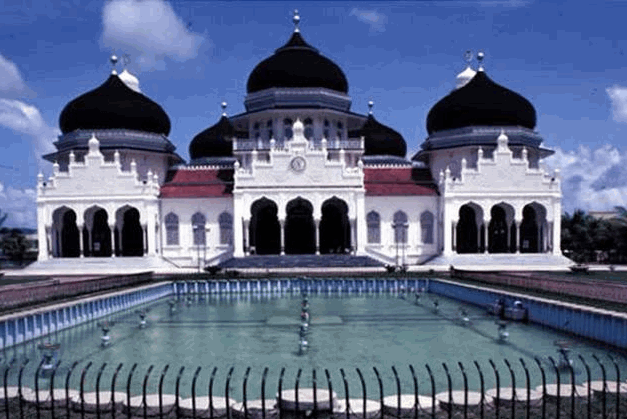
Masjid Baiturrahman, in Banda Aceh, Indonesia, represents one of the first examples of a domed mosque in Southeast Asia.
Masjid Baiturrahman replaced a mosque built in 1872 by Sultan Nur al-Alam. The original mosque, named Mesjid Raya or Grand Mosque, was said to replicate a 1614 mosque built by Sultan Iskandar Muda with its layers of wide-hipped roofs. When the kingdom of Aceh resisted Dutch mercantile treaties in 1873, the Dutch invaded Banda Aceh, starting the 30 years Aceh War, and destroying the newly constructed Mesjid Raya. In an effort to persuade the Acehnese to end their resistance, the Dutch rebuilt this central mosque
The architect, de Bruchi, modeled the new mosque on a Mughal (ruled the Indian Subcontinent 1526-1858) plan which had not been seen before in Southeast Asia. Whereas the previous mosque was laid out on a square plan with a four-tiered roof, this new Dutch creation copied many stylistic elements of Mughal mosques. These Mughal elements were further embellished with Moorish* touches, such as the tear shaped arches and the arabesque plaster moldings.
In 1936 two side domes were added. In 1957 a fourth and fifth dome were added at the rear, completing a symbolism of the five pillars of the Indonesian Pancasila. Also, in 1957 two minarets were added and the mosque was renamed Masjid Baiturrahman.
* The term Moors generally refers to Muslims from North Africa.
Extracts from Masjid Baturrachman at Archnet
Research by Nimira Dewji
Related:
- Mawlana Shah Karim: “The relationship between the Imam and his Jamat is a deep and continuing bond”
- Mawlana Hazar Imam was gifted manuscripts on architecture of Andalusia, a Knowledge Society of its time
- Mawlana Hazar Imam Designates Ismaili Center Houston as Darkhana for US Jamat, the ninth Darkhana
- Imam Hasan ala dhikrihi’l-salam appointed Sinan as his deputy in Syria
- The arts of the Fatimids, Mawlana Hazar Imam’s ancestors, continue to inspire
- Rumi: “The light that lights the heart is the Light of God”
- Pir Sabzali: “Hearing the farman, their eyes brimmed over with tears of joy”
- Al-Tusi: “The ‘nass’ is not in order to make him an Imam; it is … so that people should recognise him as such”
- Mawlana Hazar Imam Aga Khan V: “The Shia Ismaili Muslim community, of which I am the Imam, has been established in Syria for more than 1,000 years”
- Mughal Emperor Akbar’s pluralism is evidenced by an inscription of Hazrat Isa’s teaching on his “Victory Gate”
 Ismailimail