The Silk Route (Road) was an ancient network of routes stretching for over six thousand miles from China across Central Asia to the Middle East and the Mediterranean. For centuries, people travelled across this route carrying with them their commodities, music, poetry, and stories, resulting in an incredible mix of Asian, Mediterranean, and European cultures. Similar to the World Wide Web, the Silk Route connected diverse communities across long distances. Regular trade activity along the Silk Route began around 100 BC. Most traders only went part of the way, sold their goods, and returned home; others carried the goods along the next stage of the trip. Hence, things and ideas travelled farther than people did.
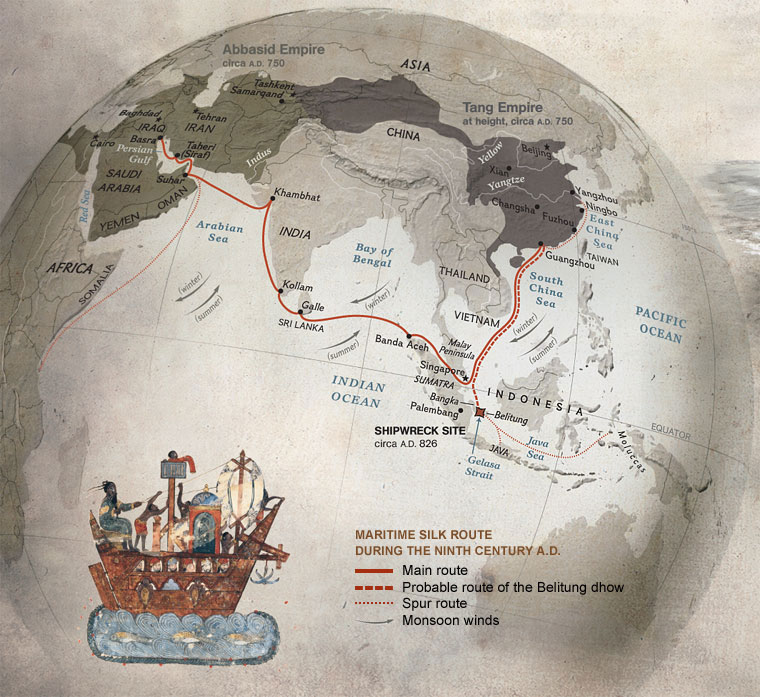
Map by Virginia W. Mason and Lisa R. Ritter, NG Staff.
Ship Reconstruction consultants: Nick Burningham and Michael Flecker.
Dhow image from Biblioteque Nationale de France.
The Silk Route comprised two large networks: an overland route from China to Europe via Central Asia, and a maritime route connecting Chinese seaports to India, the Persian Gulf, and from there to the east coast of Africa.The maritime route was initially viewed as a secondary route to the overland Silk Route. However, owing to increased wars in the West during the latter half of the eighth century, trade along the Maritime Silk Route increased while the overland volumes decreased steadily. Furthermore, technological advances in shipbuilding and navigation led to the opening of new sea routes to Southeast Asia, areas in the Indian Ocean and the Persian Gulf.

(Image: Asian Art )
The interconnections between the Chinese and Muslim empires and evidence of the maritime route are confirmed by the lost dhow found in 1998 at the bottom of the Indian Ocean. The lost Arab ship, also termed as The Belitung wreck – because it was discovered off Belitung Island, Indonesia – had its complete cargo of more than 50,000 domestic and luxury items including spice-filled jars, vessels of silver and gold, and ceramic bowls and ewers.Luxury items from China were in great demand in the Abbasid Empires (750-1258), particularly items made during the Tang dynasty.
The Tang era (618-906) was one of cultural brilliance, territorial expansion and great prosperity for much of the time, inspiring Tang craftsmen to experiment with new techniques and designs; it was ranked as the classical period of Chinese art and literature, as it set the high standard to which later artists aspired. Luxurious goods such as Persian silverware and textiles, aromatic wood and spices from India and East Africa, were in high demand by the Tang nobility. In return, China exported paper, ink, bamboo products as well as farm equipment. By the ninth century, when the technique of porcelain matured during Tang dynasty’s reign, ceramics were highly prized in the Islamic world. Since camels were unsuitable for transporting the fragile dishes and plates overland, these precious commodities arrived by sea in Arab, Persian, and Indian ships.
The artifacts recovered from the shipwreck are housed in the Asian Civilisations Museum, Singapore. Travelling for the first time outside of Singapore for its North American premiere at the Aga Khan Museum in Toronto, selected items will be on display as part of The Lost Dhow: A Discovery from the Maritime Silk Route exhibition. For more information about the exhibition, visit https://www.agakhanmuseum.org/exhibition/lost-dhow-discovery-maritime-silk-route.
References:
- Silk Road Project
- Department of Asian Art. “Tang Dynasty (618–906)”. In Heilbrunn Timeline of Art History. New York: The Metropolitan Museum of Art
Supplementary Reading:
- National Geographic: Tang Shipwreck
- k2p blog: South East Asia vary of Chinese nationalism and a return of the Maritime Silk Road
Research by Nimira Dewji
 Be the First to Know – Join Ismailimail
Get breaking news related to the Ismaili Imamat, the world wide Ismaili Muslim community and all their creativity, endeavors and successes.
Inspired? Share the story
Want to inspire? Send your stories to us at Ismailimail@gmail.com
Subscribe and join 20,000 + other individuals – Subscribe now!
Earlier & Related – Nimira Dewji at Ismailimail Archives:
- Mawlana Shah Karim: “The relationship between the Imam and his Jamat is a deep and continuing bond”
- Mawlana Hazar Imam was gifted manuscripts on architecture of Andalusia, a Knowledge Society of its time
- Mawlana Hazar Imam Designates Ismaili Center Houston as Darkhana for US Jamat, the ninth Darkhana
- Imam Hasan ala dhikrihi’l-salam appointed Sinan as his deputy in Syria
- The arts of the Fatimids, Mawlana Hazar Imam’s ancestors, continue to inspire
- Rumi: “The light that lights the heart is the Light of God”
- Pir Sabzali: “Hearing the farman, their eyes brimmed over with tears of joy”
- Al-Tusi: “The ‘nass’ is not in order to make him an Imam; it is … so that people should recognise him as such”
- Mawlana Hazar Imam Aga Khan V: “The Shia Ismaili Muslim community, of which I am the Imam, has been established in Syria for more than 1,000 years”
- Mughal Emperor Akbar’s pluralism is evidenced by an inscription of Hazrat Isa’s teaching on his “Victory Gate”
Related from the Ismailimail Archives:

 Ismailimail