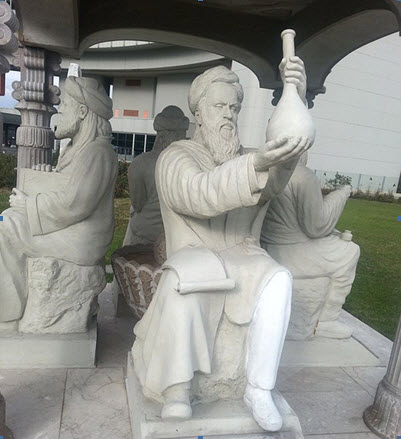
(Image: Wikipedia)
Abu Bakr Muhammad ibn Zakariya Al-Razi (d. ca. 925) was one of the greatest clinicians of the Middle Ages. Many of his medical works, translated into Latin, exercised a remarkable influence on the Latin West for many centuries. Known to the West as Rhazes, he was born in Rayy, in Iran. After a youth spent as a musician, mathematician and alchemist, Al-Razi went to Baghdad to take up the study of medicine at the age of 40. After completing his studies, he returned to Rayy and assumed the directorship of its hospital.
Al-Razi is regarded as Islamic medicine’s greatest clinician and its most important original thinker. In his first major work, which was a ten-part treatise titled Al-Kitab al-tibb al-Mansuri, (al-Mansur’s Book of Health) which he composed for the governor of Rayy, Manṣūr ibn Isḥaq, he discussed general medical theories and definitions, diets and drugs and their effects on the human body, mother and child care, skin disease, oral hygiene, the effect of the environment on health, and dental anatomy. It was translated into Latin (Liber ad Almansorem) by Gerard of Cremona and became one of the most widely read medieval treatises in Europe.
His treatise The Diseases of Children has led some historians to regard him as the father of pediatrics. He was the first to identify hay fever and its causes; his work on kidney stones is still considered a classic. In addition, he was instrumental in the introduction of mercurial ointments to treat scabies.
In his famous Al-Judaro wa al Hasbah, (A Treatise on the Smallpox and Measles), he gave the first accurate descriptions of smallpox and measles, prescribing appropriate respective treatments. His work in al-Hawi, The Virtuous Life, (Liber Continens) summarized the medical and surgical knowledge of his time. He was the first to emphasize the value of mutual trust and consultation among physicians in the treatment of patients, a rare practice at that time, but the doctor-patient relationship is still emphasized today. Among the greatest physicians of the medieval world, Al-Razi wrote more than 200 books and treatises on a variety of subjects.
In his prologue to the Canterbury Tales, Geoffrey Chaucer (d. ca.1400), a famous English poet of the Middle Ages, named the prominent physicians of the time, listing al-Razi (Razis), ‘a Doctour of Phisyk,’ as one of fifteen great sources of knowledge, along with Avicen (Ibn Sina) and Averrois (Ibn Rushd).*
References:
*Chaucer, Prologue to The Canterbury Tales, in Great Books of the Western World (Chicago: Encyclopaedia Britannica, 1988
David W. Tschanz, “The Arab Roots of European Medicine,” Aramco World, May/June 1997
Journal of Microbiology Research 2014, 4(5): 183-186 DOI: 10.5923/j.microbiology.20140405.03
Research by Nimira Dewji
 Be the First to Know – Join Ismailimail
Get breaking news related to the Ismaili Imamat, the world wide Ismaili Muslim community and all their creativity, endeavors and successes.
Inspired? Share the story
Want to inspire? Send your stories to us at Ismailimail@gmail.com
Subscribe and join 20,000 + other individuals – Subscribe now!
Earlier & Related – Nimira Dewji at Ismailimail Archives:
- Mawlana Shah Karim: “The relationship between the Imam and his Jamat is a deep and continuing bond”
- Mawlana Hazar Imam was gifted manuscripts on architecture of Andalusia, a Knowledge Society of its time
- Mawlana Hazar Imam Designates Ismaili Center Houston as Darkhana for US Jamat, the ninth Darkhana
- Imam Hasan ala dhikrihi’l-salam appointed Sinan as his deputy in Syria
- The arts of the Fatimids, Mawlana Hazar Imam’s ancestors, continue to inspire
- Rumi: “The light that lights the heart is the Light of God”
- Pir Sabzali: “Hearing the farman, their eyes brimmed over with tears of joy”
- Al-Tusi: “The ‘nass’ is not in order to make him an Imam; it is … so that people should recognise him as such”
- Mawlana Hazar Imam Aga Khan V: “The Shia Ismaili Muslim community, of which I am the Imam, has been established in Syria for more than 1,000 years”
- Mughal Emperor Akbar’s pluralism is evidenced by an inscription of Hazrat Isa’s teaching on his “Victory Gate”
Related from the Ismailimail Archives:


 Ismailimail