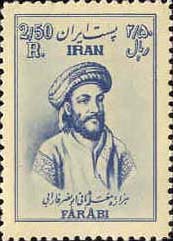
Abu Nasr al-Farabi was born around 870 CE in eastern Iran. After completing his early education in his hometown, he went to Baghdad, Iraq, to study logic with the Christian scholar Yuhanna ibn Haylan. Sometime before 942, Farabi travelled to Aleppo, Syria, eventually settling in Damascus, where he died in 950 and was buried.
In Medieval Latin texts, al-Farabi was referred to as Alfarabius or Avennasar. Being an outstanding philosopher, and influenced by the Arabic translations of Aristotle’s works, al-Farabi came to be known as ‘the second master,’ Aristotle being ‘the first master.’ Historians credit al-Farabi for preserving the works of Aristotle that otherwise might have been forgotten and subsequently lost during the Dark Ages. Al-Farabi exercised great influence on science and knowledge for several centuries; one of his more famous books, Fosos al-Hikam (The Bezels of Wisdom), remained a textbook of philosophy for several centuries at various centres of learning in Europe. Among the many works attributed to him, including such scientific examinations as The Classification of the Sciences and The Origin of Sciences, al-Farabi also wrote respected works on mathematics, political science, astronomy, and sociology.
Al-Farabi was also renowned for his music theory and compositions – there are melodies in Anatolian (Turkey) music and ragas in classical North Indian music attributed to him. Among his works on musical theory are Styles in Music and On the Classification of Rhythms in which he identified and provided detailed descriptions of musical instruments and discussed acoustics. His most famous work, the Grand Book of Music , known to the West as a book on Arab music, is a study of the theory of the Persian music of his day, discussing the general philosophical principles about music, its cosmic qualities, and its influence on the soul.
References:
An Anthology of Philosophy in Persia Volume 1: From Zoroaster to Umar Khayyam edited by S.H. Nasr and M. Aminrazavi, I.B. Taurus in association with The Institute of Ismaili Studies, London, 2008
Abu Nasr Farabi, Iran Chamber Society
Muslim Intellectuals & Scholars
ibn al-Arabi – ibn Battuta – al-Biruni – ibn al-Hani – ibn al-Haytham – Ikhwan Al Safa – al-Kirmani – al-Khwarizmi – al-Muayyad – ibn Al Muqaffa – Nasir Khusraw – Omar Khayyam – ibn Rushd – al-Sijistani – ibn al-Sina – al-Tusi – ibn Tufayl
Ibn al-‘Arabi and Imam Sultan Muhammad Shah on Continual Creation - Muḥyī al-Dīn Ibn al-‘Arabī, the great Sufi mystic and theosopher, explains how getting “bored” is… |
|
Travel Writing inspired by Hajj - The pilgrimage to Mecca gave rise to a rich genre of travel writing. Pilgrims kept… |
|
Al-Biruni developed a formula in the 11th century to measure the earth’s circumference - Al-Biruni, was born in 973 in Khwarizm, Uzbekistan. His father, a distinguished mathematician and astronomer,… |
|
Ismaili Poetry – Hani and Shirazi - The Evil of Desire – By Al Mu’ayyad fi’l din Al Shirazi The Light of… |
|
Ibn al-Haytham, a pioneer of modern optics, influenced Renaissance art and architecture - Abu Ali al-Hassan ibn al-Haytham (965-1039), a distinguished philosopher, physicist, and mathematician, was born in… |
|
Today in history: Fatimid Imam al-Hakim was succeeded by his son - The Fatimid Caliph-Imam al-Hakim bi Amr Allah was succeeded to the Imamat by his sixteen-year old son, al-Zahir li-I'zaz Din Allah, on February 13, 1021 |
|
Alternate Reading of the Events Surrounding the Declaration of Qiyama in Ismai‘li History - Excerpt: Representing the Institute, Dr Sarkozy opened the panel with the Isma‘ili Imam Hasan II’s… |
|
Nasir Khusraw: Whose hand should we touch…? - Nasir Khusraw (1004- ca.1077) was born in Qobadiyan in the eastern Iranian province of Khurasan.… |
|
Fatimid Imam al-Mustansir bi’llah composed a qasida in praise of his loyal da’i al-Mu’ayyad al-Shirazi - Abu Nasr Hibat Allah b. Musa b. Abi Imran b. Dawud al-Shirazi, one of the… |
|
A lunar crater is named after Umar Khayyam - Umar Khayyam, an Islamic poet, and mathematician, was born around 1048 in Nishapur, a prominent… |
|
New Book | Fatimid Ismaili Da’i and Philosopher Abu Yaqub al-Sijistani’s al-Risalah al-Bahirah Translated by Dr Boustan Hirji - Thanks to the pioneering and lifelong studies by Paul Walker, we are becoming increasingly knowledgeable… |
|
World’s most influential philosopher, Ibn Sina’s 1038th Birthday Celebrated by Google - Ibn Sina’s 1038th Birthday #GoogleDoodle. One of the pre-modern world’s most influential philosophers, Ibn Sina… |
|
The writings of Nasir al-Din al-Tusi illustrate the high level of intellectual life at the Nizari Ismaili fortress of Alamut - Muhammad ibn Muhammad ibn al-Hasan al-Tusi, better known as Nasir al-Din Tusi, one of the… |
|
Ibn Tufayl’s “Hayy ibn Yaqzan” had an enormous impact on the Age of Reason - Abu Bakr ibn Tufayl (d. ca.1186), a philosopher, astronomer, court official, and physician to the Almohad ruler, was… |
|
Abdullah Ibn Al Muqaffa: words of wisdom for the kings | GulfNews.com - While it is not clear whether the Ibn Al Muqaffa rendition included the Sanskrit principle… |
|
Prince Amyn: Music “binds people together and unites them” - “Music has always been an art of special importance to me: Its power of communication… |









 Ismailimail
May I suggest the following book:
How Early Muslim Scholars Assimilated Aristotle and Made Iran the Intellectual Center of the Islamic World: A Study of Falsafah
Author: Farshad Sadri
Edwin Mellen Pr (June 30, 2010)
ISBN-10: 0773437169
ISBN-13: 978-0773437166
This work demonstrates how falsafah (which linguistically refers to a group of commentaries by Muslim scholars) associated with their readings of “The Corpus Aristotelicum” in Iran has been always closely linked with religion. It demonstrates that the blending of the new natural theology with Iranian culture created an intellectual climate that made Iran the center of falsafah in the Medieval world. The author begins this book by exploring the analytical arguments and methodologies presented as the subject of the first-philosophy (metaphysics) in the works of Aristotle (in particular “The Nicomachean Ethics” and “Rhetoric”). Then, he tells the tale of the Muslims’ progression as they came to own and expand upon Aristotle’s arguments and methodologies as a measure of their own sense of spirituality. Last, Sadri surveys the implications of that sense of spirituality as it is amalgamated within the Iranian culture and today’s Islamic Republic of Iran. The author’s aim is to present a different perspective of falsafah (as it is received by Muslims and assimilated within Iranian culture), while maintaining a sense that captures the texture of everyday life-experiences in today’s Islamic Republic of Iran. This work is thus about (contemporary) Iranian falsafah and how it remains faithful to its tradition (as falsafah has actually been integrated and practiced by Iranian scholars for the last eleven centuries). It is a tradition that has taken on the task of understanding and projecting a sense of order upon the multiplicity of forms, ideas, examples, and images that have passed through Iran from East and West; it is a story that has gathered, sheltered, and introduced a style and order of Iranian Islamic (Shi’at) falsafah.
Reviews
“While Sadri’s monograph is written in an engaging, quasi-autobiographical style, still it is rich in philosophical exposition and insight coupled with a clearly developed explication of Islamic religious/philosophical thought in the Islamic Republic of Iran. In turn this is used to explain Iranian culture as it can be understood in contemporary analysis.” – Prof. Carl R. Hasler, Collin College
“The interdisciplinary approach allows [the author] to introduce a chronicle of his people that encompasses the dynamic growth of the intellectual and religious thought in the Middle East. A thoughtful study for scholars of comparative religion, Sadri juxtaposes Medieval Islam with Medieval Christianity, showing the philosophical foundations that distinguish these two contemporary religions.” – Prof. Linda Deaver, Kaplan University
“Taking as his point of departure the fate of Aristotle’s corpus in medieval Christianity and in medieval Islam, Sadri offers a masterful account of how the current status of Western and Iranian identity can be read through the palimpsest of a philosophical/religious recovery of Aristotle’s practical philosophy.” – Prof. Charles Bambach, University of Texas, Dallas
Table of Contents
Foreword
Acknowledgments
Introduction
1. Commentaries on Aristotle
2. Commentaries on Aristotle and Islam
3. Commentaries on Islam
4. Commentaries on Islam and Iran
5. Commentaries on Iran
Endnotes
Bibliography
Index
Subject Areas: Cultural Studies, Islamic Studies, Philosophy
LikeLike