For our faith constantly reminds us to observe and be thankful for the beauty of the world and the universe around us, and our responsibility and obligation, as good stewards of God’s creation, to leave the world in a better place than we found it.
The garden is, in this context, a particularly important space in Islamic cultures, the Moghul garden in urban environments, or the Bustan in rural environments. Bringing such beautiful spaces to Canada is one of our intended contributions to Canadian landscape. An example is the new park in Toronto which will surround the Aga Khan Museum and the Ismaili Centre, as well as new projects in Edmonton and Burnaby, and our endeavor to link area development to our rebuilding of Ottawa’s War Museum for the Global Centre for Pluralism.
– His Highness Prince Karim Aga Khan,
Acceptance address, 2013 Gold Medal
Royal Architectural Institute of Canada,
Delegation of the Ismaili Imamat, Ottawa Canada
November 27, 2013
The Holy Quran has more than 120 references to the Gardens of Paradise (Jannat al.-Firdaus) ranging from notions of blissful retreat to serene and safe refuge. Numerous messages of “Peace” (Salaam) inform the sentiment and vision of the Gardens of Paradise.
These gardens are the prototype on which all Islamic gardens of the chahar-bagh design are based. One of the principal functions of these “Gardens of Paradise” is to provide beautiful and harmonious surroundings, eliciting felicity, where the soul can be at peace and feel close to God.


The search for paradise on earth is, essentially, the search for peace — not just peace from the world but more importantly, peace from our ego and its desires (nafs).
Prophet Muhammad is known to have said that the greater jihad (al-jihad al-akbar), is the war we fight with our own soul. The subconscious longing of our soul, for felicity and serenity, is like a vague memory of our primordial state before the Fall when man was at peace with his Creator and therefore at peace with himself and his neighbor. In order to regain this primordial paradise, those seriously committed to the spiritual path must reach a state of constant remembrance of God (dhikr Allah).
The Islamic garden can be an aid in this remembrance; like all sacred art, the chahar-bagh aims to draw the visitor closer to God. Thus the concept of paradise is symbolic of the true peace of heart and soul for which we all yearn.
Chahar-bagh (Quranic Gardens of Paradise)
The chahar-bagh is a garden divided into four by water-channels or pathways, with a fountain or pool at the center. This four fold design of the Islamic garden developed from a combination of the ancient Persian prototype and the Gardens of Paradise as described in the Quran and the Sayings of the Prophet.
Also, inherent within the number four is a universal symbolism based on an understanding of the natural world: it encompasses the four cardinal directions, the four elements and the four seasons—and the cube, the three-dimensional form of the number four, represents solidity, the Earth.
The religion of Islam re-confirmed these ancient and universal truths and invested them with a rigorous spiritual vision. In describing his ascent to heaven (mi’raj), the Prophet speaks of four rivers: one of water, one of milk, one of honey, and one of wine. These four rivers are also mentioned in the Quran (Surah 47: Ayats 15,2).
In the Quran there is also to be found another, more esoteric, reason for the quartered layout of the Islamic garden. In Surah ar-Rahman (Sura 55: The All-Merciful), the longest reference to the Gardens of Paradise in the Quran, the four gardens are described. These four gardens are divided into two parts, the lower pair being the Garden of the Soul and the Garden of the Heart (reserved for the Righteous) and the higher pair being the Garden of the Spirit and the Garden of the Essence (reserved for the Foremost). Each of these four gardens contains, respectively, its own fruit—the olive, the date, the fig, and the pomegranate; each also contains its own fountain.
Thus the chahar-bagh became the principal symbol of the Quranic Gardens of Paradise.
Water (Reflecting Pools)
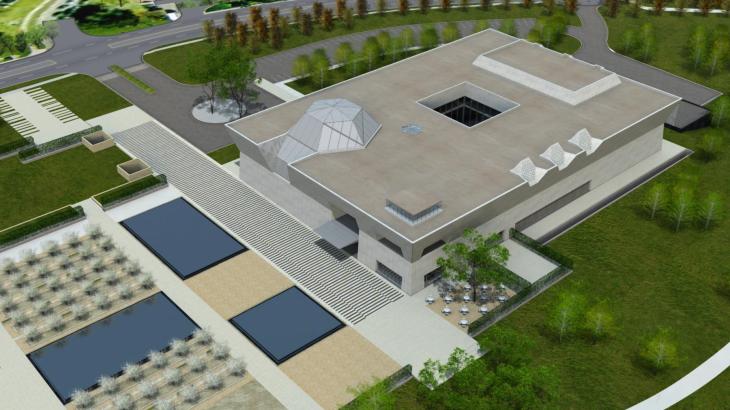
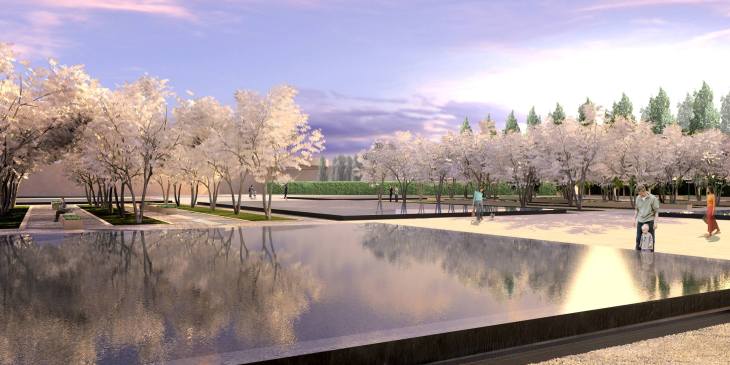
A fundamental and common element in all these gardens is water and in the case of the Aga Khan Park, the five reflecting pools. The five reflecting pools further lend symbolic meaning, embracing the five senses as the means to reach the soul.
Water is the supreme element in the Islamic garden, both on a physical and a metaphysical level. On a purely practical level, life on earth cannot survive without water; water is life-giving and in hot climates it is far more than this — it is a blessing from God. Water is also considered a direct symbol of God’s mercy. The idea of mercy and water is further reinforced in the Holy Quran, “He … sendeth down water from the sky, and there by quickeneth the earth after her death” (Surah 30: Ayat 24). However, water contains within itself far more than physically nourishing properties; as Titus Burckhardt beautifully explains, “the soul resembles water, just as the Spirit resembles wind or air.”
The concept of water as an image of the soul is a universal symbol appearing in Christian, Hindu, Japanese, and many other cultures as well as Islamic —and this symbolism derives from its very essence.
Water is used not just to cleanse ourselves of physical dirt but also to “wash away sins.” Examples include baptism in Christianity and ablution before prayers in Islam – water is used to cleanse the soul as well as the body.
The reflective water pools in the Aga Khan Park gardens represents the ever-flowing waters of the Spirit, constantly renewing the soul, like the purity of natural spring water constantly renewing itself.
“I hope today that all the people of Toronto will feel that the park that will be around these building is their park!”
– His Highness Prince Karim Aga Khan,
Remarks at the Massey Hall, Toronto Canada
February 28, 2014
Torontonians are sure lucky, as is the whole of Canada with the Aga Khan’s benevolence!
Accelerate your Awareness – Explore, Discover and Learn more about the Aga Khan Projects in Toronto
Aga Khan Toronto Park (Perspectives on matters of Felicity, Humanity and Nature)
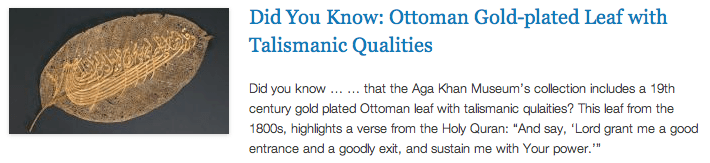
Aga Khan Museum Series (Perspectives on matters of the Intellect, Knowledge and Wisdom)
Ismaili Centres Series (Perspectives on matters of the Soul and Spirit)
 Ismailimail