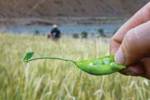
 What connects seed banks in Syria, Russia and New Zealand to Khuvaydo Ismatuloyev, a 29-year-old farmer ready to harvest his rye crop in eastern Tajikistan, is not a simple story, yet it is one of vital importance. The genetic makeup of Ismatuloyev’s plants, cultivated in a short growing season and under highly stressful conditions at more than 2000 meters (6500′) altitude in the shadow of the Pamir Mountains, may represent science’s best hope to overcome some future global food crisis caused by, say, a killer plant fungus or voracious pests or a sudden shortage of essential chemical fertilizers.
Ismatuloyev’s rye crop is a “landrace,” a primitive, highly local variety of this cereal grass. His forefathers hand-selected seeds from individual rye plants for replanting, repeating the process over many generations, because of the superior characteristics of those individual plants.

 Ismailimail